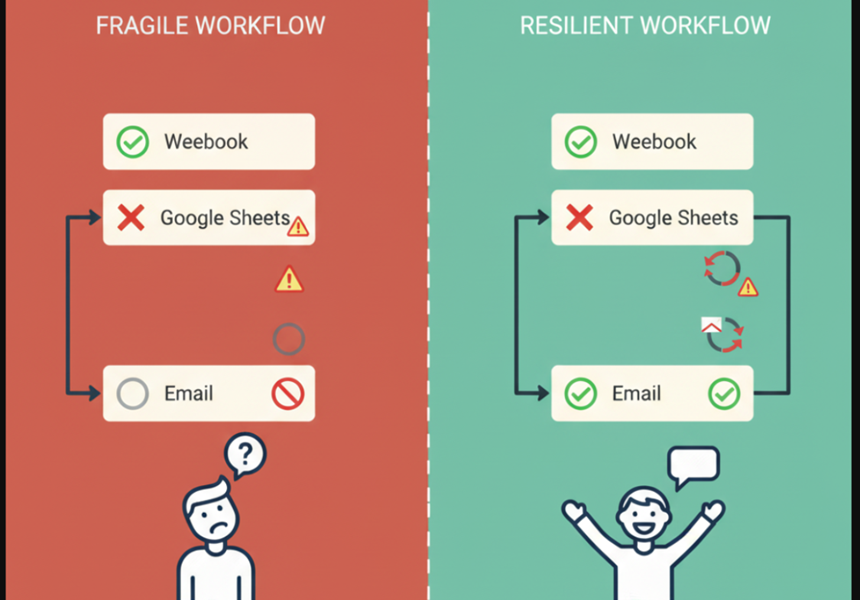

A typical n8n workflow lacks error-handling capabilities.
The workflow below receives call data from Retell AI via webhook. It then sends the call details to Google Sheets and triggers an email notification to the merchant.
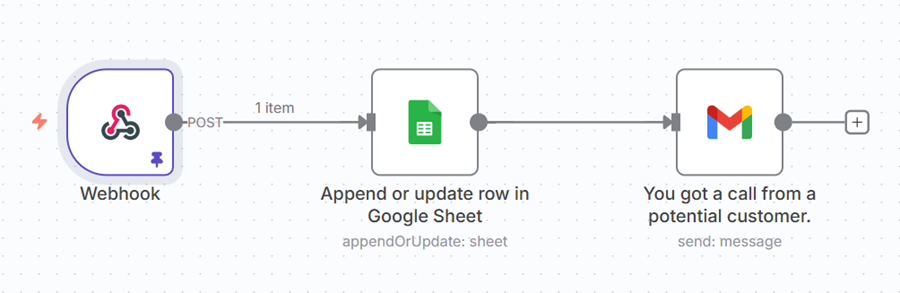
Most n8n workflows are designed as linear sequences without explicit error handling, retry logic, or failure alerts. If any node in such a workflow fails, the entire execution stops immediately, no further steps or notifications are carried out.
For example, if the “Append or Update Row in Google Sheets” node fails for any reason, the email notification to the merchant will not be sent either.
This means the merchant would remain unaware of an actual conversation that already took place between a customer and the AI voice agent.
This lack of notification is a more severe issue than failing to update Google Sheets, since the merchant must be informed of every customer interaction.
Direct branching in n8n.
Direct branching is a workflow design technique where you connect one node's output to multiple other nodes, literally “branching out” and executing those branches simultaneously.
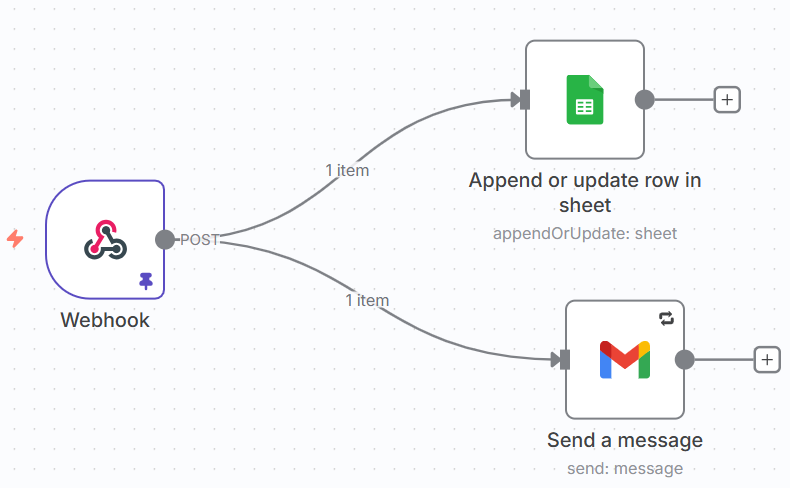
Each branch receives the same input data and can process it differently, making your workflow more flexible.
Direct branching is important because it provides a guardrail in case one node fails to execute for whatever reason; it does not stop the execution of subsequent nodes and, consequently, the entire workflow.