
Follow me on LinkedIn - AI, GA4, BigQuery

Retell AI ships a feature called Current Time Awareness. 
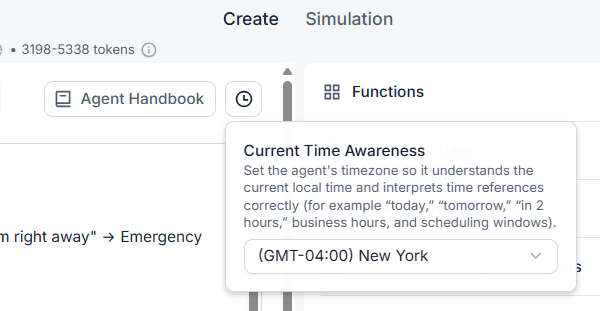

You set a timezone, and the platform is meant to inject the current local date and time into the agent's context so it can answer questions like "what time is it?" or "what is today's date?" correctly.

In theory, it should just work. In practice, it does not.


I have tested this feature multiple times on the same agent. Sometimes it works. Sometimes it does not. 

The agent can also ignore the question related to the current date and time:

The timezone is set correctly. The agent prompt has no contradictory instructions. 

And yet the agent will sometimes say, "I am not sure of the exact date," when a caller asks for today's date.


This feature is not reliable in production.

Even when it works, the agent needs explicit instruction in the prompt that tells it (a) it has access to the current date and time, and (b) when and how to use that information. 

Without that instruction, the LLM can default to disclaiming knowledge of real-time information because that is a strong default in how language models are trained.


So there are two failure modes. 

  1. The ‘Current Time Awareness’ feature fails to inject the time at all.
  2. Or the feature injects the time, but the agent ignores it because the prompt does not direct it to use the value.

Both can produce the same outward symptom: the agent says it does not know the date or time.

Why does this matter?

Real callers reference time constantly.

  • "What time is it where you are?" 
  • "Can someone come out today?" 
  • "I would like a callback in about two hours." 
  • "Are you still open?" 
  • "What is today's date?"

If the agent disclaims knowledge of the current time, every one of these questions ends in confusion or deflection. 


Callers do not trust the agent. Calls run longer because the agent cannot interpret simple references. Lead quality drops because the team's callback record has no useful time data.

Even for a business that operates 24/7, time awareness is critical. A caller asking "are you open right now?" at 11 pm wants a confident "yes, we are open 24/7" and not a vague "the team can confirm that on callback."

The fix that actually works.

Use Retell's dynamic variable syntax to inject the current time directly into the prompt where you want the agent to see it.
Current local date and time in Florida: {{current_time_America/New_York}}

At runtime, Retell substitutes the dynamic variable with the actual current value. The agent reads it as if it were any other fact in the prompt.


This is more reliable than the Retell’s ‘Current Time Awareness’ feature for two reasons. 

First, the substitution either happens or it does not. If it fails, the literal placeholder appears in the agent's transcript, which makes the failure visible rather than silent. 

Second, it puts the time information exactly where you want the agent to look for it, in a labelled section that the prompt can reference directly.

Combine the dynamic variable with explicit instructions for how to use it:

Use this when callers reference time:
- "What's today's date?" → "It's [date]."
- "What time is it?" → "It's [time] here."
- "Today" → current calendar day. "Tomorrow" → day after.
- "In [N] hours/minutes" → specific time relative to now.
Never say you don't know the date or time. The value is above. Use it.

This explicit override defeats the LLM's default disclaiming behaviour. 

The agent now has a value to read, a scripted way to answer common questions, and an instruction telling it not to fall back on "I do not have access to real-time information."

The takeaway.

Retell's Current Time Awareness feature is convenient but not reliable enough to depend on. The feature works some of the time, silently fails the rest of the time, and shows no error when it fails.


This is a general principle for production voice agents. When a platform's built-in feature is silent on failure, do not trust it. Use a visible, testable mechanism, so failures show up clearly and can be fixed quickly.

Time awareness is too important to leave to a built-in feature that may or may not work.

  1. Voice AI Knowledge Base Creation Best Practices.
  2. How to build Cost Efficient Voice AI Agent.
  3. When to Add Booking Functionality to Your Voice AI Agent.
  4. Without IP your AI company is worth nothing.
  5. AI Automation Agency Pricing Rules.
  6. How to Prevent Toll Fraud in Retell AI.
  7. Voice AI - Build once → Sell many → Collect monthly forever.
  8. State Machine Architectures for Voice AI Agents.
  9. Missing Context Breaks AI Agent Development.
  10. Avoid the Overengineering Trap in AI Automation Development.
  11. Retell Conversation Flow Agents - Best Agent Type for Voice AI?
  12. How To Avoid Billing Disputes With AI Automation Clients.
  13. Don't 'Build' AI Automation Workflows, 'Code' Them.
  14. Critical Aspect of Prompt Engineering - Domain Parameters.
  15. Zero Shot vs Single Shot vs Multi Shot Prompting.
  16. How to Build Reliable AI Workflows.
  17. Stop Building AI You Can't Fix.
  18. Automating 100% of your workflows is a disaster waiting to happen.
  19. How to build Voice AI Agent that handles interruptions.
  20. AI Automation Without CRM Is Useless for Business Growth.
  21. Structured Data in Voice AI: Stop Commas From Being Read Out Loud.
  22. Why Your Voice AI Sounds Robotic and How to Fix It.
  23. Why You Need an AI Stack (Not Just ChatGPT).
  24. AI Default Assumptions: The Hidden Risk in Prompts.
  25. Vibe Coding Fails Without Context and Expertise.
  26. How to make your Voice AI Agent Date & Time Aware.
  27. Why AI Agents lie and don't follow your instructions.
  28. How to Write Safer Rules for AI Agents.
  29. Two-way syncs in automation workflows can be dangerous.
  30. Using Twilio with Retell AI via SIP Trunking for Voice AI Agents.
  31. The Realistic Latency Target for Voice Agents.
  32. The required-field loop that breaks voice agents.
  33. Why your Voice prompt needs a clean-up pass.
  34. When to split your voice agent - The Bleed Test Framework.
  35. Abuse Ladder in Voice AI.
  36. Understanding Retell AI Transfer Screening Agents.
  37. The 80/20 Rule of Voice Agent Development.
  38. Retell AI Current Time Awareness has a reliability problem.
  39. Every dynamic variable in voice agent needs a fallback.
  40. When your Voice AI grader is wrong, not your agent.