

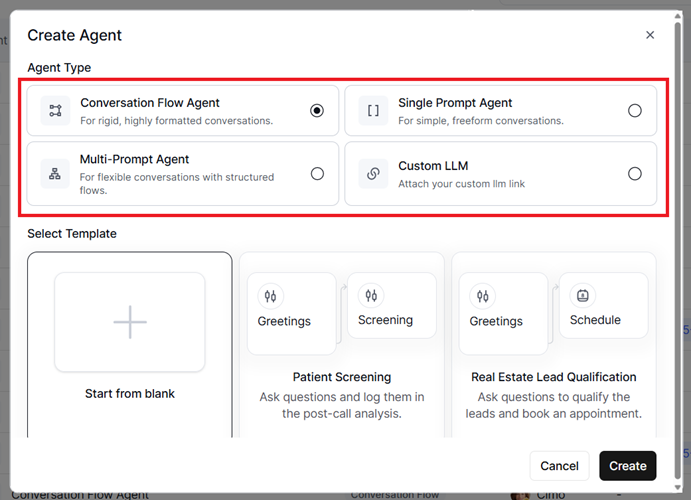
- Conversation Flow Agent.
- Single Prompt Agent.
- Multi Prompt Agent.
- Custom LLM.
There’s no official guidance on which one is “best,” but understanding how they differ can save you a huge amount of time, especially when you’re learning, debugging, or scaling client projects.
On the surface, these agent types look similar in terms of functionality and usage, but there are nuances that you become aware of only when you go deep into building agents.
And that’s where many people lose weeks or even months.
Don't repeat my mistakes.
I don’t want you to repeat the mistakes I made when selecting the agent type.
There is clearly a winner here when it comes to agent type, but most AI gurus don’t tell you this for a variety of reasons:
Reason #1: They have not compared these agent types to each other in great detail.
Reason #2: They use and promote the agent type they are most comfortable working with, not what is actually best for most use cases.
Reason #3: They haven't built complex multi-service agents (10+ services) where the differences become critical.
Best Practice: Stick to one Agent Type.
You would be better off learning and mastering just one agent type and then sticking to it, instead of switching between different agent types for each new project/client.
Because each agent type requires a different mental model, workflow, debugging and maintenance:
Different debugging approaches.
>> Troubleshooting a single prompt agent means re-reading and tweaking text.
>> Troubleshooting a Multi-prompt agent means tracing state transitions through prompt trees.
>> Troubleshooting a Conversational Flow agent means examining node connections visually.
The skills don't fully transfer between different agent types.
Different architecture thinking.
>> Single prompt agent trains you to write comprehensive instructions.
>> Multi-prompt agent trains you to think in states and transitions.
>> Conversational Flow agent trains you to think in nodes, edges, and deterministic paths.
Switching between different agent types means constantly context-switching in how you conceptualise conversations.
Your templates and patterns don't transfer.
That qualification sequence you perfected in one agent type? It doesn't copy-paste into another. You're rebuilding from scratch, relearning what works for every new client.
Scaling agent development becomes much harder.
You can't scale agent development if you keep switching between different agent types for each new client or industry.
>> Every client project adds to your library. Qualification flows, objection handling, appointment booking, build once, deploy everywhere. This only works if you're consistently using the same agent type.
>> You can hire and onboard people into one system. "Here's how we build agents" becomes a documented process, not "well, it depends on the project."
>> When you know exactly how long a lead qualification flow takes to build because you've done it twenty times, you can quote confidently. Switching agent types means every project has unknown unknowns.
>> "When X happens, check Y" only works when X and Y are consistent across projects. Your accumulated troubleshooting knowledge becomes an asset instead of resetting with each client.
>> Supporting ten clients on the same agent type is much more manageable than supporting them across four different agent types.
Depth beats breadth.
>> Surface-level knowledge of all three means you hit the same walls repeatedly.
>> Deep knowledge of one means you've already solved most edge cases and know the workarounds. For example, six months deep in conversational flows means you've encountered and solved problems that someone switching between types will keep hitting for years.
>> The real cost isn't learning time. It's the accumulated expertise you lose every time you switch.
The agency that picks one agent type and goes deep will outpace the one that picks "whatever seems right for this project" every time. Not because flexibility is bad, but because compounding expertise beats starting fresh.
So if you have already mastered single-prompt agents, keep using them. If you have become very comfortable with multi-prompt agents, keep using them.
Critical Problems with Conversation Flow Voice Agents.
Before diving into the comparison, understand these practical issues that only surface when building complex agents:
#1 JSON Import Failures.
This is one of the most frustrating issues with Conversation Flow agents because it happens silently or with cryptic errors, often after you've spent hours building a flow.