

Voice AI agents are built with different levels of state machine architecture:
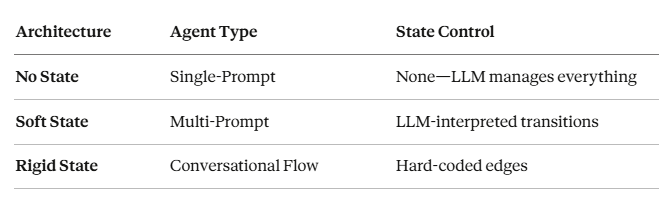
Understanding these architectures is critical for building voice agents that actually work in production.
Why Understanding the State Architecture Matters?
The architecture you choose determines:
1. How your agent handles the unexpected.
Real callers don't follow scripts. They interrupt, change topics, ask random questions, and give incomplete answers. Your architecture determines whether your agent adapts or breaks.
2. How you scale and maintain agents.
One agent is manageable. Fifty agents across different clients require programmatic creation, updates, and consistency. Some architectures make this impossible.
3. How do you debug production failures?
When a call goes wrong at 2am, you need to know WHERE it went wrong. Some architectures localize problems. Others hide them in a maze.
4. How reliable your agent is under pressure.
Complex conversations with many intents expose architectural weaknesses. The wrong choice means stuck agents, hallucinations, or chaos.
Choose wrong, and you'll rebuild from scratch. Choose right, and you'll scale efficiently.
What is a State Machine?
A state machine is a system that can be in exactly ONE state at a time. Transitions between states occur under specific conditions or events.