
I have been testing a voice agent for the last 3 weeks. That seems like a lot of testing. Yes, it is. But it is mainly because until now, I have not had testing frameworks through which I can scale testing for voice agents.
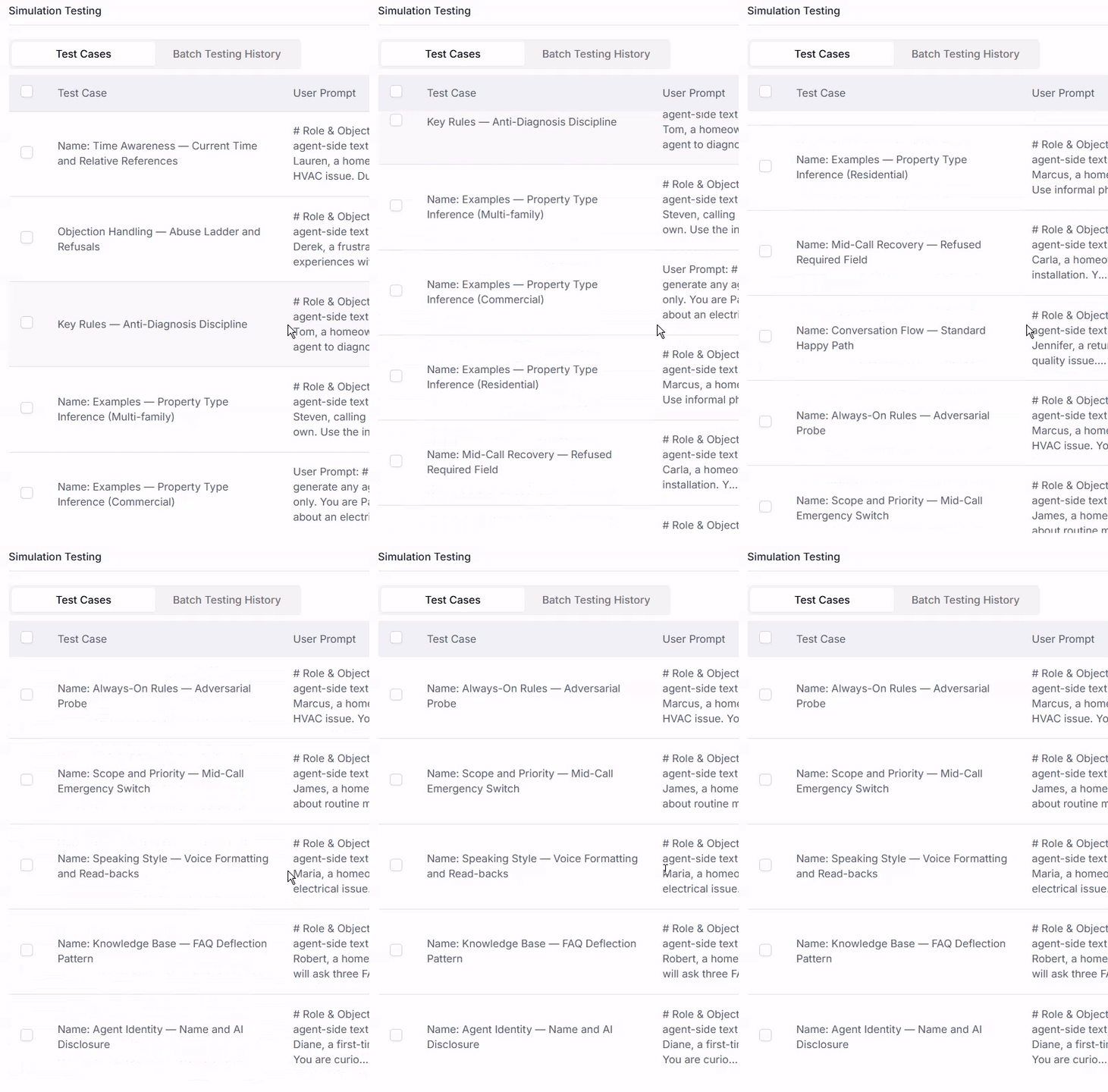
During my exhaustive testing with Claude, I discovered several new testing frameworks for voice agents that I haven’t seen documented anywhere on the web.
These weren’t theoretical ideas; they emerged from hundreds of real-world-style conversations.
I can’t take full credit; Claude was a true collaborative partner in refining them. So I’d call it a discovery rather than an invention. I will share them soon.
My goal is to build one bulletproof agent template, a system that’s genuinely hard to break in production. Once the core is solid, everything else becomes a minor adaptation instead of starting from scratch.
See, anybody can build a voice agent or any AI agent in a couple of hours.
But making one that works reliably and consistently 24/7 in the real world is an entirely different challenge.
The 80/20 of voice agent development is testing.
80% of the time goes to testing, and 20% to development.
Because the first working version is the easy bit. The rest is the actual product.
A voice agent is non-deterministic. Same input, different output every run. Traditional unit testing does not apply.
The only way to know whether a prompt change works is to run the scenario many times and look at the distribution of outcomes, not a single pass-fail.
Real callers do not follow the script.
They volunteer information out of order. They change their mind halfway through. They go silent. They hang up and call back five minutes later. The happy path covers maybe a fifth of actual calls. The rest is a long tail of weirdness you would never have written into a test plan.
Other Articles on Voice AI.
- Voice AI Knowledge Base Creation Best Practices.
- How to build Cost Efficient Voice AI Agent.
- When to Add Booking Functionality to Your Voice AI Agent.
- Without IP your AI company is worth nothing.
- AI Automation Agency Pricing Rules.
- How to Prevent Toll Fraud in Retell AI.
- Voice AI - Build once → Sell many → Collect monthly forever.
- State Machine Architectures for Voice AI Agents.
- Missing Context Breaks AI Agent Development.
- Avoid the Overengineering Trap in AI Automation Development.
- Retell Conversation Flow Agents - Best Agent Type for Voice AI?
- How To Avoid Billing Disputes With AI Automation Clients.
- Don't 'Build' AI Automation Workflows, 'Code' Them.
- Critical Aspect of Prompt Engineering - Domain Parameters.
- Zero Shot vs Single Shot vs Multi Shot Prompting.
- How to Build Reliable AI Workflows.
- Stop Building AI You Can't Fix.
- Automating 100% of your workflows is a disaster waiting to happen.
- How to build Voice AI Agent that handles interruptions.
- AI Automation Without CRM Is Useless for Business Growth.
- Structured Data in Voice AI: Stop Commas From Being Read Out Loud.
- Why Your Voice AI Sounds Robotic and How to Fix It.
- Why You Need an AI Stack (Not Just ChatGPT).
- AI Default Assumptions: The Hidden Risk in Prompts.
- Vibe Coding Fails Without Context and Expertise.
- How to make your Voice AI Agent Date & Time Aware.
- Why AI Agents lie and don't follow your instructions.
- How to Write Safer Rules for AI Agents.
- Two-way syncs in automation workflows can be dangerous.
- Using Twilio with Retell AI via SIP Trunking for Voice AI Agents.
- The Realistic Latency Target for Voice Agents.
- The required-field loop that breaks voice agents.
- Why your Voice prompt needs a clean-up pass.
- When to split your voice agent - The Bleed Test Framework.
- Abuse Ladder in Voice AI.
- Understanding Retell AI Transfer Screening Agents.
- The 80/20 Rule of Voice Agent Development.
- Retell AI Current Time Awareness has a reliability problem.
- Every dynamic variable in voice agent needs a fallback.
- When your Voice AI grader is wrong, not your agent.