

Cal.com is an open-source, API-driven scheduling platform you can run hosted or self-hosted.
Unlike Calendly, it is designed to be embedded and customized as backend appointment scheduling software (infrastructure) rather than treated only as a standalone SaaS booking link.
Cal.com is among the best appointment booking engines for voice AI.
Cal.com is one of the best appointment booking engines for voice AI because it combines an open source, API‑first scheduling infrastructure with native AI calling (Cal.ai) and direct integrations with major voice‑agent platforms such as Retell AI and ElevenLabs.
I don’t have any affiliation with cal.com. I only recommend tools I personally use and find useful.
With Cal.com you can rely on ‘Cal Video’ or ‘Google Meet’ as your video conferencing tool. So you don’t really need an extra solution like ‘Zoom Meetings’.
Calendly is more video‑tool‑agnostic and doesn’t provide its own built‑in video platform, which makes Cal.com stronger if you want an integrated video + scheduling stack.
I cancelled both Calendly and Zoom Meetings after switching to Cal.com. Now I use cal.com for scheduling meetings, video conferencing, and for Voice AI.

One major advantage of Cal.com over tools like Calendly is Cal.ai, a built‑in AI phone agent tightly integrated with Cal.com Workflows.
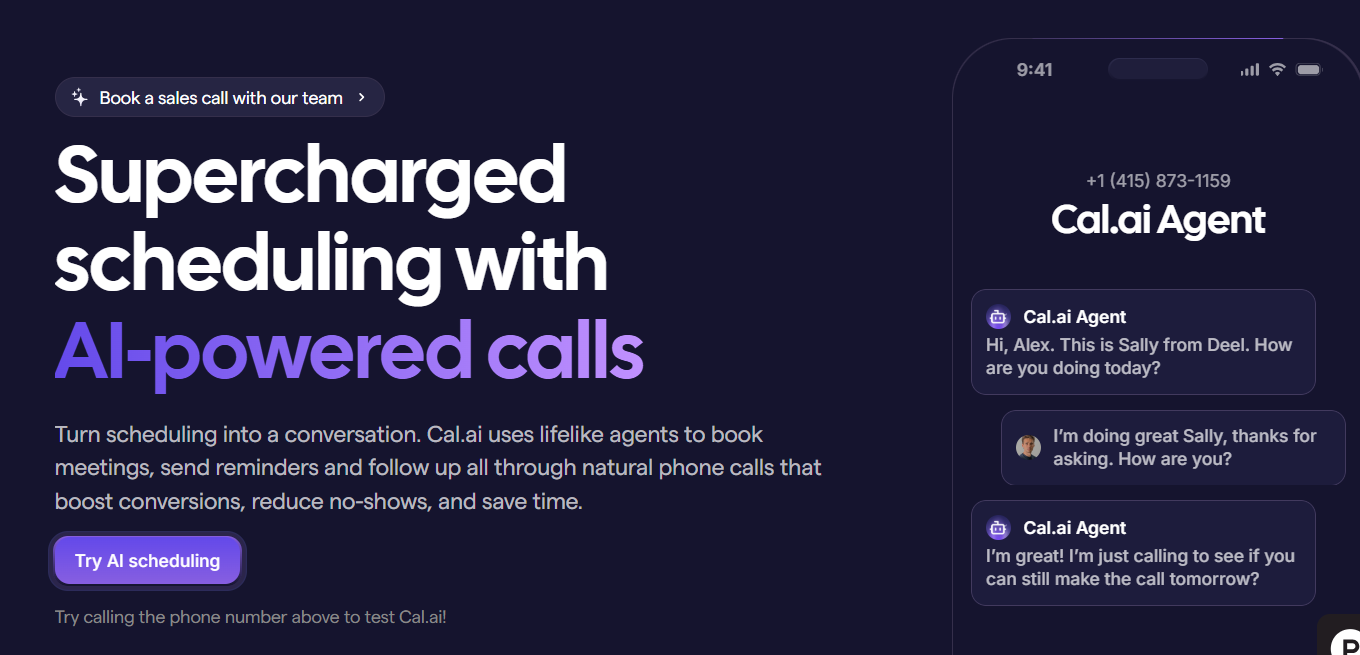
It gives you an all‑in‑one stack for scheduling, reminders, and voice follow‑ups, without extra platforms or custom plumbing.
You can:
- Trigger AI phone calls on booking, no‑show, or cancellation events without third‑party tools.
- Configure prompts, personality, and goals for AI reminder/confirmation/follow‑up calls right inside the Cal.com UI.
- Get transcripts, analytics, and performance metrics for those AI calls in the same dashboard as your scheduling.
Calendly does not have an equivalent first‑party AI calling product; you’d need external voice providers plus glue (Zapier, Make, etc.) to match this.
Calendly works well as plug-and-play, but Cal.com offers more control and composability, exactly what you need when the agent is the UI.
Key advantages of using Cal.com for Voice AI Solutions:
The following are the key advantages of using cal.com for Voice AI Solutions:
# Native integration: Several voice/agent platforms (like Retell AI, ElevenLabs, VoiceGenie, Voiceflow, etc.) offer native or first‑party style integrations with Cal.com
# Native AI Calling Layer - Cal.ai is Cal.com’s own native AI calling layer, built directly into Cal.com Workflows.
# API-first and developer-friendly: Robust REST API with detailed docs. Open source means you can inspect, extend, or self-host for deep customization or on-prem deployments.
# Built for embedding: "Cal Atoms" and embeddable components let you define LLM/voice agent tools that map directly onto Cal.com endpoints for availability, booking, and rescheduling.
# Data ownership: Self-hosting keeps all scheduling data within your own infrastructure, making it attractive for regulated industries or enterprise clients with strict data policies.
# Complex scheduling scenarios: Supports multiple schedules, multi-calendar connections, round-robin/team routing, time-zone handling, and in-person vs virtual logic.
# White-label by design: Full control over branding, domains, and appearance. Treat it as a headless scheduling service, callers never see Cal.com.
Setting up cal.com for voice AI solutions like Retell AI could be tricky. To fix this issue, I have written a step by step guide with screenshots (60 pages) which covers setting up cal.com the correct way, integrating it with Retell AI and then testing appointment bookings: