

What is OpenRouter?
Think of OpenRouter as a universal booking counter at an airport.
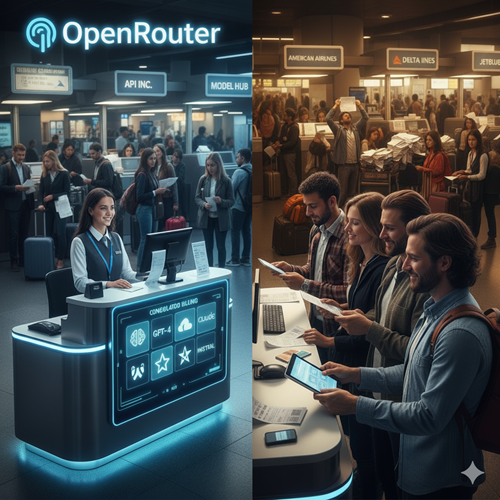
Instead of going to separate airline counters (OpenAI, Anthropic, Google, Mistral, Meta, etc.), you go to one counter that gives you access to hundreds of LLM models from over 60 providers (all through a single, standardised API and a single API key).
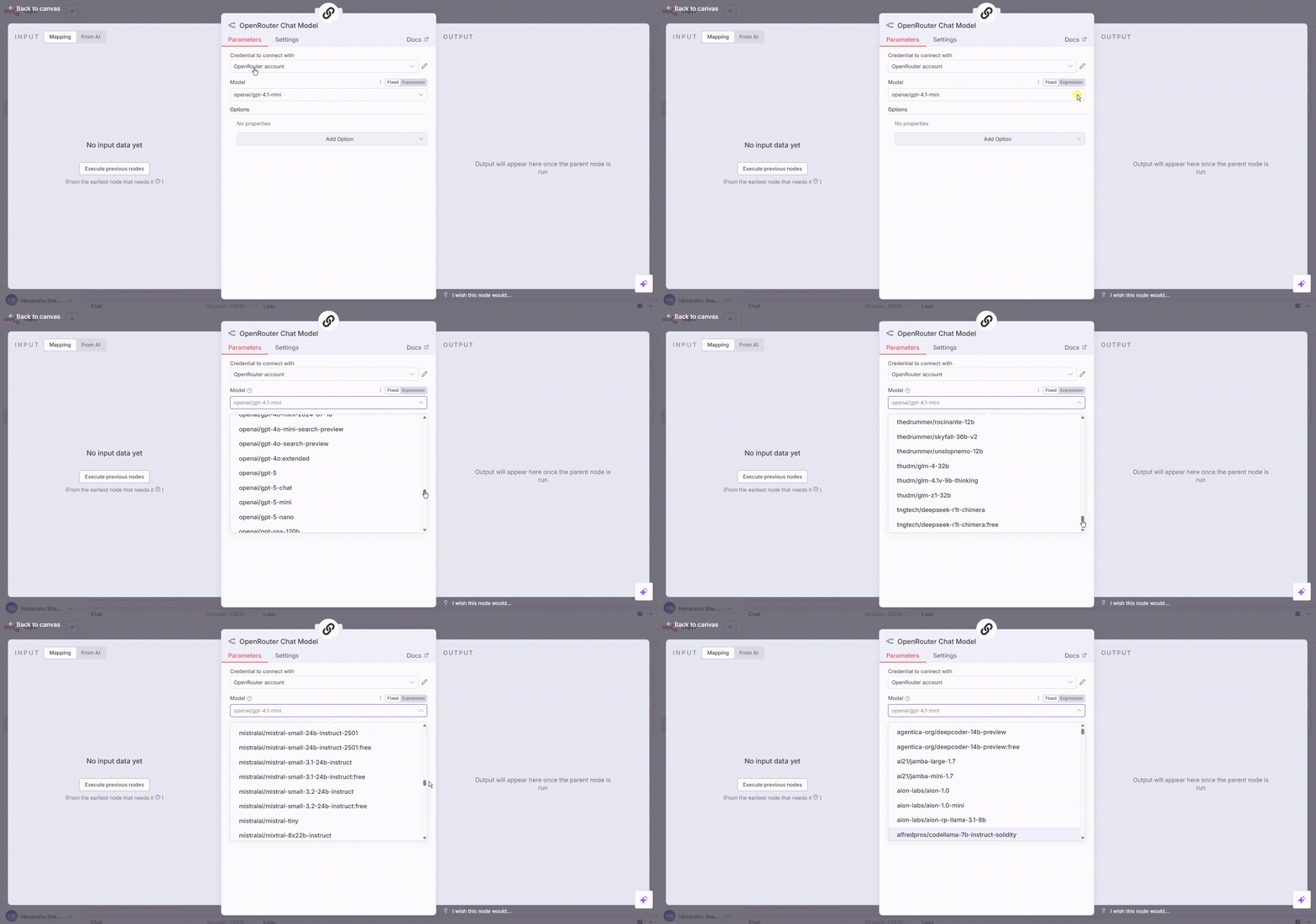
OpenRouter acts as a proxy between your app and the actual LLM model provider (OpenAI, Anthropic, Google, Meta, Mistral, and many open-source projects).
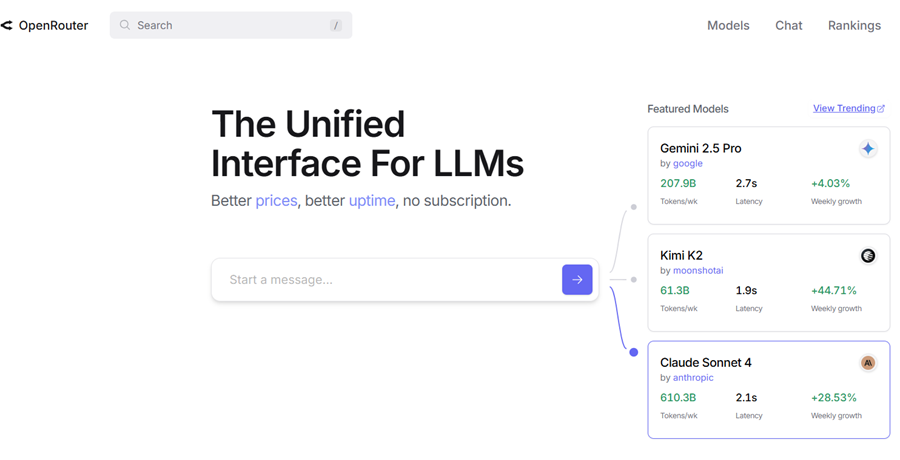
Why OpenRouter Matters (Scenarios + Technical Benefits)?
- Single API, Multiple Models.
- Simplified Workflow Management.
- Smart Routing & Fallback.
- Simplified Integration.
- Consolidated Billing.
#1 Single API, Multiple Models.
Without OpenRouter: A traveller must go to each airline counter separately, wait in line, follow each airline’s rules, and pay separately.
Technical Equivalent: Without OpenRouter, a developer must integrate with each provider’s API, handle different authentication methods, manage separate credentials, and maintain multiple client libraries.
With OpenRouter: The traveller goes to one booking counter and can purchase tickets for any airline from the same place.
Technical Equivalent: With OpenRouter, a developer integrates once with a single API and key. Switching between models (GPT-4, Claude, Gemini, etc.) is done by simply changing a parameter.
#2 Simplified Workflow Management.
Without OpenRouter: If a traveller wants to switch from one airline to another, they must leave the counter, queue again at a different one, and re-enter all details.
Technical Equivalent: Without OpenRouter, switching models requires using different nodes, rewriting code, updating authentication, re-testing client libraries, and handling provider-specific quirks.
With OpenRouter: The traveller simply asks at the same counter to issue a ticket for another airline.
Technical Equivalent: With OpenRouter, a developer can instantly switch between models (e.g., GPT-4 for accuracy, Claude for long context, Mistral for cost efficiency) by just changing the model parameter in their API call.
#3 Smart Routing & Fallback.
Without OpenRouter: If an airline cancels a flight, the traveller is stranded until they manually go to another counter and buy a new ticket.
Technical Equivalent: Without OpenRouter, if a provider is down, the app fails unless the developer has pre-coded complex fallback logic for each provider.
With OpenRouter: If one airline cancels, the booking counter automatically rebooks the traveller on another airline with minimal disruption.
Technical Equivalent: With OpenRouter, if the chosen model is unavailable, requests can be automatically rerouted to another compatible model, keeping the app running smoothly.
For example, you request Claude. Claude’s API is temporarily down; OpenRouter can switch to Llama 3 instantly, keeping your workflows working.
#4 Simplified Integration.
Without OpenRouter: A traveller managing multiple trips must separately track every booking, check-in rule, baggage policy, and loyalty program for each airline. It’s time-consuming and repetitive.
Technical Equivalent: Without OpenRouter, in tools like n8n, you must create separate credentials for each provider (OpenAI, Anthropic, Google, Mistral, etc.), set up multiple nodes, and manage them individually.
With OpenRouter: The traveller has one travel assistant who manages all bookings across airlines, keeps all tickets in one place, and applies the right rules automatically.
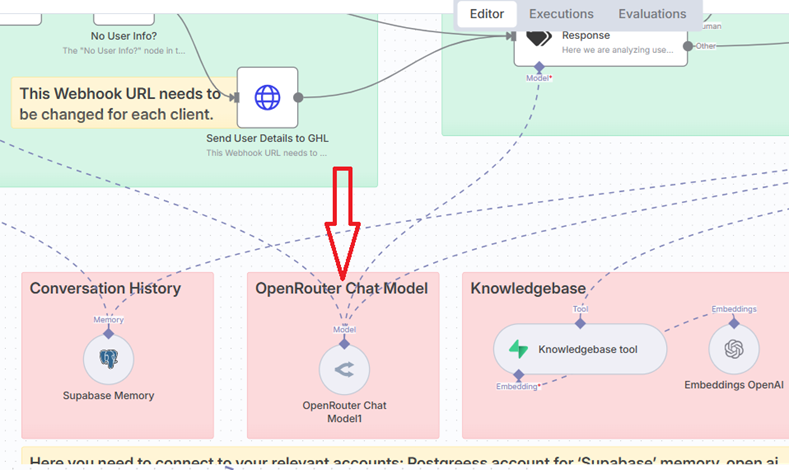
Technical Equivalent: With OpenRouter, you no longer need to set up and manage separate credentials for each LLM provider (OpenAI, Anthropic, Google, Mistral, etc.) in n8n’s AI Agent node.
You only need to connect once using your OpenRouter account credentials.
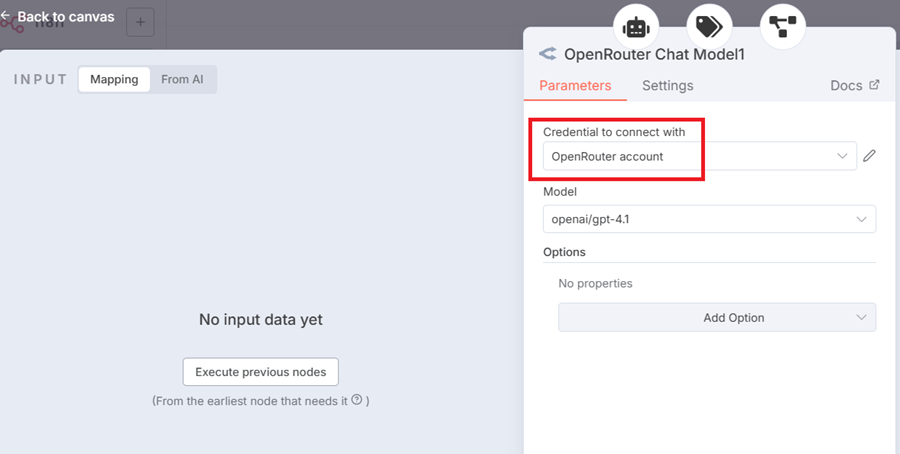
Add your OpenRouter API key as the credential for the node.
Once connected, you can select from any of the hundreds of supported models available via OpenRouter.
You simply pick the desired model from a dropdown or enter the model name (e.g., openai/gpt-4o-mini, anthropic/claude-3-5-sonnet, google/gemini-pro, etc.) in the node’s parameters.
You can even set the model parameter dynamically, allowing workflows to switch models on the fly based on your logic or workflow needs.
You no longer need to add separate nodes for each LLM provider (like OpenAI, Anthropic, Google, etc.) in your n8n workflows. Instead, you use the OpenRouter Chat Model Node:
#5 Consolidated Billing.
Without OpenRouter: The traveller collects multiple receipts from different airlines, sometimes in different currencies, and must track them all separately.
Technical Equivalent: Without OpenRouter, you will need to track multiple bills from different vendors, each in their own portal, sometimes in different currencies.
With OpenRouter: The traveller receives one consolidated invoice from the booking counter that covers all airlines.
Technical Equivalent: When you use OpenRouter, a single dashboard displays all your LLM usage/costs, allowing you to pay just one invoice.