
I’ve been tracking my time for over a decade using a time-tracking tool called 'Hravest'.
So naturally, I also log the hours I spend learning about AI, and as of today, it’s over 1000 hours.
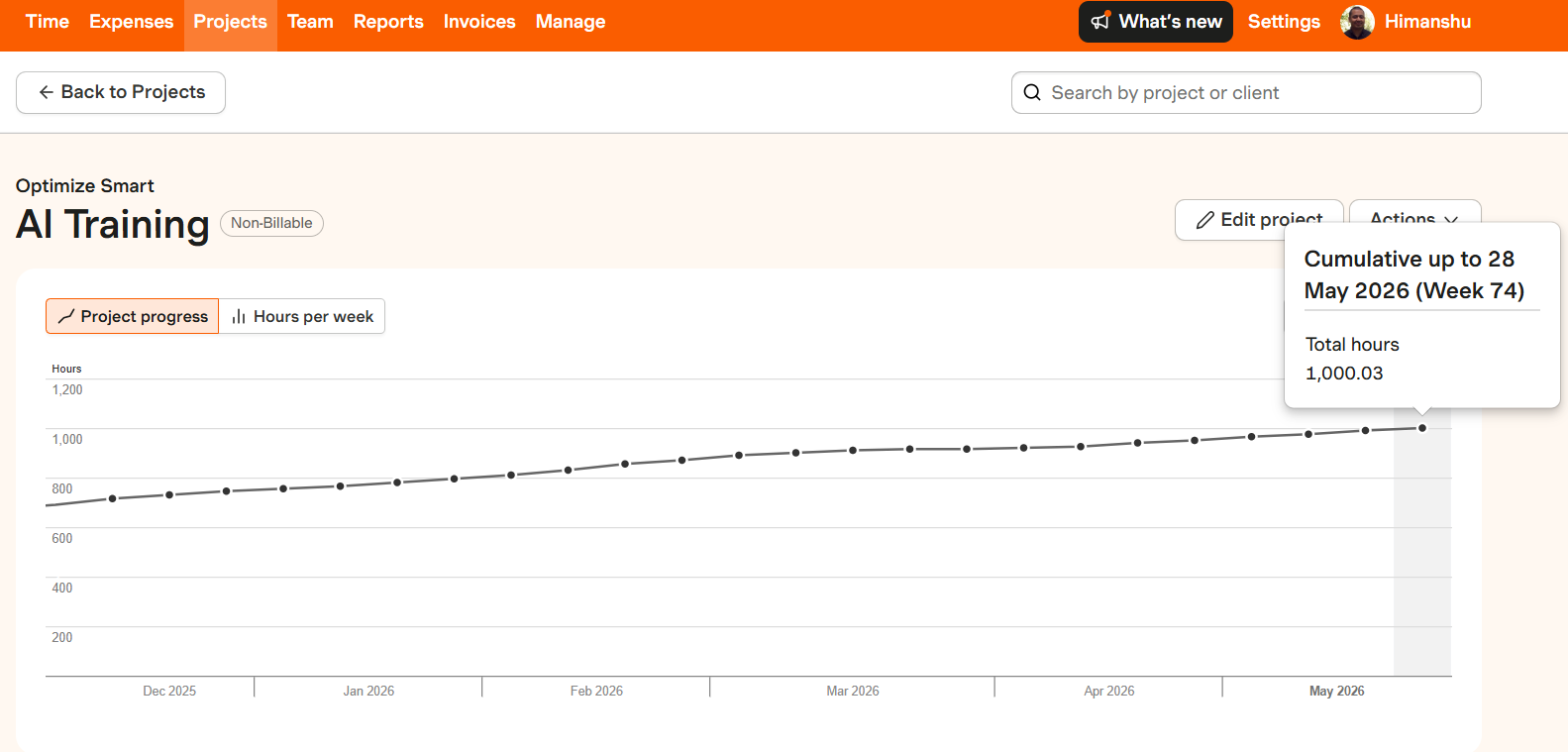
When I say AI training, I am not just talking about actively learning AI from others, but also working on AI projects. Because working on a real-life AI project is also AI training, and imho the best training you will ever get.
It will feel chaotic in the beginning.
When you first start learning AI, it can feel overwhelming.
The term “AI” is extremely broad. It includes machine learning, problem-solving, workflows, prompting, domain expertise, prompt engineering, AI agents, APIs, webhooks, Voice AI, RAG, and much more.
So if you are just getting started, it is completely normal to feel confused.
You may not know what to learn first, what to ignore, or where to focus your attention.
As a result, you may find yourself watching random YouTube videos, buying random AI courses, and trying to learn everything at once.
But even after all that effort, you may still feel like you do not know enough or know how to apply what you have learned.
At this stage, very little may make sense.
You may be experimenting without a clear direction, trying to piece together an AI puzzle that still feels incomplete.
I want you to know this is normal.
In my experience, something interesting happens around the 300-hour mark of AI training.
That is when things start to click.
You begin connecting the dots. You start to understand how the different parts of AI automation fit together. You begin to see the bigger picture.
This is also when you may start to discover your niche and area of speciality.
Before that point, it often feels like learning chaos. You may feel like you are running around in circles, trying everything but not feeling clear about anything.
The following are the key lessons I learned on my journey through more than 1,000 hours of AI training:
#1 You learn AI best by working on real projects.
You learn AI much faster when you work on real projects instead of relying only on courses, YouTube videos, or advice from other people.
My best Voice AI teacher was not a course, a YouTube channel, or a private group of experts. It turned out to be Claude.
Not because it simply gives me code, but because it helps me understand the thinking behind the code.
It explains architectural decisions, trade-offs, edge cases, and system-level design in a way that is hard to find elsewhere.
Most people skip that part. They ask for the code, copy it, paste it, and move on. But I focus more on the reasoning behind the solution.
The code is useful, but the explanation behind the code is often far more valuable.

I’m learning and documenting patterns and frameworks that I haven't found in any articles, videos, courses, or on the open web.
This is the kind of knowledge that only emerges when you are actively building, breaking things, debugging, and iterating in real time esp. when you have a strong reasoning partner (like ‘Claude’) that can help you turn messy logs, strange audio artifacts, latency spikes, and unexpected failures into deeper architectural insight.
That is where the real learning happens. Not from passively consuming more content, but from working through real problems.
So if you are serious about learning and implementing AI, multimodal agents, Voice AI, or any bleeding-edge technology, stop only consuming. Start building. And bring the right AI collaborator into the loop.
#2 Think with AI and not through AI.
"Think with AI" means you stay the thinker and use the model as an instrument: you bring the judgment, the domain knowledge, and the final call, and the AI amplifies that.
"Think through AI" means you outsource the thinking itself to the AI assistant, taking the output as the answer rather than as input to your own reasoning.
When you outsource your thinking, you start agreeing with everything the AI suggests. You say “yes” to every recommendation. You stop questioning the output. You stop challenging the logic.
As a result, you become less able to spot problems.
You may miss inconsistencies, hallucinations, context erosion, overcorrection, weak assumptions, or advice that sounds confident but does not actually fit your situation.
This is one of the biggest traps for AI users. They assume the AI knows best. But AI should not replace your thinking. It should sharpen it.
#3 Working with AI should fry your brain.
Working with AI should feel mentally demanding. That is often a sign that you are using it properly.
Whenever I work deeply with AI, my cognitive load goes up, not down. This is different from the common idea that AI always reduces cognitive effort.
In my experience, the people who become mentally passive with AI usually do not read the output carefully.
They are not challenging the model. They are not questioning its assumptions.
They are not checking whether it has retained the original context, constraints, decisions, and verified results from the very beginning.
Because if you do all of that properly, using AI is not effortless. It requires intense focus.
You have to read the model’s output, evaluate whether it is correct, compare it against earlier context, check for inconsistencies, and verify the changes it made. And you have to do this repeatedly until the task or project is complete.
That cumulative cognitive cost can fry your brain within a couple of hours. But that is also where the value is.
You are not passively accepting AI output. You are actively supervising, correcting, validating, and steering it. That process should make you sharper.
When you reach the point where you can no longer read the model’s output carefully, and you start skimming, that is your signal to pause. Take a break or switch to something that demands less cognitive effort, such as reading emails.
#4 The AI learning curve is BRUTAL, and it’s never enough.

Once you start building AI agents, you quickly realise how much you do not know.
You may begin with a simple goal: build and deploy an AI agent. But very soon, your progress gets blocked by a tool, platform, API, integration, workflow, or technical concept you do not yet understand.
So you pause the project and start learning that missing piece. Then that missing piece reveals another missing piece. And before you know it, you are no longer just “building an AI agent.”
You are learning automation platforms, APIs, webhooks, databases, authentication, error handling, prompt engineering, system design, monitoring, deployment, and the domain knowledge required to make the agent useful in the real world.
What looked like a quick project can easily turn into weeks or months of learning.
Building a production-ready AI agent is not just about writing prompts. It requires strong problem-solving skills, knowledge of multiple platforms, and the ability to connect AI to real business processes.
The deeper you go, the more you realise how much there is to learn. Days turn into weeks. Weeks turn into months. And eventually, you understand how little you actually know.
That is the brutal part of the AI learning curve. So do not expect overnight success. Expect confusion, detours, frustration, and constant learning.
#5 Prompt Engineering remains the most important AI Skill.

All else being equal, the performance difference between two AI agents often comes down to the quality of their system prompts.
You can give two people access to the exact same model and the exact same tools, yet get completely different results.
One agent may produce precise, context-aware, reliable outputs. The other may struggle with confusion, inconsistency, weak reasoning, or poor alignment with the task.
The difference is often not the model. It is the prompt architecture.
Imagine two customer support AI agents built on the same LLM.
Agent A has a generic system prompt: “You are a helpful assistant.”
Agent B has a carefully designed system prompt that defines its tone, reasoning boundaries, escalation rules, knowledge scope, response style, and failure-handling behaviour.
The result is very different.
Agent A feels robotic, vague, and inconsistent. Whereas Agent B feels intelligent, reliable, and on-brand.
This is why prompt engineering still matters so much.
A strong system prompt does not just tell the AI what to do. It shapes how the AI thinks, responds, handles uncertainty, follows constraints, and behaves across different situations.
After years of working extensively in prompt engineering, my conclusion remains unchanged: it is still the number one skill in AI.
#6 AI doesn’t replace domain expertise; it multiplies it.
AI does not remove the need for domain expertise. It makes domain expertise more valuable.
This message is especially important for founders and CEOs who think they can fire subject-matter experts and replace them with AI agents.
That is a dangerous assumption.
To use AI effectively in any field/industry, you still need to know what to ask, how to ask it, what context to provide, and how to evaluate the answer. All of that comes from domain expertise.
AI tools do not magically fill in the blanks when your question is vague, incomplete, or based on incorrect assumptions.
For example, take GA4.
If you do not understand how events, parameters, dimensions, metrics, and scopes work, you will struggle to even frame the right question.
And if you cannot frame the right question, you are unlikely to get a useful, accurate, or actionable answer from AI.
No matter how advanced AI becomes, it still needs clear requirements, operational context, and informed judgment.
If you cannot clearly explain what you need in operational terms, AI will not reliably give you the result you want.
In short: AI doesn’t replace domain expertise, it multiplies it.
#7 Your prompts are your proprietary data. Don’t give them away for free.
They capture your reasoning process, domain expertise, and problem-solving patterns. In many cases, your prompts are more valuable than the tools you use.
Anyone can access the same AI models, but your prompts, the way you structure context, define behaviour, and guide outputs are what make your agent unique.
Treat them like intellectual property. Protect them, refine them, and build on them.
#8 Niche down early. Don’t remain an AI generalist.
Pick a niche early. It could be real estate, dental clinics, hotels, restaurants, law firms, accountants, coaches, or any other specific market.
But once you pick a niche, stick with it long enough to understand it deeply.
It is very hard to scale if you keep jumping from one niche to another.
Every niche has different problems, workflows, language, objections, regulations, tools, customer expectations, and buying behaviour.
To build AI automations that solve real-world problems at scale, you need deep niche expertise.
That expertise helps you understand the client’s actual pain points. It helps you speak their language. It helps you design better systems. And it helps you reuse what you have already built instead of starting from scratch every time.
For example, a real estate Voice AI agent has a very different qualification flow from a dental clinic booking agent.
One may need to qualify buyers, sellers, budgets, locations, timelines, and property preferences. The other may need to handle appointment availability, treatment types, patient details, urgency, insurance, cancellations, and reminders.
Without niche expertise, you are constantly learning on the job. That slows delivery, reduces margins, and makes every project feel like a custom build.
Niching down also makes selling much easier.
When you can say, “I have helped three other estate agents solve this exact problem,” your credibility increases immediately.
You are no longer seen as a generic “AI automation person.” You become the obvious specialist. Your marketing also becomes sharper.
You know where your prospects spend time, what problems they care about, what language resonates with them, and what outcomes matter most in their world.
That is how you move from selling generic AI services to building a focused, scalable AI business.
#9 Focus on building a SaaS product instead of a service.
Instead of building custom AI automation systems from scratch for each new client, build one system until it's bulletproof, then sell it repeatedly with minor tweaks.
Same architecture, same playbook, different clients with nearly identical needs.
This will give you more time to sell than to build from scratch for each new client. What that means is not chasing one-off projects.
#10 Charge for outcomes, not for time, effort, or features.
Don’t price your automations based on the time or effort spent building the workflow or the features. Charge for outcomes.
This aligns with well-established value-based pricing principles. Businesses prefer to pay for results, not your hours or the complexity of what you built.
Time-based pricing caps your income at the number of hours you can work. Outcome-based pricing ties your revenue to the value you create, which has no theoretical ceiling.
#11 Selling AI is even harder than learning it.

When it comes to selling AI solutions, it feels like the early days of the dot-com era, when convincing businesses they needed a website wasn’t easy.
Most people (even those working in the Tech industry) still don’t fully understand what AI agents do, how they integrate into real workflows, or how to measure their ROI.
We’re still very early in this journey. The technology is evolving much faster than its adoption, especially beyond personal or small-scale use.
#12 No single AI tool can solve all your problems.
Just like you built your marketing or analytics stack, you need to build your AI stack and then commit to it.
Don't jump from one AI tool to the next or from one LLM model to the next.
For example, I usually stick with ChatGPT models and n8n for workflow automation.
If you keep chasing shiny objects, you’ll learn nothing.
You don’t need to know every new tool that hits the market. What you need is a tight, reliable stack that grows with you.
#13 Without CRM integration, your automation is pretty much useless.
If your automation workflow does not send and receive data from your CRM, it’s pretty much useless for commercial purposes.
Without CRM integration, every automated task operates in isolation.
You might be sending emails, logging calls, or pushing invoices. Still, if those activities aren’t tied back to a single customer profile, you lose the ability to see the full activity history of a prospect or customer.
You won’t be able to create workflows which work across channels with a unified memory.
#14 You are never building and selling workflows. It's always about AI infrastructure.
At the start, your goal may be to quickly create and deploy a single AI agent workflow.
But soon you realize that a single workflow is just a demo with little to no commercial value.
Real value only comes when multiple workflows, databases, integrations, and human oversight connect into a reliable system that supports a business end-to-end.
What begins as a small workflow project almost always evolves into building and ultimately selling AI infrastructure.
Which means you probably heavily underestimated the task at hand from the very beginning.
#15 The more your agents rely on LLMs, the more fragile they become.
It’s ironic, considering they’re called “AI agents.”
But as long as LLMs continue to hallucinate, lose context and overcorrect they will never be as reliable as actual code blocks, specialized third-party tools, or human oversight.
The more critical your workflows depend on LLMs, the less reliable they are. Reduce your reliance on LLMs and prompts alone.
#16 The future isn’t “no-code AI.”
Because if you did not build the logic, you do not fully control it. It is that simple.
When something breaks, you may have no clear idea what went wrong. And customising the system beyond what the AI thinks you meant can become very difficult.
Many AI app builders are designed around natural-language orchestration rather than explicit logic definition.
That means you describe what you want in plain language, and the platform interprets your intent.
This can be useful for quick prototyping. But it also creates a serious limitation.
If there is no clear code map, logic flow, or visible explanation of how your data moves and transforms, then much of the system is hidden behind model interpretation.
The system may do the right thing most of the time. But when it misunderstands your intent, you may have no proper surface to debug.
You cannot easily inspect the logic. You cannot clearly trace the failure. You cannot always see why the system made a particular decision.
And that becomes a problem when you are trying to build something reliable.
Natural-language prompts are not magic.
Unless you can explain your requirements in operational terms, including the exact data, logic, dependencies, edge cases, and expected behaviour, your prompts are unlikely to produce consistent results.
This is why domain expertise still matters.
The better you understand the process, the better you can define it. And the better you can define it, the more control you have over the AI system.
No-code AI may help you move faster. But it does not remove the need to understand logic, systems, and the domain you are building for.
#17 Do not underestimate the role of Agent Supervisors.

Most people and businesses heavily underestimate the role of Agent Supervisors.
That is one reason there are not many job openings for this role yet.
Many companies think they only need an agent developer. They assume that once the agent is built, the job is done.
But that belief usually falls apart when the agent fails to deliver real business outcomes, fails to follow company guidelines, or behaves in ways that are technically correct but operationally wrong.
The common assumption is that the business already has all the required domain knowledge, and that the developer can simply extract it during a few meetings.
But that is not how domain knowledge works.
Domain authority is not just a document. It is judgment. And judgment does not transfer through a kickoff meeting. This is where many AI projects fail.
The company hires an agent developer, but not the person responsible for supervising the agent’s behaviour, decisions, edge cases, outputs, and alignment with business reality.
Then, when the AI fails, the company concludes: “AI is not ready.” Or: “This technology does not work for our use case.”
But that is often the wrong lesson. The real lesson is that they hired half a team.
They hired someone to build the agent, but not someone to supervise whether the agent is actually making the right decisions in a real business context.
Right now, Agent Supervisors are an invisible working class.
I recognised their value in my current hybrid role, where I work as both an agent developer and an agent supervisor.
And that experience made something very clear to me:
Agent Supervision is a full-time job in itself, especially at scale and inside larger companies.
I also think it is very difficult for someone who has never worked in a hybrid role to fully understand the importance of Agent Supervisors. So I cannot blame them completely.
They may understand the role intellectually. They may agree with it in principle. But they often cannot feel the operational burden until they have lived it.
From the outside, agent supervision sounds simple: “Just tell the developer what the agent should do.”
But from the inside, it is much more than that.
The real work begins when the agent produces an output that is technically correct but commercially wrong, when the SOP says one thing, but the client situation requires something else, when the agent follows the workflow perfectly but still damages trust or when it violates tone, ignores policy nuance, misunderstands priority, or escalates too late.
These are not just development problems. They are supervision problems.
And until businesses recognise that, many AI agent projects will continue to fail for reasons they do not fully understand.
Related Article: Most AI Projects Fail. But Yours Will Succeed.
#18 The AI wave isn't optional esp. in the tech industry.
It's infrastructure, like electricity or the internet. You don't "opt out" of infrastructure and thrive. You learn to build on top of it.
Chasing an "AI-proof" career is a pipe dream.
You treat AI as "not real work" → The market disagrees. → You are replaced by a person who uses AI, or worse, you are replaced by an agent.
Dodge AI long enough, and obsolescence isn't a risk; it's the default outcome.
Embrace AI aggressively now, and in a few years you'll look back at "AI-proof" as the saddest career strategy imaginable.
Finally, drop the Cope.
AI is not going anywhere, no matter how many memes you post or how many times you highlight its shortcomings or current issues on social media. It won't stop decision makers from preferring AI agents over humans. It won't fizzle or reverse AI adoption.

The best time to start learning AI was 3 years ago. The second-best time is now. It's better to be late than never.
Every day you delay puts you further behind, forcing you to play catch-up in a world that’s already moving so fast.
Other Articles on Voice AI.
- State Machine Architectures for Voice AI Agents.
- Missing Context Breaks AI Agent Development.
- Avoid the Overengineering Trap in AI Automation Development.
- Retell Conversation Flow Agents - Best Agent Type for Voice AI?
- How To Avoid Billing Disputes With AI Automation Clients.
- Don't 'Build' AI Automation Workflows, 'Code' Them.
- Critical Aspect of Prompt Engineering - Domain Parameters.
- Zero Shot vs Single Shot vs Multi Shot Prompting.
- How to Build Reliable AI Workflows.
- Stop Building AI You Can't Fix.
- Automating 100% of your workflows is a disaster waiting to happen.
- How to build Voice AI Agent that handles interruptions.
- AI Automation Without CRM Is Useless for Business Growth.
- Structured Data in Voice AI: Stop Commas From Being Read Out Loud.
- Why Your Voice AI Sounds Robotic and How to Fix It.
- Why You Need an AI Stack (Not Just ChatGPT).
- AI Default Assumptions: The Hidden Risk in Prompts.
- Vibe Coding Fails Without Context and Expertise.
- How to make your Voice AI Agent Date & Time Aware.
- Why AI Agents lie and don't follow your instructions.
- How to Write Safer Rules for AI Agents.
- Two-way syncs in automation workflows can be dangerous.
- Using Twilio with Retell AI via SIP Trunking for Voice AI Agents.
- The Realistic Latency Target for Voice Agents.
- The required-field loop that breaks voice agents.
- Why your Voice prompt needs a clean-up pass.
- When to split your voice agent - The Bleed Test Framework.
- Abuse Ladder in Voice AI.
- Understanding Retell AI Transfer Screening Agents.
- The 80/20 Rule of Voice Agent Development.
- Retell AI Current Time Awareness has a reliability problem.
- Every dynamic variable in voice agent needs a fallback.
- When your Voice AI grader is wrong, not your agent.
- Voice Agent Prompt Formatting Matters Lot More Then You Think.
- Most AI Projects Fail. But Yours Will Succeed.
- Run both Voice AI agent and test simulator on the same model.
- Four LLM Failure Modes and One User Failure Mode.
- What over 1000 Hours of AI Training Taught Me.
- Zero-Width Characters in Voice Agent Prompts.
- Reducing Voice Agent Latency by Testing Different TTS Engines.