
Follow me on LinkedIn - AI, GA4, BigQuery

What is SQL Query Logic?

SQL query logic means how you structure your SQL queries.

You have to use different SQL logic depending on the scope of your analysis (event-level analysis, session-level analysis, user-level analysis), dataset size, and computational efficiency.

Understanding and using the correct Query Logic is your moat in the age of AI.

Understanding and using the correct query logic is your moat because AI can write syntactically valid SQL, but it cannot (by default) know your data models, business logic and how to query or manipulate data to achieve specific business outcomes.

LLMs (unless specially trained) have a limited understanding of:

  • The GA4 BigQuery Schema.
  • How GA4 dimensions and metrics are calculated.
  • Data aggregation at the event, session and user level.
  • GA4 Dimensions and metrics scopes.

This is where human expertise is required. 


The skill is no longer in writing the correct SQL but in conceptualising what data interactions are necessary for business decisions.

Understanding SQL logic is far more important than copy-pasting a pre-built SQL code or using a pre-calculated field of a custom schema.


There could be ‘N’ use cases, and it won’t be possible for me or anyone to provide you with ready-made SQL for every possible case. So, understanding the logic is very important.

Once you understand the SQL logic, you can manipulate data however you want. You achieve the freedom that other BigQuery users can only dream of.


With the advent of AI chatbots, the value of “human input” in tech businesses is less about the mechanics of implementation (like manually writing SQL/JavaScript, on-page optimization…) and more about the vision and strategy behind what gets implemented.

There is a significant shift in the tech landscape where the emphasis has moved away from technical execution to “strategic conceptualization”.

Your GA4 BigQuery data is only as good as the SQL query logic you use.

Your text prompt is only as accurate as your Query Logic.

When you understand the query logic, you can write accurate prompts because you know exactly which tables, fields, scopes (event/session/user), and aggregations the AI must respect, and that lets AI reliably generate the SQL you actually need instead of “plausible but wrong” queries.

If you don’t understand the underlying data model and aggregation rules, your prompts stay vague (“get sessions by source”) and the AI has to guess how to define sessions, which fields hold source, and how to avoid double-counting, leading to incorrect SQL/output.

Your data Extraction Workflow in 2026 and beyond.
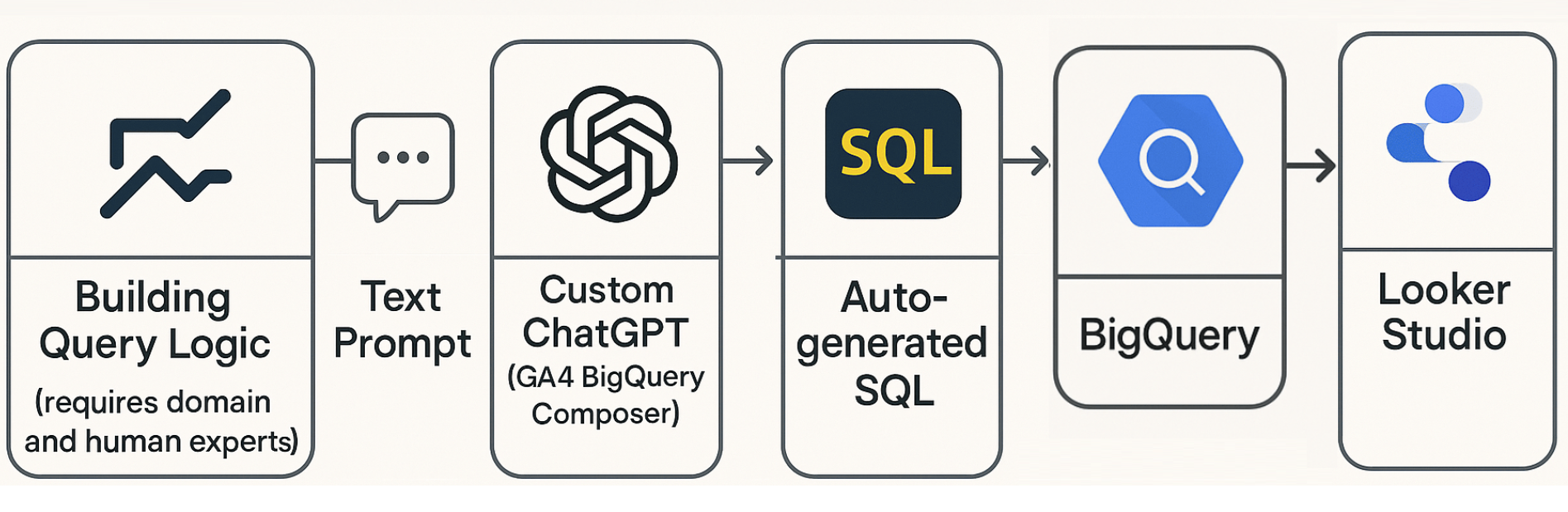
The following are the different types of SQL query logic:

  1. Event-Centric Logic.
  2. Session-Level Aggregation.
  3. User-Level Aggregation.

Event-Centric Logic.

Event-centric logic is a type of SQL query logic in which you directly process raw event-level data without any pre-aggregation.

In this approach, each event row is processed independently, and all calculations of dimensions and metrics are done directly on event data.

Use event-centric logic in the following cases:

  • If your dataset is smaller than 1 million rows.
  • You want to do event-level analysis, like analyzing every event (button click or product view) individually.
  • You are not worried about data reusability, data volume, data storage and data processing costs.
  • You are a beginner in GA4 BigQuery.

Session-Level Aggregation.

Session-level aggregation is a type of SQL query logic in which you aggregate event-level data at the session level.

While you still process raw event-level data, you do it only once to create a session table.

Once this aggregation is done, you no longer work with event rows. Instead, you work with session rows.

Use session-level aggregation in the following cases:

  • If your dataset is larger than 1 million rows.
  • You want to do session-level analysis, like calculating dimensions and metrics with session scope.
  • You want data reusability.
  • You want to keep data processing costs down.

Why is aggregating event-level data to the session level important?

Suppose a session has 3 page_view events (all with the same source) and 2 scroll events (with a missing source).

If you count these events as “sessions” without aggregation, you’ll see 5 sessions for one user-session combination.


So, if you don’t aggregate event data to the session level, you may end up overcounting sessions.

That’s why aggregating event-level data to the session level is important.

User-level aggregation.

User-level aggregation is a type of SQL query logic in which you aggregate event-level data or session-level data to the user level.

Once user-level aggregation is done, you no longer work with event rows or session rows. Instead, you work with user rows.

Use user-level aggregation in the following cases:

  • If your dataset is larger than 1 million rows.
  • You want to do user-level analysis like calculating dimensions and metrics with user scope.

Why is user level aggregation important?

If you calculate user-level metrics without aggregating session-level data at the user level, you might double-count metrics, resulting in inaccurate reports.

The two SQL queries (see the screenshots) are similar in purpose but differ in their approach.

session level aggregation 1
event centric logic

The first query uses ‘session level aggregation’. The second query uses ‘event-centric logic’.


I have an entire module on Query Logic in my GA4 BigQuery Course.