

2026 will mark a major turning point in the global job market, the year of mass layoffs driven by the rise of AI agents.
Multiple surveys, visible market signals, and the rapid growth of agent building communities support this.
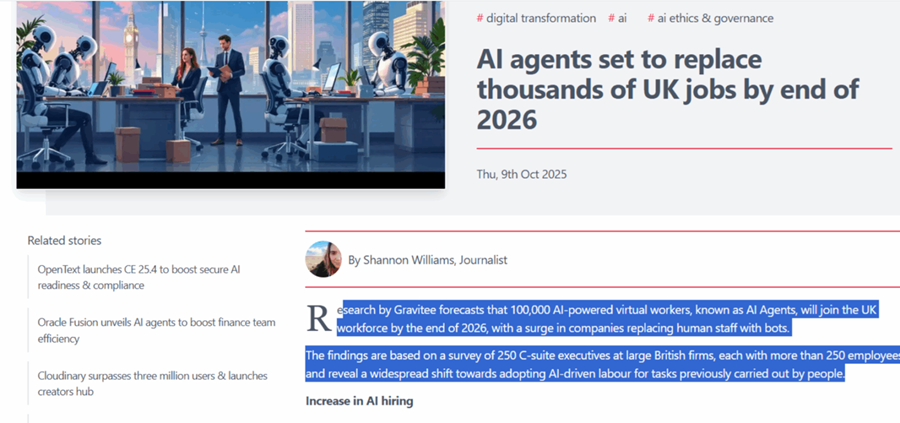
“Executives said a share of employees would be “exited” because they simply could not be retrained fast enough for AI-heavy roles. . . Accenture just delivered a jolt to white-collar workers everywhere. The global IT and consulting giant announced more than 11,000 job cuts tied to an $865 million “reinvention” effort.”
Source: https://finance.yahoo.com/news/company-just-laid-off-11-123000530.html
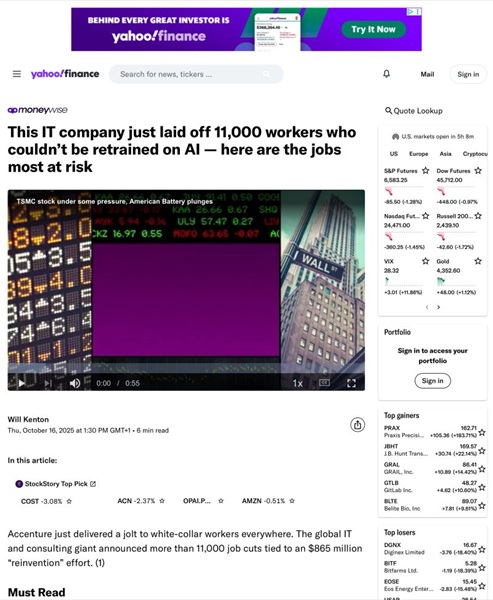
>> Market research and survey data indicate that by the end of 2026, about 37-41% of companies intend to replace workers with AI agents, with many already conducting layoffs in anticipation of further automation. (Source: IT Brief).
>> A global survey found that 41% of employers expect to reduce their workforce in areas where AI can automate tasks. (Source: World Economic Forum, Future of Jobs Report 2025).
>> Another report estimates that up to 47 % of US workers could see their roles exposed to automation over the coming decade. (Source: The Oxford Martin School study by Carl Benedikt Frey & Michael A. Osborne).
>> Warnings from major firms highlight “jobless growth” where productivity rises but employment stagnates. (Source: Goldman Sachs Research, 2025).
>> Research shows that changes in the skills required for AI-exposed jobs are happening 66% faster than in less exposed roles. (Source: PwC - 2025 Global AI Jobs Barometer).
The rise of AI Agents.
Thousands of AI agent developers are in training and experimentation today, and I am part of these communities.
They are fine-tuning autonomous systems that automate entire workflows, not just repetitive tasks.
These are not simple chatbots or no-code templates; they are agents that can run sales outreach, customer support, project coordination, reporting, and parts of decision-making.
By late 2025 and early 2026, many builders will shift from learning to launching, creating a flood of ready to deploy agents marketed as cost saving and productivity boosting tools.
The harsh economic logic.
Leaders will compare an AI agent that can perform 60 to 80% of a role around the clock at a fraction of the cost with a full-time employee who is slower, more expensive, and requires benefits.
That economic calculus will trigger layoffs.
The financial pressure behind layoffs.
In 2025, more than 166,000 tech jobs were cut, showing momentum heading into 2026.
Companies have invested hundreds of billions of dollars in AI, yet a reported 95% of projects are yielding zero returns, creating pressure to reduce costs through headcount reductions.
Stock prices have remained high due to optimism and heavy buybacks, but when support wanes, executives often opt for more layoffs.
Tech workers are the first casualties, no matter how you look at it.
If AI works more effectively, agents can quickly replace large categories of work. If AI disappoints, funding contracts and firms cut jobs to survive.
Companies have set high public expectations for AI productivity, and to sustain those narratives, they will reduce staff even if the gains are not yet fully realised.
This means that workers could be laid off based on projected efficiency, rather than actual performance.
No matter how you look at it, tech workers are the first casualties.
You will be left with only two options.
Become an AI Agent Supervisor (who provides strategic direction to AI Agents) or become an AI developer (who builds the agent).
Most companies of the future will revolve around two core roles: Agent Developers and Agent Supervisors.
Over time, every department will likely operate within this structure.
Agent Supervisors will be senior subject-matter experts responsible for overseeing the performance, reliability, and strategic alignment of AI agents.
Their role will include validating AI outputs, minimising hallucinations, and ensuring that the AI’s work aligns with brand, business, and compliance standards.
For example, a CMO could act as the Agent Supervisor for one or more marketing agents, guiding them to produce campaigns that stay on-brand and are strategically aligned with company goals.
Agent Developers, on the other hand, will build, maintain, and optimise these agents, translating business logic and domain knowledge into operational code, APIs, and workflows.
In this model, traditional junior roles may disappear.
Repetitive, execution-heavy tasks will be handled by AI agents, leaving only a few experts to supervise and a few developers to build.
That means no large, siloed teams for SEO, analytics, or marketing; instead, functional leads act as Supervisors, supported by Developers.
Even traditional HR departments may shrink as organisations move toward smaller, highly specialised teams, where human expertise drives strategy, and AI handles execution.
The mass layoff won't be gradual; it will be sudden.
A single voice agent that handles twenty calls simultaneously can replace twenty people immediately. An agent that manages ten client accounts with reporting can replace ten account managers simultaneously.
When the break happens, there will be little time to upskill.
The practical response is to adapt now.
Audit your role for exposure, build skills in AI engineering, ML operations, cloud, security, and especially AI implementation.
Companies will pay for people who can make AI work in production, and documenting real results will protect your career.
2026 will force a choice.
Be replaced by agents, or learn to manage and build them.
Related Articles:
- How to Self Host n8n on Google Cloud - Tutorial.
- How to use APIs in n8n, GoHighLevel and other AI Automation Workflows.
- How to use Webhooks in n8n, GoHighLevel and other AI Automation Workflows.
- What is OpenRouter API and how to use it.
- How to Connect Google Analytics to n8n (step by step guide).
- How To Connect Google Analytics MCP Server to Claude.
- State Machine Architectures for Voice AI Agents.
- Using Twilio with Retell AI via SIP Trunking for Voice AI Agents.
- Retell Conversation Flow Agents - Best Agent Type for Voice AI?
- How to build Cost Efficient Voice AI Agent.
- When to Add Booking Functionality to Your Voice AI Agent.
- n8n Expressions Tutorial.
- n8n Guardrails Guide.
- Modularizing n8n Workflows - Build Smarter Workflows.
- How to sell on ChatGPT via Instant Checkout & ACP (Agentic Commerce Protocol).
- How to Build Reliable AI Workflows.
- Correct Way To Connect Retell AI MCP Server to Claude.
- How to setup Claude Code in VS Code Editor.
- How to use Claude Code Inside VS Code Editor.
- How To Connect n8n MCP Server to Claude.
- How to Connect GoHighLevel MCP Server to Claude.
- How to connect Supabase and Postgres to n8n.
- How to Connect WhatsApp account to n8n.
- How to make your AI Agent Time Aware.
- Structured Data in Voice AI: Stop Commas From Being Read Out Loud.
- How to build Voice AI Agent that handles interruptions.
- Error Handling in n8n Made Simple.
- How to Write Safer Rules for AI Agents.
- AI Default Assumptions: The Hidden Risk in Prompts.
- Why AI Agents lie and don't follow your instructions.
- Why You Need an AI Stack (Not Just ChatGPT).
- How to use OpenAI Agent Kit, Agent Builder?
- n8n AI Workflow Builder And Its Alternatives.
- Two-way syncs in automation workflows can be dangerous.
- Missing Context Breaks AI Agent Development.
- How To Avoid Billing Disputes With AI Automation Clients.
- ChatGPT prompt to summarize YouTube video.
- Avoid the Overengineering Trap in AI Automation Development.