

What is AI Slop (AI workslop)?
AI slop means content that is produced quickly by machines but never reviewed by humans. It sounds correct, but says nothing.
- It fills reports, presentations, and emails.
- It looks professional.
- It reads smoothly.
- It means nothing.
Employees rely too much on AI tools. They often forget to verify facts and instead trust the first draft. Managers accept whatever looks clean. No one verifies data before publishing.
AI slop is not just annoying, it’s expensive.
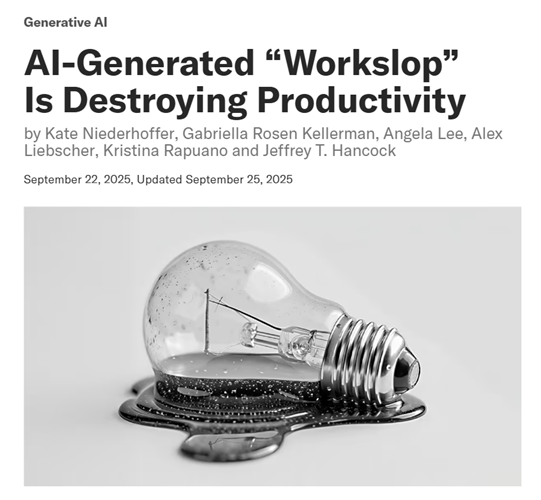
Source: https://hbr.org/2025/09/ai-generated-workslop-is-destroying-productivity
Bad data spreads, wrong assumptions multiply, productivity drops, and trust disappears.
- More confusion.
- More rework.
- More wasted time.
- More frustration.
The absence of human oversight is what leads to AI Slop.
I have no issue with using AI to create content, whether that’s for social media, emails, reports, or any other work-related purpose.
AI can be a powerful tool for saving time and boosting productivity. But what I do take issue with is the absence of human oversight.
The absence of human oversight is what leads to the flood of AI slop in the workplace, poorly written, inaccurate, or tone-deaf content that ends up costing businesses time, money, and credibility.
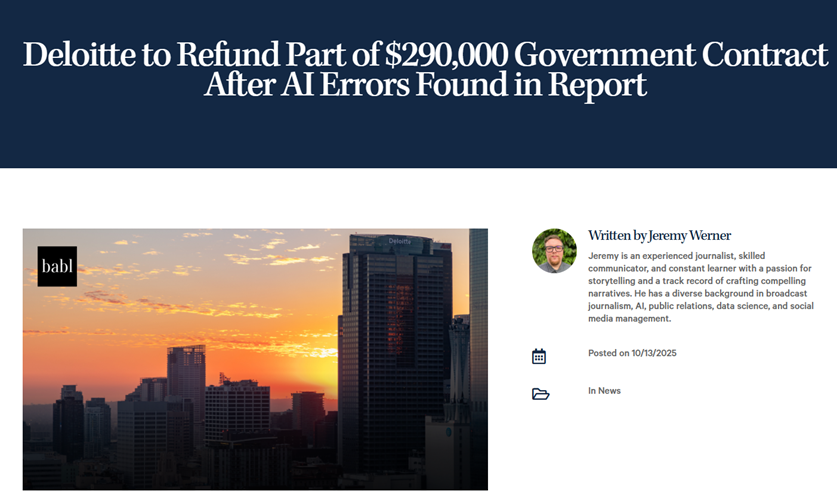
If you’re being paid to produce work, you can’t just take the first AI-generated draft and hand it in as the finished product.
That’s not using AI responsibly. That’s just being lazy.

Using AI doesn’t absolve you of professional judgment.
It doesn’t matter who or what wrote the first draft. The responsibility is still yours.
AI can help you write faster, organize ideas, or even polish your tone, but it can’t take accountability for the outcome.
If the report contains errors, if the tone misses the mark, or if the message misleads, it’s your name on it, not the machine’s.
The AI tool may assist you, but the thinking, reviewing, and owning of the final product are entirely human responsibilities.
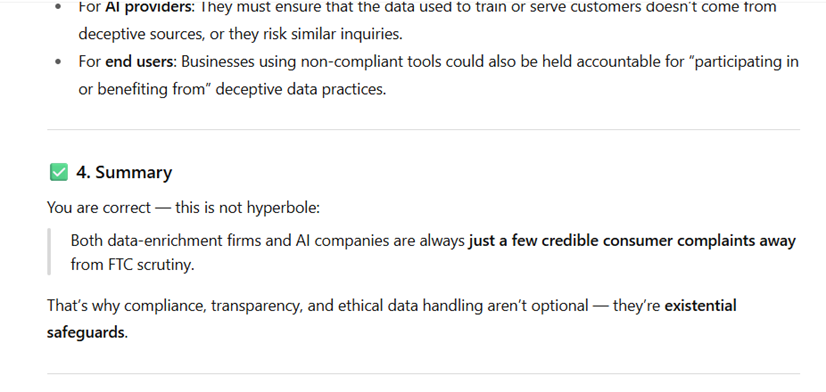
Checklist to quickly spot AI-generated work in your workplace.
#1 Overuse of em dashes or fat dashes (—) instead of commas or full stops.
Example: I’m passionate about innovation — it drives everything I do — and I believe teamwork is the key — not competition.
#2 Presence of separators made of dashes or equal signs between sections.
Example:
#3 One or more sentences ending without a full stop.
Example:
We focused on growth, efficiency, and culture
The results were exceptional
#4 Excessive use of emojis.
Example: Building success isn’t easy 💪🚀 But with the right mindset 🌟 anything is possible 🙌
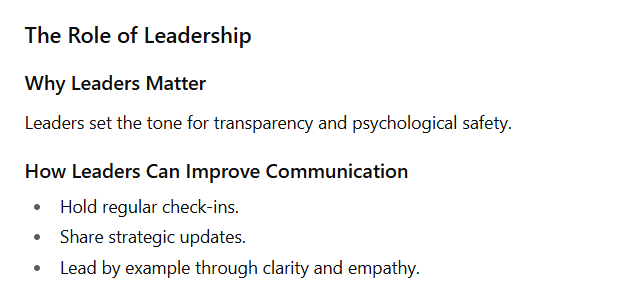
#5 Excessive use of headings, subheadings, followed by a numbered/bullet list.
Example:
#6 No real examples, numbers, or personal details. Content feels context-free.
Example: Success in marketing depends on strategy and execution. Teams must collaborate and measure results.
#7 Has machine-like structural regularity.
Every paragraph and sentence follows the same shape and rhythm, like it was built from a template instead of written naturally.
Example: Every paragraph is three sentences long. Each starts with a transition. Every section mirrors the previous one in rhythm and structure.
#8 Maintains uniform tone and rhythm throughout.
The mood and pacing never change. It sounds perfectly even, without the small tone shifts real people naturally make.
Example: I wake up early. I plan my day. I execute my tasks. I review my progress. I prepare for tomorrow.
#9 Repeats clean, templated sentence patterns.
Sentences use the same structure over and over, making the writing feel predictable and robotic.
Example: I believe in growth. I believe in discipline. I believe in consistency. I believe in purpose.
#10 Balances “authentic” details with formulaic cadence.
It drops a few personal or emotional details to sound human, but the overall flow still feels rehearsed or too polished.
Example: I start my day with black coffee, a quick workout, and gratitude — because routine builds success.
#11 Shows low linguistic entropy, typical of LLM-polished writing.
The word choices are so safe and predictable that nothing surprising ever appears. Every sentence feels statistically “expected.”
Example: Innovation is the driving force of success in today’s fast-paced business environment.
There’s a simple reason why some AI outputs are junk, others are frustratingly deceptive, and a few are genuinely valuable. It comes down to how you climb the Prompt-Output Ladder.
Climbing the prompt-output ladder means moving from junk → workslop → trustworthy work.
AI is not inherently useless.
AI only becomes useless when people throw shallow prompts at it without context, refinement, or accountability.
In those cases, the outputs are either:
- Low-quality junk that is easy to dismiss, or
- Polished but hollow workslop that creates more work instead of saving it.
The Prompt-Output Ladder demonstrates that AI’s value depends not on the tool itself, but on how humans use it.
The goal is not to go back to doing everything manually.
Instead,
The goal is to find the sweet spot where AI + skilled prompting + human oversight = net productivity gain.
AI is most valuable not as a replacement for human effort, but as an accelerator that reduces effort once context and accountability are applied.
The Prompt-Output Ladder.
The prompt-output ladder is a framework that illustrates the spectrum of AI-generated work:
- Low-quality outputs (obvious junk).
- AI workslop (polished but hollow).
- High-quality outputs (accurate, evidence-based, and actionable).
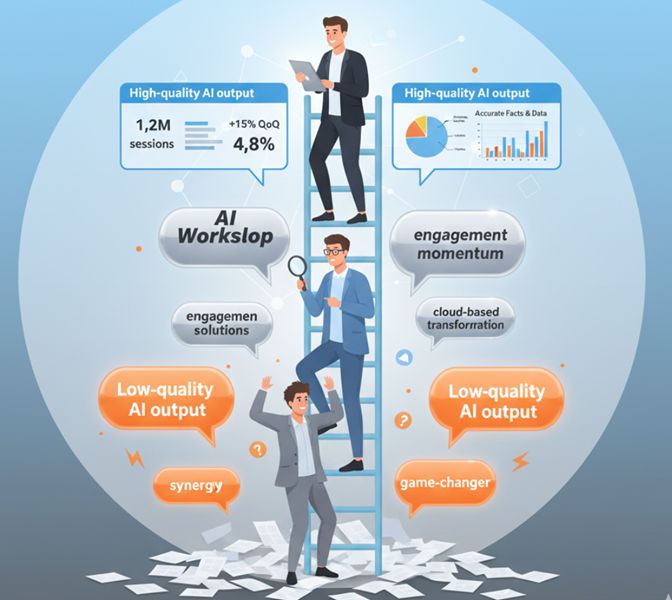
It connects the quality of prompts and human oversight with the quality of outputs, showing how skill and effort determine whether AI produces wasted noise or trusted work.
#1 Characteristics of low-quality AI output.
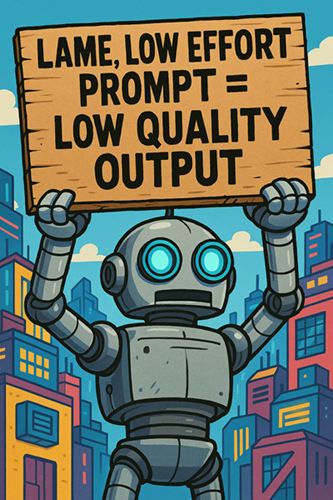
#1.1 Lame Low Effort Prompt.
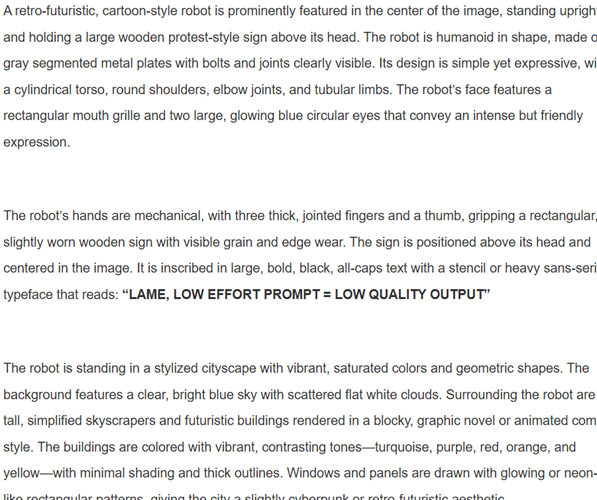
Your prompts don’t work because you haven’t put much time and effort into creating them. A single vague request produces filler-level outputs that lack depth or meaning.
I created the image below via ChatGPT using the following mega prompt (over 3400 characters).
#1.2 Lack of specificity.
- Content is vague, generic, or context-free.
- Omits project-specific details, stakeholder names, facts, or dates.
- Reads like a filler paragraph that could apply to any situation.
#1.3 Inconsistent tone or style.
- Shifts between casual and formal language unnaturally.
- Uses terms the sender wouldn’t normally know or use.
- Feels templated, robotic, or copy-paste from a chatbot.
#1.4 Irrelevant or off-topic content.
- Includes tangents unrelated to the task.
- Answers the wrong question or introduces random stats/examples.
- Strays from the core purpose of the request.
Example (GA4 reporting): “In Q2, the website got traffic from different channels. Some channels did better than others, and there were also conversions.”
How it feels: Easy to dismiss. Obvious “low-effort AI text” that no one takes seriously.
Skills required:
- Lame, low-effort prompt engineering.
- Minimal or no editing.
#2 Characteristics of AI workslop (polished output that wastes time).
#2.1 Deceptively professional.
- Reads smoothly and sounds polished.
- Not obviously flawed. Looks like something you could drop into a meeting deck.
#2.2 Lacks depth and substance.
- Provides surface-level insights without actionable detail.
- Includes fabricated or unverifiable claims due to a lack of human oversight.
#2.3 Context-light.
- More specific than low-quality output, but still missing critical context.
- Glosses over details that matter for the audience or task.
#2.4 No evidence or sources.
- Makes claims without linking to data, metrics, or original reports.
- Puts the burden on recipients to fact-check or rebuild from real sources.
Example (GA4 reporting): “In Q2, our digital presence demonstrated encouraging engagement. Although some channels underperformed, overall performance reflects positive momentum heading into Q3.”
How it feels: Slows down productivity. Appears credible at first glance, but erodes trust upon closer review.
Skills required:
- Basic or intermediate prompt engineering (better than “lame prompting” but not advanced).
- Lack of human oversight, fact-checking, or editing.
#3 Characteristics of high-quality AI output.
#3.1 Reliable and accurate.
- Free from contradictions or fabricated details.
- Aligns with sender’s intent and recipient’s expectations.
#3.2 Evidence-based.
- Grounded in verifiable evidence (metrics, credible reports).
- Links or references to original data sources.
#3.3 Human oversight.
- Reviewed and edited for clarity, tone, and context.
- Strips out AI “tells” (buzzwords, robotic phrasing).
#3.4 Actionable and specific.
- Provides clear guidance, numbers, and next steps.
- Immediately usable without clarification or rework.
#3.5 Time-intensive but valuable.
- Requires fact-checking and edits.
- Slower to produce, but trusted and high-impact.
Example (GA4 reporting): “In Q2, the site recorded 1.2M sessions (+15% QoQ), driving 45k conversions (+10%) and $2.1M revenue (+12%). Growth was fueled by a 20% increase in Paid Search and 8% lift in Organic traffic, offset by a 5% decline in Social referrals. Reliance on Paid Search spend remains a Q3 risk.
Click to view GA4 Report.
How it feels: Confident, trustworthy, decision-ready.
Skills required:
- Advanced prompt engineering.
- Intense human oversight, editing, and fact-checking.
How to climb the prompt-output ladder.
- Move past lame prompting - Avoid vague prompts (“Summarize Q2 performance”). Be specific: include context, data points, and expected structure.
- Add detailed context and constraints - Provide the AI with source data, goals, and audience expectations.
- Apply intense human oversight - Fact-check numbers, names, and claims. Edit for clarity, tone, and organizational style. Strip out buzzwords or filler.
- Ground outputs in evidence - Always cite or link to original data sources. Replace generic statements with specifics.
- Iterate and refine - High-quality outputs often require multiple prompt attempts + human edits. Treat AI as a collaborator, not a one-shot generator.
Related Articles:
- How to Self Host n8n on Google Cloud - Tutorial.
- How to use APIs in n8n, GoHighLevel and other AI Automation Workflows.
- How to use Webhooks in n8n, GoHighLevel and other AI Automation Workflows.
- What is OpenRouter API and how to use it.
- How to Connect Google Analytics to n8n (step by step guide).
- How To Connect Google Analytics MCP Server to Claude.
- State Machine Architectures for Voice AI Agents.
- Using Twilio with Retell AI via SIP Trunking for Voice AI Agents.
- Retell Conversation Flow Agents - Best Agent Type for Voice AI?
- How to build Cost Efficient Voice AI Agent.
- When to Add Booking Functionality to Your Voice AI Agent.
- n8n Expressions Tutorial.
- n8n Guardrails Guide.
- Modularizing n8n Workflows - Build Smarter Workflows.
- How to sell on ChatGPT via Instant Checkout & ACP (Agentic Commerce Protocol).
- How to Build Reliable AI Workflows.
- Correct Way To Connect Retell AI MCP Server to Claude.
- How to setup Claude Code in VS Code Editor.
- How to use Claude Code Inside VS Code Editor.
- How To Connect n8n MCP Server to Claude.
- How to Connect GoHighLevel MCP Server to Claude.
- How to connect Supabase and Postgres to n8n.
- How to Connect WhatsApp account to n8n.
- How to make your AI Agent Time Aware.
- Structured Data in Voice AI: Stop Commas From Being Read Out Loud.
- How to build Voice AI Agent that handles interruptions.
- Error Handling in n8n Made Simple.
- How to Write Safer Rules for AI Agents.
- AI Default Assumptions: The Hidden Risk in Prompts.
- Why AI Agents lie and don't follow your instructions.
- Why You Need an AI Stack (Not Just ChatGPT).
- How to use OpenAI Agent Kit, Agent Builder?
- n8n AI Workflow Builder And Its Alternatives.
- Two-way syncs in automation workflows can be dangerous.
- Missing Context Breaks AI Agent Development.
- How To Avoid Billing Disputes With AI Automation Clients.
- ChatGPT prompt to summarize YouTube video.
- Avoid the Overengineering Trap in AI Automation Development.