

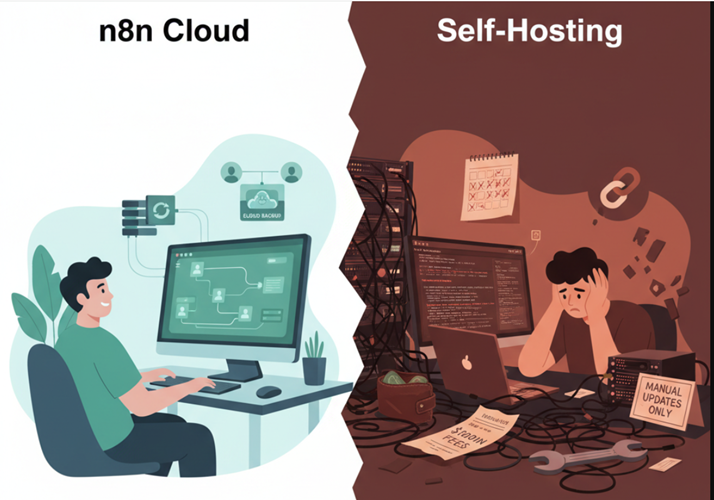
When self-hosting n8n, the first thing many people notice is the “SAVINGS.”
n8n Cloud starts at ~$30/month.
A VPS (virtual private server) can run as low as $5/month.
On paper, it looks like a no-brainer.
But the benefits of self-hosting end right there.
The hidden cost of playing or paying Server Admin.
I tried playing server admin, and it blew up in my face.
To self host n8n reliably, you need server administration skills, or you’ll have to hire someone with suck skills.
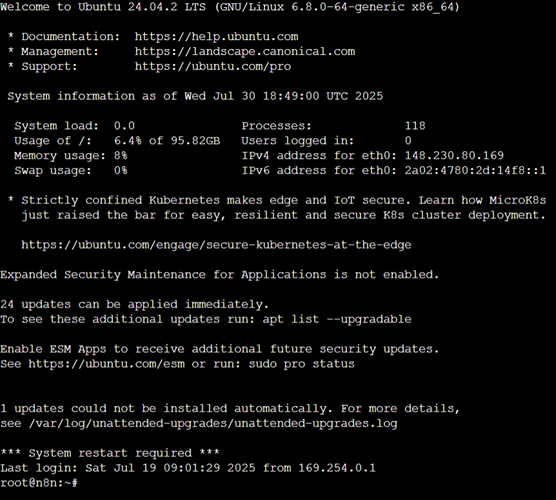
Most VPS setups run on Ubuntu, a Linux-based operating system. And while AI chatbots or tutorials can walk you through the initial setup, the real problems begin when:
- A server crashes.
- Performance drops.
- Security vulnerabilities need patching.
At that point, “step-by-step guidance” won’t cut it. You need deep expertise in Linux, networking, and troubleshooting.
If you don’t have that background, you’re left hiring an admin, which quickly wipes out any cost savings.
I made a big mistake by self-hosting n8n, which resulted in losing one week's worth of work.
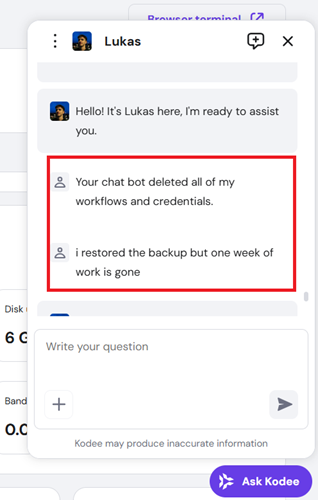
For a moment, I actually lost everything, all workflows and credentials, thanks to the AI chatbot that guided me to update to the latest n8n version, but ended up deleting all of the data.
And when you do lose your data, all you will get is this insincere apology message from a soulless AI.
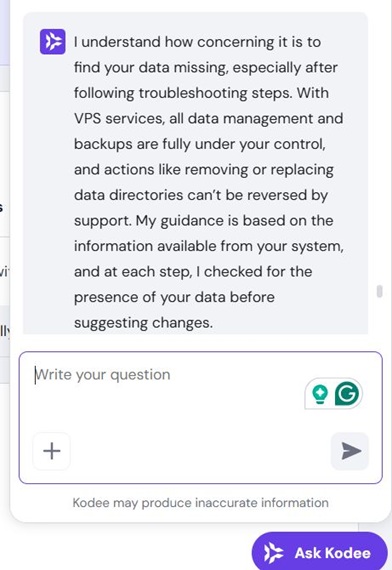
Fortunately, I lost only practice workflows and credentials.
In my opinion, it's not worth the hassle of playing Server Admin.
The automations need to work uninterrupted. Otherwise, there is no point in setting them up.
The following are the top reasons for not using self-hosting n8n:
- Data loss due to manual updates or errors.
- Collaborating on projects becomes a nightmare.
- You lose access to the official n8n AI Assistant.
- Inadequate support and documentation access.
- Integration difficulties.
- Prolonged downtime during updates or failures.
- Data loss/corruption is not worth saving cloud fees.
#1 There is always a risk of Data Loss due to manual updates or errors.
Unlike n8n cloud, when you self-host n8n, there is generally no built-in "one-click update" button in the web interface for upgrading to the latest version.
Instead, you must update n8n using command-line tools or a terminal, usually through your browser's SSH/terminal interface provided by your server host or hosting panel.
A lot can go wrong during these manual updates (like restarting containers or running CLI commands).
Even with daily backups and technical expertise, you can still lose intra-day data if the update fails for any reason, such as incorrect advice from your hosting provider's AI chatbot (as happened in my case).
In contrast, n8n Cloud (the managed SaaS version) handles updates automatically with oversight from the n8n engineers, minimizing the risk of human error during the upgrade process.
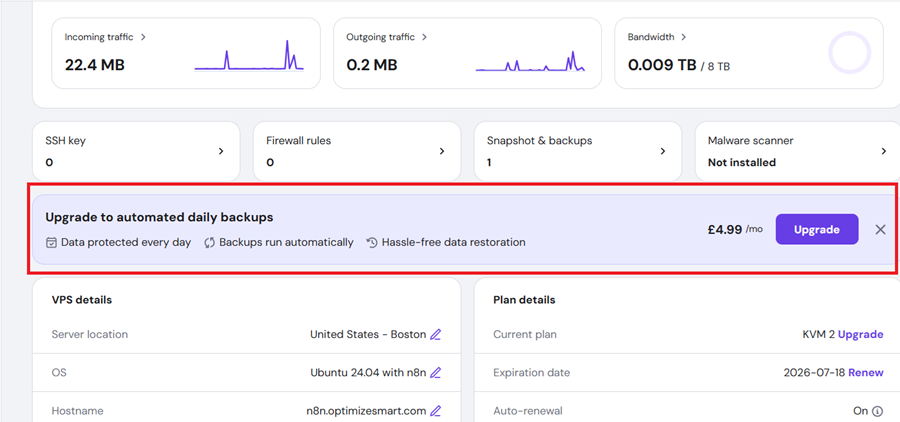
According to n8n’s legal page, daily backups are standard, and the managed environment likely leverages more frequent internal snapshots and quick rollback tools.
This managed approach means updates, rollbacks, and disaster recovery are part of the service, so your risk of permanent data loss or downtime from failed updates is much lower, and you benefit from professional support should issues arise.
With self-hosting, you usually need to pay extra for daily backups.
#2 Collaborating on projects becomes a nightmare.
#1 Self-hosting n8n version lacks native features for:
- Workflow sharing.
- Credential sharing.
- User roles or permissions.
All workflows reside in a single user’s space, with no direct way to collaborate within the app.
#2 You will have to rely on manual exports, file sharing, or version control (e.g., Git) to collaborate. These methods are cumbersome, error-prone and inefficient for frequent updates or large teams.
So, unless you want to remain a one-man shop, self-hosting n8n is not a good option in the long term.
#3 You lose access to the official n8n AI Assistant.
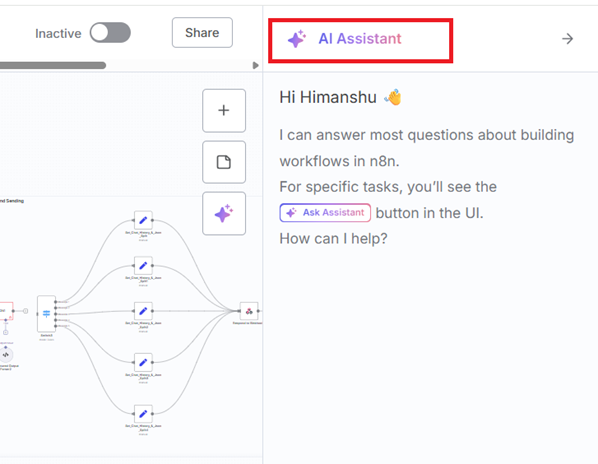
n8n Cloud includes a powerful built-in AI Assistant to help debug workflows, write expressions, and troubleshoot errors directly inside the app.
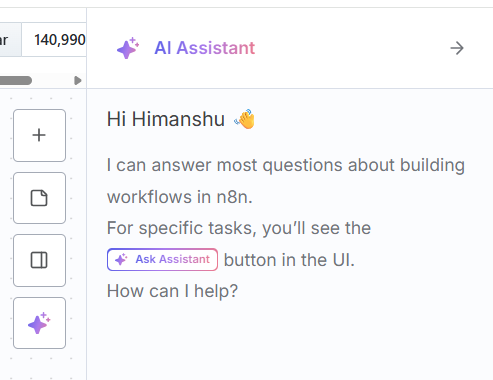
The n8n AI Assistant has no direct parallel, as it is trained specifically on n8n’s documentation and community discussions.
It’s useful for both beginners and experienced users, but it’s exclusive to the Cloud version.
If you self-host, you lose this feature entirely.Now you are at the mercy of generic AI Assistants (like ChatGPT), which are often not as good as the n8n AI Assistant.
#4 Inadequate support and documentation access.
When you are self-hosting n8n, you are pretty much on your own when something goes wrong. You can’t even rely on an AI chatbot to provide you with accurate recommendations all the time.
I followed the instructions given by the hosting provider’s AI agent, which resulted in data loss.
The agent also lied to me that it had checked the presence of data before suggesting changes.
n8n Cloud includes better-integrated AI assistance with direct access to documentation, enhancing troubleshooting compared to self-hosted limitations.
#5 Integration difficulties.
Popular integrations like Gmail, Google Sheets, Slack, Notion, etc., require OAuth authentication.
In self-hosted n8n, you must create and configure OAuth apps manually:
- Set up Google Cloud or third-party dev consoles.
- Manage Client IDs, secrets, scopes, and redirect URIs.
- Troubleshoot issues like mismatched URIs, invalid tokens, or quota limits.
n8n Cloud makes it simple to connect to services (like Google Sheets, Gmail, and other Google tools) by offering built-in OAuth support. This means:
- One-click sign-in. No manual setup needed.
- No need to create Google Cloud projects or handle OAuth credentials (in most cases).
- Redirect URIs are pre-configured (e.g., oauth.n8n.cloud).
#6 Prolonged downtime during updates or failures.
When you use n8n cloud, the downtime during updates is usually not more than 2 minutes. Also, there is little to no risk of failure.
However, when self-hosting n8n, downtime during updates is significantly longer.
Downtime can extend well beyond a few minutes, sometimes reaching 30 minutes or more if complications arise, such as misconfigurations, missed prerequisites, or the need to manually troubleshoot errors, especially when updates are performed without sufficient automation or experience.
In worst-case scenarios, corrupted databases, failed migrations, or incomplete backups can lead to permanent loss of intra-day data generated since the last backup.
I find manual updates very risky, even if the hosting provider has a daily backup feature.#7 Potential data loss/corruption is not worth saving cloud fees.
When you're responsible for storing your clients' data and running their automations, the stakes are much higher than just your own operational concerns.
Risking data loss or corruption, even if only for potential intra-day gaps, can have severe consequences for your reputation and your clients' business continuity.
The trust clients place in your service is paramount; a single incident of lost or corrupted data could irreparably damage that trust and impact future business.
Saving £60 a month by self-hosting may seem attractive on the surface, but it pales in comparison to the potential costs (both tangible and intangible) of a data incident.
The n8n Cloud protect against these risks with frequent, automated backups, professional maintenance, and rapid recovery processes, all designed to safeguard your clients' data integrity and your business reputation.
For service providers, the peace of mind and professional assurance offered by a managed solution are usually well worth the additional monthly fee.
Clients don’t care if you're self-hosting, they care if your automation works and saves/makes them money.
The Bigger Picture - No cost savings, just headaches.
If you’re in a sensitive industry (such as finance or healthcare), self-hosting n8n is the only option for privacy reasons.
But for most businesses, saving a few bucks a month is not worth:
- The constant risk of downtime or data loss.
- The hidden cost of hiring a server admin or DIY server management.
- The loss of collaboration tools & AI support.
When clients trust you with their data and automations, the stakes are too high to gamble with.
Self-hosting n8n may appear cheaper on the surface, but in reality, it can often cost significantly more than cloud fees.
Related Articles:
- How to Self Host n8n on Google Cloud - Tutorial.
- How to use APIs in n8n, GoHighLevel and other AI Automation Workflows.
- How to use Webhooks in n8n, GoHighLevel and other AI Automation Workflows.
- What is OpenRouter API and how to use it.
- How to Connect Google Analytics to n8n (step by step guide).
- How To Connect Google Analytics MCP Server to Claude.
- State Machine Architectures for Voice AI Agents.
- Using Twilio with Retell AI via SIP Trunking for Voice AI Agents.
- Retell Conversation Flow Agents - Best Agent Type for Voice AI?
- How to build Cost Efficient Voice AI Agent.
- When to Add Booking Functionality to Your Voice AI Agent.
- n8n Expressions Tutorial.
- n8n Guardrails Guide.
- Modularizing n8n Workflows - Build Smarter Workflows.
- How to sell on ChatGPT via Instant Checkout & ACP (Agentic Commerce Protocol).
- How to Build Reliable AI Workflows.
- Correct Way To Connect Retell AI MCP Server to Claude.
- How to setup Claude Code in VS Code Editor.
- How to use Claude Code Inside VS Code Editor.
- How To Connect n8n MCP Server to Claude.
- How to Connect GoHighLevel MCP Server to Claude.
- How to connect Supabase and Postgres to n8n.
- How to Connect WhatsApp account to n8n.
- How to make your AI Agent Time Aware.
- Structured Data in Voice AI: Stop Commas From Being Read Out Loud.
- How to build Voice AI Agent that handles interruptions.
- Error Handling in n8n Made Simple.
- How to Write Safer Rules for AI Agents.
- AI Default Assumptions: The Hidden Risk in Prompts.
- Why AI Agents lie and don't follow your instructions.
- Why You Need an AI Stack (Not Just ChatGPT).
- How to use OpenAI Agent Kit, Agent Builder?
- n8n AI Workflow Builder And Its Alternatives.
- Two-way syncs in automation workflows can be dangerous.
- Missing Context Breaks AI Agent Development.
- How To Avoid Billing Disputes With AI Automation Clients.
- ChatGPT prompt to summarize YouTube video.
- Avoid the Overengineering Trap in AI Automation Development.