

What is a key performance indicator (KPI)?
A key performance indicator (or KPI) is a metric that is one of the most important indicators of the current performance level of an individual, department and/or company in achieving goals.
To make it simple, KPI is a quantifiable measure that will help us understand whether or not we are hitting our goal. It helps us track the effectiveness of our campaigns.
Always consider that your KPI should be relevant to your overall business goals and needs to be attainable. If it is not relevant to your business goals, it should not be considered a KPI.
Always limit your business to having four to five KPIs. Any more than that, and you may lose track of the measurement.
What is a metric?
A metric can be a number or a ratio. So we can have number metrics, and we can also have ratio metrics.
Examples of number metrics
The following are examples of number metrics because they are in the form of numbers:
- Visits (or sessions)
- Pageviews
- Revenue
- Conversions
- Gross profit
- Operating profit
- Net profit
Examples of ratio metrics
The following are examples of ratio metrics because they are in the form of ratios:
- Bounce rate
- Conversion rate
- Average order value
- Averages (mean, median)
- Return on investment (ROI)
- Profit margin
- Percentage change
- Customer lifetime value
What are number KPIs?
Since a KPI is a metric and a metric can be a number, we can have KPIs in the form of numbers. So we can have ‘number KPIs’.
Examples of number KPIs: ‘Days to purchase’, ‘visits to purchase’, ‘Revenue’ etc
What are ratio KPIs?
Since a KPI is a metric and a metric can be a ratio, we can have KPIs in the form of ratios. So we can have ratio KPIs.
Examples of ratio KPIs: ‘Conversion rate‘, ‘Average order Value’, ‘Task completion rate’ etc
What is the difference between a metric and a KPI?
Every KPI is a metric. But not every metric can be used as a KPI.
A KPI is a key metric that can directly impact the cash flow (revenue, cost) and/or conversions (both macro and micro conversions) considerably.
For example, if you sell ‘display banner ad space’ on your website and ‘display advertising’ is the main revenue source, then ‘pageviews’ can be used as a KPI.
The more page views you get, the more you can charge for every thousand impressions (CPM) from your advertisers.
Similarly, ‘average order value’ can be used as a KPI because it hugely impacts website sales.
You can greatly increase your website sales at the present conversion rate by increasing your orders’ size (i.e. the ‘average order value’).
What is the difference between a KPI and a goal?
A KPI is not a goal. However, it needs an accompanying goal to be effective.
A goal is a specific outcome or result you want to achieve. In comparison, a KPI is a metric that tells you whether you are on track to achieving your goal.
For example, if your goal is to decrease acquisition cost, your KPI could be a ”percentage decrease in CPA in the last month‘.
Here the KPI does not define the goal itself. It only tells you whether you are on track to decrease your acquisition cost. So don’t try to use KPIs and Goals interchangeably.
They are not the same thing.
What is the difference between KPI and KRA?
KRA (key result areas) are the things that are critical to the company’s goals.
Once you identify the KRA, the next thing is to add quantifiable measures to those. This is where the KPIs will come into the picture.
KPIs are normally numbers, percentages or units that can be measured to understand the progress of your business.
What is a KPI used for?
KPI is used to measure your performance (as an individual, department or company) in achieving key goals. They are used to track your goals against business objectives and implement changes as required.
Who should use KPIs?
If you are an individual, department, or company and have set up clearly defined goals for yourself, you should use KPIs to measure your performance in achieving your goals.
Who should not use KPIs?
If you do not know your goals as an individual, as a member of your department or as a member of your company, you don’t need to use any KPI.
When should I use a KPI?
The best time to use KPI is when you have set up clearly defined goals and strategies, and you are now ready to measure your performance in achieving those goals.
Use KPIs when you need to track the progress of your goals against your business objectives.
What are the attributes of a good KPI?
A good KPI has got the following attributes:
- It is available and measurable.
- It highly impacts its corresponding goal.
- It is relevant to its corresponding goal.
- It is instantly useful.
- It is available in a timely manner.
#1 Available and measurable
You can use only those metrics as KPIs, which are available to you in the first place.
For example, if the ‘Net Promoter Score’ metric is not available to you, you cannot use it as a KPI.
Similarly, if you come up with something impossible to measure (like ‘frustration level of customers who abandoned the shopping cart for the third time’), you cannot use it as a KPI.
So when you are finding your KPIs, you need to be 100% sure that there is a mechanism/tool available to measure and report your KPI in the first place.
#2 Highly impacting
If a metric does not greatly impact its corresponding goal, it is not a good KPI.
#3 Relevant
If your KPI is highly impacting, then it must be relevant to its corresponding goal.
#4 Instantly useful
If your KPI is highly impacting, then it will be instantly useful, i.e. you can quickly take actions based on the insight you get from your KPI.
#5 Timely
Your KPI should be available to you in a timely manner so you can take timely decisions.
For example, if you are using a compound metric (a metric that is made up of several other metrics) as a KPI and it takes several months to compute it once and then several more months to compute it the second time, then it is not a good KPI, as you can not make timely decisions based on such a KPI.
What are the different types of KPIs?
There are three broad categories of KPIs:
- Business KPIs
- External KPIs
- Internal KPIs
Apart from the KPIs that we have looked at above, there are other KPIs that could make the most sense for your business objectives:
- Quantitative KPIs
- Qualitative KPIs
- Leading KPIs
- Lagging KPIs
How to set up KPIs
Follow the steps below to set up KPIs:
- Establish your company’s mission and vision statements
- Define your core values (principles) as a business.
- Define your company’s core business goals (objectives)
- Make each core business goal SMARTER by creating well-defined strategies for achieving them.
- Set up business KPIs for each SMARTER core business objective.
- For each business KPI, set up a clear target that defines what success looks like
- Iterate your strategy for each business KPI so that it clearly outlines how you will achieve your business KPI targets
- Share core business objectives and corresponding business KPIs and targets across your organization
- Break down each core business goal into several smaller goals (external goals)
- Make each external goal SMARTER by creating well-defined strategies for them.
- Set up External KPIs for each external goal.
- For each external KPI, set up a clear target that defines what success looks like.
- Iterate your strategy for each external KPI to clearly outline how you will achieve your external KPI targets.
- Share external goals and corresponding external KPIs and targets with your team/department.
- Break down each external goal into several smaller goals (called ‘Internal Goals’).
- Make each internal goal SMARTER by creating well-defined strategies for them:
- Set up internal KPIs for each internal goal
- For each internal KPI, set up a clear target that defines what success looks like.
- Iterate your strategy for each internal KPI to clearly outline how you will achieve your internal KPI targets.
- Monitor your KPIs against your targets on a weekly/monthly basis.
- Review and adjust your goals, strategies, KPIs, and targets at regular intervals so that they effectively capture any strategic, functional or tactical change in your business.
What is a mission statement, and how to create one
The mission statement is a written declaration of your organisation’s core purpose/cause. Why does it exist? What problem are you trying to solve?
Your mission should be bigger than yourself and solve a real-life problem for others in a bigger and better way.
Your company does not exist just to make money.
Sure your company needs to make money to survive, but there needs to be an added mission that serves others and, at the same time, positively impacts your business bottom line.
If your company is just driven by business opportunity/money, then you won’t go very far in your business.
For example, Google’s mission is “to organize the world’s information and make it universally accessible and useful.” And this has been their mission from the very start.
Their mission was never about making more money.
A mission statement does not change over time.
A mission statement helps you keep on track. It is like a compass that, when used daily, keeps your organization in the right direction.
Unlike a business goal, a mission is not something you aim to achieve. A mission is something that drives your day to day actions and decision-making processes in a business.
For example, your business goal could be to generate $100k in additional sales in the next year. But this can not be your mission.
What is a vision statement, and how to create one?
A vision statement is a written declaration of what an organization would like to achieve in the long term.
For example, Google’s corporate vision is “to provide access to the world’s information in one click.”
Amazon’s vision is “to be earth’s most customer-centric company; to build a place where people can come to find and discover anything they might want to buy online.“
The difference between mission and vision statements is that the mission is a general statement of how you will achieve your vision.
What are the core values (principles) of a business?
Principles (core values) are how your organization should behave on its way to achieving its vision. Your core values support your mission and vision and drive your day to day decision making processes.
It is like the foundation of your company.
Without core values, your company has got no identity, no culture.
Following are examples of the core values of a business:
- Market backward (focus on what the market wants and then deliver it to them).
- Simplicity (less is more)
- To the point (no rambling)
- Focus is everything (do less, better)
- Customers obsession
- Results-oriented
- Long-term thinking
- Ever evolving, always innovating to become a better version of ourselves.
What are core business goals?
The core business goals are the results you want to achieve, improve or maintain as an organization in the short term and in the long run.
Your core business goals can be:
- Support and maintain the company’s core values.
- Increase/maintain market share
- Increase profitability
- Improve brand retention
- Provide excellent customer service etc.
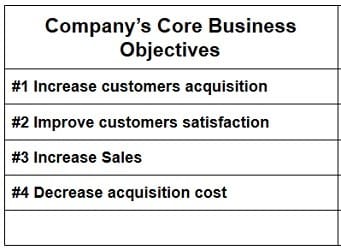
Following are the most common core business objectives for an ecommerce business:
- Acquire more customers (i.e. Increase customers acquisitions)
- Retain existing customers (i.e. Improve customer satisfaction).
- Increase sales
- Decrease the cost of acquiring customers (i.e. decrease acquisition cost)
You can find your company’s core business goals through ‘Key Performance Questions’.
What are Key Performance Questions (KPQs)?
Key Performance Questions or KPQs are those questions that help you in setting up your goals and strategies.
For example, if one of your core business goals is to increase customers acquisition, then your KPQs can be:
- How can we increase customer acquisition?
- Can we acquire two times more customers than last year? Is that realistically possible?
- If it is possible, then what do we need to change/adopt to achieve this goal?
Note: KPQs are the building blocks of goals, strategies, and KPIs.
How to set up core business goals
You can ask yourself the following KPQs, to set up core business goals:
- Why does my business exist?
- What is the purpose of the business?
- What am I trying to achieve as an organization?
- What are my company’s mission and vision?
- What are the short term and long term goals of my company?
- What are the core values of my company?
Founders / top management executives should play a key role in setting up and monitoring their core business goals.
If you are an external consultant/agency, you determine core business goals with the help of the people who actually run the business and not from the website or Google Analytics reports.
Consequently, you need to interview your client.
Note(1): The core business objectives can vary from industry to industry and from business to business. Thus there is no standard set of core business objectives that should be adopted/copied.
Note(2): Your core business goals must be SMARTER (i.e. SMARTER core business goals). Your ‘key performance questions’ must help you set up SMARTER business goals.
What are SMARTER goals?
SMARTER stands for ‘Specific’, ‘Measurable’, ‘Attainable’, ‘Relevant’, ‘Time-bound’, ‘Evaluated’ and ‘Readjusted’
‘Specific’
Your goal needs to be clear and specific. It should target a very specific outcome. The more specific your goal, the higher your probability of achieving it.
For example, ‘generating more’ sales is not a specific goal. Generating 10k extra per month is a specific goal.
You must be able to quantify your goal. You must be able to measure it. Otherwise, it is not a goal but just some obscure direction.
‘Measurable’
Your goal needs to be measurable. You should be able to measure the results and progress of each goal.
You would need to establish criteria for measuring results and progress towards the attainment of each goal.
For example, ‘Customers’ happiness’ can not be your goal unless you have a mechanism to quantify and differentiate between different human emotions (happiness, frustration, etc.).
‘Attainable’
Your goal is considered achievable if you can achieve it in the short term. And by short term, I mean within a year. However sooner, the better.
Long term goals are not achievable unless you have accomplished corresponding short term goals. That’s why it is critical to break down your long term goals into several smaller short term goals.
That’s how you create an alignment between your short-term and long-term goals. So that every time you achieve a short term goal, you come one step closer to achieving your long term goal.
So when we talk about an attainable goal, we refer only to the short term goals. Without short term goals in place, your long term goal is not a goal but just some obscure direction and wishful thinking.
You should be able to achieve your goal within the area of your responsibility and expertise.
At the organization level, an ‘attainable’ goal should be based on SWOT (‘strength’, ‘weaknesses’, ‘opportunities’ and ‘threat’) analysis.
A SWOT analysis can help you make better and more profitable business decisions. Understanding the internal and external factors that affect your business is crucial to its success.
‘Relevant’
Your goal must help you in achieving the desired outcome(s).
‘Time-bound’
Your goal must have a deadline (target date) attached to it. Without deadlines, no goal is unachievable.
You can achieve it next week, next month or next year. There is no urgency.
Set an exact date when you plan to achieve your goals.
Work on your goals backwards
If your five-year goal is to generate 1 million dollars in sales, what should be your one-year goal?
If your one-year goal is to generate $200k in sales, what should be your quarterly goal?
If your quarterly goal is to generate $50k in sales, what should be your monthly goal?
If your monthly goal is to generate $16,667 in sales, what should be your weekly goal?
If your weekly goal is to generate $4167 in sales, what should be your daily goal?
Then start working on achieving your daily goals.
The shorter the time frame, the more likely you will achieve your desired goal. The longer the time frame, the less likely you will achieve your desired goal.
‘Time-bound’ goals bring urgency and help you stay focused and motivated.
‘Evaluated’
Evaluate where you are with achieving your goals. You need to evaluate your goals regularly.
Things change, circumstances change, market change over time, and you may need to adjust your goals accordingly. If you fail to adjust your goals, they may become irrelevant over time.
‘Readjusted’
If one approach is not working, you may need a different approach to achieve your goals.
Example of SMARTER business goal – increase website sales by 100% in the next six months by improving organic search traffic through SEO.
How can you make a business goal SMARTER?
You can make a business goal SMARTER by creating well-defined strategies for achieving them.
What is a strategy?
A strategy is a specific method you use to achieve your goals. These goals could be business goals, external goals or internal goals.
How to create a strategy
You can create strategies through ‘Key Performance Questions’. These questions include ‘why’, ‘what’, ‘who’, ‘where’, ‘when’ and ‘how’.
Why?
‘Why’ denotes the objective and reasoning of your strategy. What are you trying to achieve? What should be the outcome?
What?
‘What’ denotes what is involved in implementing your strategy. Creating and implementing any strategy requires time, cost, people, subject matter expertise and other resources.
Who?
‘Who’ is involved in implementing your strategy. These people can be you, your colleagues, boss, clients, etc.
Where?
‘Where’ denotes the ‘direction’ in which your strategy should move to get the highest possible return on your investment.
Your strategy should move in the direction where it helps you achieve your goals most efficiently. Thus ‘where’ can also denote ‘efficiency’.
When?
‘When’ denotes ‘situation’, ‘date and time’, ‘assumptions’, ‘risks’, ‘barriers’, ‘deadlines’, ‘opportunities’ etc.
A strategy also needs to be time-bound to be cost-effective. Without deadlines, there is no urgency.
How?
‘How’ denotes the ‘process’ you will use to execute your strategy.
This includes coming up with a certain set of tasks. When these tasks are complete, the strategy is considered to be executed.
Thus a strategy can be made up of one or several tasks.
Note: Without setting up goals and strategies beforehand, you will have difficulty coming up with KPIs.
What is a business KPI?
A business KPI (also known as a high-level KPI) is the KPI set up for measuring the performance of a core business goal.
A business KPI is a metric that is one of the most important indicators of the current performance level of a business in achieving its core business goals.
For example, if one of your core business goals is to acquire more customers, your business KPI can be ‘Customers Growth Rate’ (a measure of the percentage increase in customers between two time periods.)
The metric that you choose as a business KPI must highly impact the corresponding core business goal.
This is possible only when the metric can provide recommendation(s) for action, which can greatly impact the business’s bottom line.
In other words, your KPI must have the ability to provide recommendation(s) for action, which can highly impact the business’s bottom line.
Business KPIs are set at the organization level and focus on measuring a business’s overall performance.
How to ensure a metric can be used as a business KPI
If you are not sure whether or not a metric can be used as a business KPI then correlate it with its corresponding core business objective and then determine the following two things:
#1 Determine whether a linear relationship exists between your chosen KPI and its corresponding core business objective
As the value of your KPI increases or decreases, there should be a corresponding positive or negative impact on the core business objective.
For example, if you sell ‘display banner ad space’ on your website and ‘display advertising’ is the main source of revenue for your company, then ‘pageviews’ can be used as a business KPI. The more page views you get, the more you can charge for every thousand impressions (CPM) from your advertisers.
#2 Determine the strength of the linear relationship between your chosen KPI and its corresponding core business objective
As the value of your KPI increases or decreases, there should be a significant positive or negative impact on the core business objective.
Founders / top management executives should play a key role in setting up and monitoring the business KPIs.
Your core business objectives need to be crystal clear before finding business KPIs.
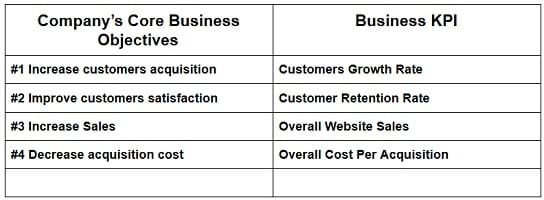
Note: Acquisition is also known as ‘conversion’ or ‘customer’. So the cost per acquisition (CPA) can be the ‘cost per conversion’ or the average cost of acquiring a customer.
What is the difference between a KPI and a target?
A KPI is not a target. However, it needs the accompanying target to be effective.
A target is a metric to define success and failure in achieving your goals. When you have achieved your target, it is considered a success.
When you do not achieve your target, it is considered a failure. Whereas a KPI is a metric that tells you whether you are on track to achieving your goal.
For example, your KPI could be a ‘percentage decrease in CPA in the last month‘. Here the KPI does not define what percentage decrease in CPA is considered a success.
For that, we need to set up a KPI target like the one below:
Ten or more percentage decrease in CPA in the last month.
So KPIs and targets are not the same things.
Why the core business objectives and their corresponding business KPIs must be shared?
The core business objectives and their corresponding business KPIs must be shared across your organization so that everyone is aware of what their company is trying to achieve.
This will help your employees and departments set up goals and KPIs that align with your business KPIs. Do not mess up at this stage (as many businesses do).
In many companies, employees/managers have difficulty understanding how they are adding ‘value’ to the business bottom line and whether what they are currently doing is worth the time and investment.
And this happens because the organization’s core business objectives and business KPIs are not shared across the organization.
Everyone in the company must be pushing towards the same organizational goals. This is the only way to ensure maximum productivity and profitability.
And this can happen only when the core business objectives and business KPIs are shared across the organization.
What are external goals?
External goals are those core business goals that you can achieve within the area of your responsibility and expertise.
For example, for the business goal ‘Acquire new customers‘, the following can be your external goals:
- Acquire customers through organic search traffic.
- Acquire customers through paid search traffic.
For the business goal ‘Retain existing customers‘, the following can be your external goals:
- Build brand loyalty
- Increase user engagement
For the business goal ‘Increase website sales‘, the following can be your external goals:
- Increase the number of transactions
- Increase user engagement
Similarly, for the business goal ‘Decrease acquisition cost‘, the following can be your external goals:
- Re-target users
- Fix website tracking issues
How to find external goals
You can find your external goals through ‘Key Performance Questions’.
For example, if one of your core business goals is to increase customers acquisition, then your KPQs for setting up an external goal for SEO can be:
- How can we increase customer acquisition?
- Can we acquire two times more customers than last year? Is that realistically possible?
- If it is possible, then what do we need to change/adopt to achieve this goal?
- Why doubling the rate of acquiring customers is important to the business? How would this impact sales and profitability from organic search?
- Who would be responsible for increasing customer acquisition through SEO?
- What does success look like?
- What should be the time frame for achieving this goal?
Your ‘key performance questions must help you set up SMARTER external goals.
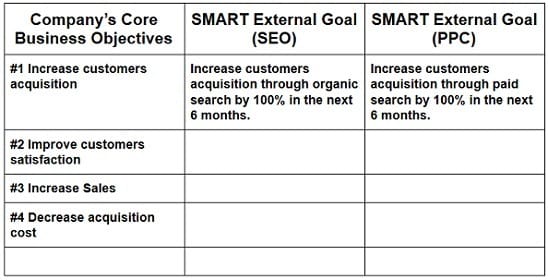
External goals should be department/function specific.
For example, if you work as an SEO, your external goal is to increase customer acquisition and decrease customer acquisition costs through ‘Search Engine Optimization’.
Similarly, if you manage PPC campaigns, your external goal is to increase customer acquisition and decrease customer acquisition costs through ‘Paid Search Optimization’.
Whatever you choose as an external goal, make sure that it is always directly tied to achieving the company’s core business goals.
Business owners/senior-most management and department heads must be involved in setting up, approving and monitoring SMARTER external goals.
How do you create an alignment between your external goals and business goals?
Break down each core business goal into several smaller goals called the ‘external goals’. That’s how you create an alignment between your external goals and business goals.
So whenever you achieve one of your external goals, you get one step closer to achieving your corresponding business goal.
What is an external KPI?
An external KPI (also known as low-level KPI) is the KPI set up to measure an external goal’s performance.
An external KPI is one of the most important indicators of the current performance level of the team /department in achieving external goals.
An external KPI is also known as a department/function/team specific KPI.
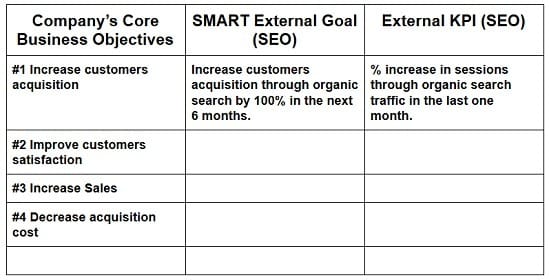
External KPIs are set at the department/team/function level and focus on measuring the overall performance of a department/team.
External KPIs are tied to external goals and determine how you or your team/department are performing in achieving external goals. These are the KPIs we generally report to clients/senior management.
Whenever we talk about KPIs in general, we refer to external KPIs.
Following are examples of different categories of external KPIs:
- Sales KPIs
- Marketing KPIs
- Financial KPIs
- Customer Support KPIs etc
Examples of sales KPIs: Monthly sales growth, customer turnover rate, shopping cart abandonment rate, average order value, average purchase value, average conversion time.
Examples of marketing KPIs: Sales-accepted leads (SAL), net promoter score, retention rate, marketing qualified leads (MQL), sales qualified leads (SQL).
Examples of financial KPIs: Net profit margin, current ratio, accounts payable turnover, budget variance, vendor expenses, financial error output, return on equity, resource utilization.
Examples of customer KPIs: Service renewal rate, number of customer testimonials, service level agreement (SLA) failures.
Examples of project management KPIs: Planned value, actual cost, earned value, schedule variance, cost per index(CPI), return on investment.
Examples of service KPIs: Utilization rate, attention/retention, employee health index, employee satisfaction score, profit margin, employee engagement score.
Note: Business owners/senior-most management and department heads must be involved in setting up, approving and monitoring external KPIs.
How to ensure a metric can be used as an external KPI
The metric you choose as an External KPI must highly impact the corresponding external goal.
This is possible only when your chosen KPI can provide recommendation(s) for action, which can highly impact your external goal.
As the value of your external KPI increases or decreases, there should be a corresponding positive or negative impact on the external goal, and this impact should be significant.
For example, if one of your external goals is to improve website sales, you can use ‘Average Order Value’ as an external KPI because it can highly impact website sales.
You can greatly increase website sales at the present conversion rate just by increasing the size of the orders.
Why external goals and their corresponding external KPIs must be shared
The external goals and their corresponding external KPIs must be shared across your team/department so that everyone is aware of what their team/department is trying to achieve.
This will help the individuals within your team/department set up goals and KPIs that align with external KPIs.
Everyone in the team/department must be pushing towards the same team/department goals. This is the only way to ensure maximum productivity and profitability.
And this can happen only when the external goals and their corresponding KPIs are shared across the team/department.
What are internal goals?
The internal goals are the goals directly tied to achieving optimization objectives. They may or may not be directly tied to your core business goals.
For example, if you are running an SEO campaign, your internal goal could be to improve the quality of your outreach emails to earn more high-quality backlinks for your website.
This, in turn, can increase the organic search traffic on your website.
If you work in SEO, improving your outreach emails’ quality cannot be your external goal.
That is because improving the quality of email outreach can never really be a core goal of any business (unless that’s all they do).
How to find internal goals
You can find your internal goals through ‘Key Performance Questions’.
Individuals who directly work on optimization tasks must be involved in setting up and monitoring SMARTER internal goals.
Your internal goal must be SMARTER (i.e. SMARTER internal goal). Your ‘key performance questions must help you set up SMARTER internal goals.
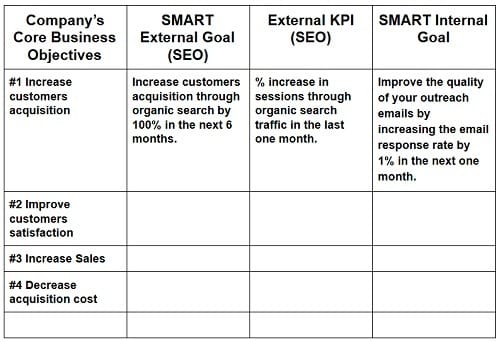
How do you create an alignment between your external and internal goals?
Break down each external goal into several smaller goals called the ‘Internal Goals’. That’s how you create an alignment between your external goals and internal goals.
So whenever you achieve one of your internal goals, you get one step closer to achieving your corresponding external goal.
For example, for the external goal ‘Acquire Customers through organic search traffic‘, the following can be your internal goals:
- Increase organic search traffic
- Increase the quality of your email outreach
- Fix website crawlability and indexing issues.
Why the alignment between external and internal goals is the key to success?
Each employee/team/department needs to have both external and internal goals and there needs to be an alignment between their goals.
Only then will they be in a position to achieve the core business objectives within the area of their responsibility and expertise, and that too in the most efficient manner.
Let us look at the internal and external goals of an SEO guy.
External goal – Increase customer acquisition and decrease customer acquisition cost through ‘Search Engine Optimization.
Internal goal – Improve the quality of outreach emails
Now, once the SEO improves his outreach emails’ quality, he can earn more high-quality backlinks for his website.
Which in turn can increase the organic search traffic of his website and which in turn can increase customer acquisition and decrease customer acquisition cost through ‘Search Engine Optimization.
Thus there is a clear alignment between the SEO’s external and internal goals. Our SEO guy knows exactly how his day to day work activities impact the business bottom line.
Unfortunately, this is not the case with many companies where employees/managers have difficulty understanding how they add ‘value’ to the business bottom-line and whether what they are currently doing is worth the time and investment.
By aligning/re-aligning your external and internal goals on a daily/weekly basis, you and your team can stay focused and productive and achieve the organizational goals (core business objectives) in the most effective manner.
But all of this can happen only when you share: Core business objectives, Business KPIs, External goals and External KPIs across your organization.
So this type of sharing and openness is very important.
What is an internal KPI?
An internal KPI (also known as low-level KPI) is the KPI set up to measure an internal goal’s performance.
An Internal KPI is one of the most important indicators of the current performance level of an individual in achieving internal goals.
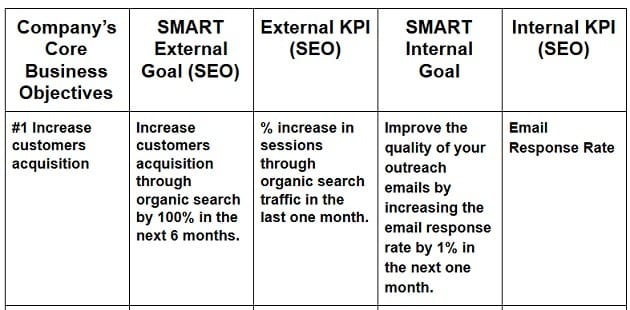
Internal KPIs are tied to internal goals and measure optimization efforts. They may or may not be directly tied to core business objectives.
These KPIs are internally used by team members to measure and optimize their marketing campaigns’ performance. They are not always reported to clients/boss/senior management.
For example, the following KPIs can be used to measure your link building outreach campaigns:
- Delivery Rate
- Open Rate
- Response rate
- Conversion Rate of outreach
- ROI of outreach
Often marketers make this terrible mistake of reporting internal KPIs to clients/senior management.
For example, ‘bounce rate’ is a good internal KPI for optimizing landing pages. But it is not something which you will report to a CEO.
We only report high business bottom-line impacting KPIs to senior management.
Related Article: How to become Champion in Data Reporting
How to ensure a metric can be used as an internal KPI
The metric you choose as an Internal KPI must highly impact the corresponding internal goal.
This is possible only when your chosen KPI can provide recommendation(s) for action, which can highly impact your internal goal.
As the value of your internal KPI increases or decreases, there should be a corresponding positive or negative impact on the internal goal, and this impact should be significant.
For example, if one of your internal goals is to improve the quality of your outreach emails, you can then choose ‘response rate’ as an internal KPI.
Note(1): Internal KPIs do not need to impact the business bottom line.
Note(2): External KPIs can also be used as internal KPIs. There is no hard and fast rule here.
Individuals who directly work on optimization tasks must be involved in setting up and monitoring internal KPIs.
Note: External KPIs can also be used as internal KPIs. There is no hard and fast rule here.
What is a quantitative KPI?
A quantitative KPI is the KPI set up for measuring the quantity. These are always represented in numbers or ratios. For example, pageviews, unique visitors, new users.
What is a qualitative KPI?
A qualitative KPI is the KPI set up to measure a process’s descriptive characteristics or a business decision. These are not measured in numbers. Examples of qualitative KPIs include customer satisfaction, opinions, properties, and traits.
What is a leading KPI?
A leading KPI is the KPI set up for measuring the future performance level of an individual, department and/or company in achieving goals. Through leading KPIs you can determine where you are heading.
Leading KPIs can help in taking corrective actions early.
What is a lagging KPI?
A lagging KPI is the KPI set up for measuring the past and current performance level of an individual, department and/or company in achieving goals.
Whenever we are talking about KPIs in general, we refer to lagging KPIs.
How should an organization use KPIs?
An organization should use KPIs at multiple levels (organizational level, department level, individual level).
Remember the top-down approach in setting up goals and KPIs
Before setting up internal goals, you need to know your external goals.
Before setting up external goals, you need to know your core business goals.
Before setting up core business goals, you need to have mission and vision statements and well-defined core values.
The strategic direction needs to come from the top management.
If the captain (aka your CEO) is not sure to which port his ship (aka company) should sail then the sailors (aka employees) can’t help him, no matter how good they are as an individual or team.
Similarly,
Before setting up internal KPIs, you need to know your external KPIs.
Before setting up external KPIs, you need to know your business KPIs.
Before setting up business KPIs, you need to know your core business goals and the strategies to achieve those business goals.
The strategic direction needs to come from the top management.
What is a KPI dashboard?
A KPI dashboard is used to present your KPI analysis to decision-makers. It is a medium of communicating your insight from KPIs to key stakeholders so that they can make data-informed business and marketing decisions.
Dashboards are used to create ‘changes’ within your company. Therefore it is important for a dashboard to recommend great actions.
There are two types of KPI dashboards:
#1 Tactical (operational) KPI dashboards
#2 Strategic KPI dashboards
What is a tactical KPI dashboard?
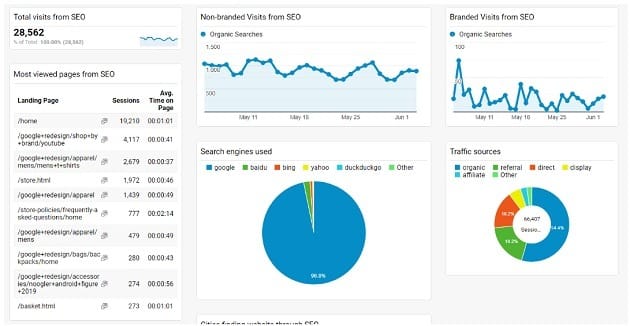
The goal of a tactical KPI dashboard is to help team leaders better understand the performance of their team/department/function.
We can create tactical dashboards for the SEO team, PPC team, affiliate marketing team, social media team, etc. A tactical dashboard is used to present the analysis of your external KPIs to decision-makers.
Such dashboards are created to show aggregated/segmented data and are often created via a web analytics tool like ‘Google Analytics’.
There isn’t a lot of context or explanation of insights, etc. In such dashboards, the people for which these dashboards are built already understand what they are doing.
So when a web analyst gives them a tactical dashboard, they know exactly how to interpret the data, what conclusions to draw, and what actions to take.
Following is an example of a tactical KPI dashboard:
What is a strategic KPI dashboard?
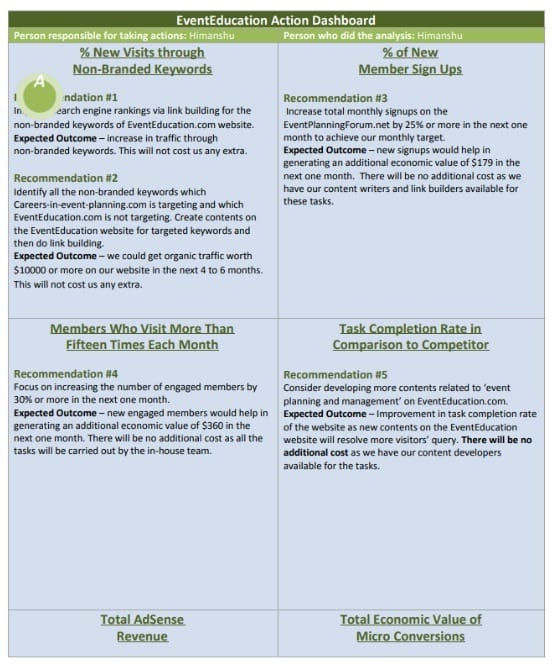
A strategic KPI dashboard aims to help key stakeholders (often top management executives) better understand the performance of their core business objectives.
A strategic dashboard is used to present the analysis of business KPIs to key decision-makers.
Such dashboards are NOT created to show aggregated/segmented data and are NOT usually created via a web analytics tool like ‘Google Analytics’.
There is a lot of context or explanation of insights, etc. The people for which these dashboards are built in do not know exactly how to interpret the data and what conclusions to draw.
Following is an example of a strategic KPI dashboard:
Checklist for designing a strategic KPI dashboard
#1 Segment your KPIs before you present them. The segmentation also improves its measurement.
#2 Don’t just rely on Google Analytics to find KPIs. Also, use other data sources.
#3 Show key trends and insights (first in words and then in graphical format). Use a date range of at least three months, or even better, six months. Remember, two months don’t make a data trend.
#4 Show which KPI is up or down.
#5 Describe the impact of the KPI on the company’s bottomline.
#6 Recommend actions that impact the business bottomline.
#7 Skip lame KPIs. For example, do not use the bounce rate as KPI. This is because it does not correlate well with conversions. Use the bounce rate as a diagnostic metric.
#8 Remove the cluttering of metrics from your dashboard. Present only those relevant metrics in your reports which are meaningful to your decision-makers. Don’t do data puking.
#9 As a web analyst, the only conclusion drawn from your KPI analysis should not be to do more analysis. You should not say ‘do more analysis’ in your recommendations because it is your job.
#10 Include recommendations in your KPI analysis. An analysis without solid recommendations is just data puking. It has no commercial value.
How to make solid recommendations:
- If we do this, then we should get that.
- The company should do ‘X’, which will cost ‘y’ but could bring additional revenue ‘z’.
- Include surprises in your recommendations. If some of your recommendations do not surprise you, you haven’t done enough analysis.
- Compute the impact of each of your recommendations on the business bottomline in monetary terms.
- Prioritize your list of recommendations based on their impact on the business bottomline.
- Recommendations must be about changing things about the website, campaigns, strategies, etc.
- The recommendation should not be to do more analysis.
- If you want senior management to implement your recommendations, you must show the expected outcomes.
- Compute and show the cost of delaying in implementing the recommendations.
Recommendations:
1st Priority: ……………………..
Cost of delaying the implementation: 1-month delay can result in $___ of lost revenue.
2nd Priority: ……………………..
Cost of delaying the implementation: a one-month delay can result in $____ of lost revenue.
3rd Priority: ……………………..
Cost of delaying the implementation: a one-month delay can result in $____ of lost revenue.
#11 Design your dashboards with your target audience in mind. Don’t make the insight obvious. Spell it out.
#12 Wherever possible, present all the data in bulleted points (use numbered list).
#13 Add annotation and graphic elements to your reports, tables, and graphs (like arrows, brackets, etc.).
#14 Always format the data in your tables. Make your data tables easy to read.
Table formatting tips
- Use conditional formatting to highlight data trends.
- Use callouts in your formatted table
- Insert rectangles to drive attention to your data.
- Use numbered list
- Use colours
#15 Don’t jump to conclusions in your reports. Base your recommendations based on analysis.
#16 Try to use at least one competitor in your analysis. Decision-makers usually pay great attention to what their competitors are doing and are more likely to consider your recommendation if their competitors are already executing it.
#17 Don’t repeat what one can easily find through graphs and charts.
#18 Avoid using screenshots from Google Analytics reports for your strategic dashboard. Most of the time, they are just data puke.
#19 Don’t fake data if you don’t have one. Don’t make numbers out of thin air.
#20 Don’t select KPIs just to impress your decision makers or just because they are popular in your industry.
#21 Decide in advance how you want to present your data. Decide what you want to highlight. Your agenda.
#22 Your summary dashboard should fit into a single page, and it should summarize all your analysis and provide recommendations. Assume the executives read only this. So make sure it conveys everything of importance and yet can be read quickly and easily.
#23 Dashboards created in Google Analytics can become data puke very quickly. So be cautious when you use the G.A. dashboards for your KPI analysis.
#24 Your dashboard should show ‘Acquisition’, ‘Behaviour’, and ‘outcomes’. Organize your dashboards into three columns: acquisition, behavior, and outcomes.
#25 The data you present on the dashboard must help understand the acquisition, behavior, and outcomes.
#26 If you can’t organize a dashboard created for each KPI into acquisition, behavior, and outcomes, make sure that you have some KPI dashboards that cover acquisition, some KPI dashboards that cover ‘behavior’ and some dashboards that cover ‘outcomes’.
#27 The actual number of slides/KPI dashboards in each category (acquisition, behavior, and outcomes) would depend upon your ‘Web Analytics Measurement Model’.
#28 Whenever you do competitive analysis, always compare it with your business. Comparisons ads ‘context’. Never present data without comparison.
#29 If your analysis doesn’t include recommendations, it is not an analysis.
#30 If your data involves ‘low numbers, ’ then don’t include them in your analysis. Avoid reporting such data as it is unlikely to be statistically significant.
#31 Include at least one competitive KPI in your ‘web analytics measurement model’.
#32 Show segmentation and distribution using the ‘average’ metric as KPI.
#33 Avoid using compound metrics.
#34 Figure out in advance that the analysis which you are planning to do is worth doing in the first place.
#35 Your KPI analysis should include:
- Clickstream analysis (what)
- Outcome analysis (how much)
- Voice of customer analysis, experimentation, and testing (why)
- Competitive analysis (underperforming, outperforming, opportunities you are missing)
#36 Use multiple analytics tools in your analysis to execute the ‘strategy of multiplicity’.
#37 If your written or spoken words repeat what is mentioned in the graphs and tables, then it means ‘analysis’ is missing and only ‘reporting’ has been done.
#38 When you do competitive analysis and draw trends, use at least six months of data.
#39 Use Visual Clues (like small coloured triangles) to show how to read the report.
#40 Write your commentary on what the reports tell your decision-makers. Your commentary is more important than your graphs.
#41 If, after completing the analysis, you have no good recommendations, then this is your hint that you may have chosen a weak business goal or KPI. You should now amend your WAMM (Web analytics measurement model) and begin your analysis again.
#42 Dashboards are not reports. Since they are not reports, you can’t leave the interpretation of the data to executives.
#43 Your dashboard should be one page and readable. It should fit in one A4 size piece of paper.
#44 At least once a quarter, you should re-visit your dashboard. Figure out what is working, determine what is not working, and then learn to kill metrics.
#45 Dashboards have to be living, breathing things.
Examples of good KPIs
#1 Gross Profit.
It is the profit after production and manufacturing costs.
Gross Profit = Sales – Direct Cost.
A direct cost can be something like the cost of manufacturing a product
#2 Gross Profit Margin.
It is used to determine the effectiveness of your business in keeping production costs in control.
Gross Profit Margin = (Gross Profit/ Sales) * 100
The higher the gross profit margin, the more the money is left over for operating expenses and net profit.
#3 Operating Profit.
It is the profit before interest and taxes.
Operating Profit = Sales – Operating Cost.
Operating cost is the ongoing cost of running a business, product or system. It can include both direct and indirect costs.
#4 Operating Profit Margin.
It is used to determine the effectiveness of your business in keeping operating costs in control.
Operating Profit Margin = (Operating Profit/ Sales) * 100
The higher the operating profit margin, the more the money is left over for net profit.
#5 Net Profit.
Also known as net income, net earnings, bottom-line. It is the profit after interest and taxes
Net Profit = Sales – Total cost (this includes any direct and indirect cost + interest + taxes)
#6 Net Profit Margin.
Also known as profit margin, net margin, net profit ratio. It is used to determine the effectiveness of your business in converting sales into profit.
Net Profit Margin = (Net Profit/ Sales) * 100
A low profit margin indicates a higher risk that a decline in sales will erase the profit and result in a net loss.
#7 Sales Growth Rate.
Also known as the revenue growth rate. It measures the percentage increase in sales between two time periods.
Revenue Growth Rate = (Current month’s Sales – Last month’s Sales) / (Last month’s Sales) * 100
#8 Total Economic Value.
The total value added by your product/service/campaigns to the business bottom line.
Total Economic Value = Total Sales + Total value of the assisting conversions + Total value of the last click conversions
The ‘total economic value’ also considers the role played by micro conversions and conversions, which assisted and completed the sales.
#9 Return on Investment (ROI).
It is used to evaluate the efficiency of your investment or to compare the efficiency of different investments.
ROI= (Gain from investment – cost of investment)/cost of investment
#10 Return on Ad Spend (ROAS).
It is used to evaluate the efficiency of investment in an ad campaign.
ROAS = (Sales from investment – cost of investment)/cost of investment
ROAS is different from ROI because it takes only ad cost into account. In contrast, ROI takes total cost into account.
#10 Net Promoter Score.
Net Promoter Score tells you how likely it is that your customers will recommend your business to a friend or colleague.
To calculate the net promoter score, ask your customers the following question:
“ On the scale of 1 to 10, how likely is it, that you would recommend our business to your friend or colleague”
Group the respondents into the following three categories, on the basis of their score:
#1 Promoters – customers who gave you a score of 9 or 10. These are the customers who are most likely to recommend your business.
#2 Passives – customers who gave you a score of 7 or 8. These customers are satisfied but not very keen to recommend your business.
#3 Detractors – customers who score your business 0 to 6. These customers have the potential to damage your brand, through negative feedback/reviews.
Net promoter score = % of promoters – % of detractors
To learn more about net promoter score, check out this article: https://www.netpromoter.com/know/
#11 Customer Lifetime Value
The customer lifetime value is the projected revenue (repeat business) a customer will generate during their lifetime.
Following is the formula to calculate customer lifetime value:
(Average order value) X (Number of Repeat Transactions) X (Average customer lifespan in months/years)
Average customer lifespan means how long they remain your customer. The life span can be measured in number of days, weeks, months, or years.
Different types of customers have different lifetime values (LTV).
One of the best ways to boost LTV is by improving customer satisfaction and retention.
With ever-increasing competition and market saturation, customer acquisition is becoming more and more difficult, and expensive.
Therefore, it has become more important than ever, to focus on acquiring only the best customers, the ones which are profitable, both in the short term and long term.
In the context of acquisition, the ‘customer lifetime value’ metric is very important, as it helps in truly understanding and optimizing the performance of your acquisition strategy.
#12 Customer Retention Rate.
The Customer Retention Rate is used to determine how good your business is in retaining customers.
Customer Retention Rate = [1- (Customers lost in a given time period/total number of customers acquired in the same time period)] * 100
The shorter your product lifespan/sales cycle, the more meaningful, customer retention rate becomes.
For example,
If you sell Fast Moving Consumer Goods, you would expect your customers to shop frequently. For that to happen, you need to make sure your customers stick around with you.
On the other hand, the longer your product lifespan or sales cycle, the less meaningful, the customer retention rate becomes.
For example, if you sell swimming pools, you won’t expect your customer to return any time soon. So there is no point in spending time and money on improving customer retention rates.
Customer retention rate is very important for businesses that sell services, and who expect repeat business from the same client. This metric is also useful for SAAS businesses.
You can increase customer retention rate by:
- Constantly being in touch with your customers through social media, newsletters, blogs, etc, with the aim to keep them engaged and happy.
- By providing outstanding after-sales service.
- By developing loyalty and reward programs.
- By building a highly personalized customer experience.
- By providing patronage discounts and offers (the ones which are available only to existing customers).
- Through remarketing campaigns.
#13 Customer Profitability Score.
The Customer Profitability score is used to separate profitable customers from unprofitable customers and is a much more important metric than ‘lifetime value’, as it takes ‘cost’ into account.
You can calculate this score for each individual customer or for each individual customer’s persona.
Customer profitability score = Revenue earned through the customer in a given time period + Projected revenue the customer will generate during their lifetime (LTV value) – Average cost of acquiring a customer (CPA) – Average cost associated with customer’s management, retention or service during their lifetime.
Note: Instead of average costs, you can also separately calculate and use the ‘total cost’ associated with each individual customer. But I don’t find that very practical, especially for a large number of customers.
You need to calculate and monitor customer profitability scores at least once a month, as it may increase or decrease over time.
For example,
If there is a sharp increase in the cost associated with customer management, your profitability score will decrease over time. This is especially true in the case of the service industry and SAAS businesses.
Your customer profitability score can also go down to the point, where your customer is no longer profitable for you, as the cost associated with customer’s management, retention or service has exceeded (or is projected to exceed) far more than the sum of ‘Revenue earned through the customer so far’ and his lifetime value.
Therefore, it is critical that you calculate and monitor the customer profitability score for each individual customer or customer persona, esp. if you are in the service industry or run a subscription-based ecommerce business.
#14 Cost Per Lead.
It is the average cost of generating a lead.
Cost per lead = total cost/total leads
#15 Cost Per Acquisition (CPA).
CPA is the average initial cost of acquiring a customer or generating a conversion.
Cost per acquisition = total initial cost of acquiring customers / total unique customers acquired in a given time period.
The CPA decreases over time, once the customer starts making repeat purchases.
So in order to determine your true cost per acquisition, you need to calculate the customer’s lifetime value.
Related Article: CPA optimization – How to reduce cost per acquisition.
#16 Revenue Per Acquisition.
It is the average revenue earned through an acquisition.
Revenue Per Acquisition = Total Sales / Total acquisitions
#17 Per Visit Value.
It is the average value of a visit to your website.
Per Visit Value = Total Sales / Total Visits
#18 Goal Conversion Rate.
It is the percentage of visits that result in goal conversions.
Goal Conversion Rate = (Total Goal conversions / total visits) *100
#19 Ecommerce Conversion Rate.
It is the percentage of visits that result in ecommerce transactions.
Ecommerce Conversion Rate = (Total E-commerce transactions/ total visits) *100
#20 Average Order Value.
It is the average value of an ecommerce transaction. Through this metric, you can measure how effective your upselling and cross-selling efforts are and whether you are helping people find the product they are looking for.
Average order value = Total Revenue/Total ecommerce transactions
#21 Task Completion Rate.
The percentage of people who came to your website and answered ‘yes’ to this survey question: “Were you able to complete the task for which you came to the website?”
Task completion rate = (number of people said ‘yes’ to the survey question/ Total number of survey responses) *100
#22 EPS (earnings per share).
EPS stands for earnings per share. It is the indicator of a company’s profitability.
The higher the EPS, the more profitable the company is to investors.
Since EPS measures the company’s profitability, a negative EPS means the company is not profitable for investors.
Earnings per share is quite meaningless if analyzed on its own. Although the higher the number, the better for shareholders themselves.
EPS is most useful as a comparison metric.
EPS is generally considered the single most important variable in determining a share’s price.
Formula to calculate EPS:
Net Earnings / average number of Outstanding Shares
For example,
Company A had earnings of $100 million and 10 million shares outstanding, which equals an EPS of 10 ($100 Million / 10 Million = 10).
Company B had earnings of $100 million and 50 million shares outstanding, which equals an EPS of 2 ($100 Million / 50 Million = 2).
So, Company ‘A’ seems to be more profitable to investors.
Types of EPS
#1 Trailing EPS – previous year’s EPS and the only actual EPS. It is often compared with the current EPS
#2 Current EPS – is the current year’s EPS.
#3 Forward EPS – is a forecast of what the EPS might be in the future.
Note: Most recorded and quoted EPS values are trailing.
#23 Price to Earnings Ratio (P/E).
The Price to Earnings Ratio gives you an idea of what the market is willing to pay for the company’s earnings.
The higher the P/E, the more the market is willing to pay for the company’s earnings.
P/E metric is quite meaningless if analyzed on its own. Although the higher the number, the better for shareholders themselves.
P/E is most useful as a comparison metric.
Formula to calculate P/E – Current Stock Price/EPS
For example, a company with a share price of $40 and an EPS of $8 would have a P/E of 5 ($40 / 8 = 5).
Note: Companies that are losing money do not have a P/E ratio.
There is virtually no limit to the number of good KPIs you can find and use. It all depends upon the nature of the business and the industry you work in, and your goals.
For example, if you work in an industry where the majority/all of the conversions happen offline via phone calls, you can use ‘Phone Calls’ as your KPI.
#24 Recovered Revenue.
Recovered revenue is the amount of revenue you recovered from checkout or trial abandonment. The sales recovered through remarketing are called ‘recovered revenue’.
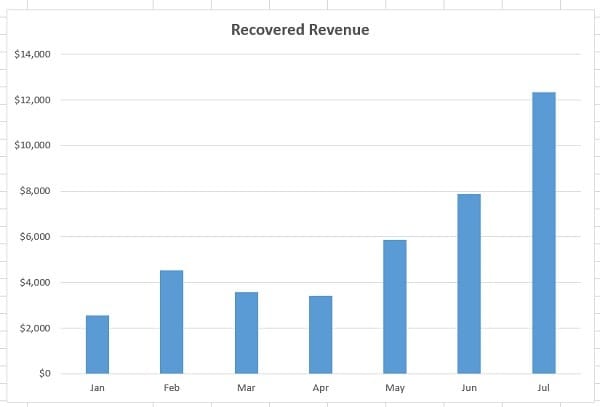
Around 80% of your potential clients will abandon the checkout today. This is inevitable. So you need to be mentally prepared to deal with checkout abandonments.
But how would you know whether your checkout abandonment efforts are a success or failure?
In the checkout abandonment world, “recovered revenue” is a powerful KPI and is monitored and reported just like regular sales. So how much revenue have you recovered in the last month?
Most businesses do not focus on increasing their recovered revenue (which is a very important KPI) and therefore tend to have a poor website conversion rate.
#25 Customer sales cycle length.
Custom sales cycle length is the average time (measured in days, weeks, months, and sometimes years) it takes, for a person/website visitor, to turn into your customer.
Customer sales cycle length can vary greatly, among products, services, businesses, and industries.
Some purchases (like buying a car/house) require much more consideration and research than other purchases (like buying a pint of milk).
However, by shortening your sales cycle, you can greatly reduce your cost per acquisition and can also increase customer lifetime value and profitability score.
One of the best ways to shorten the sales cycle is by focusing only on acquiring high-value customers, the ones most profitable and the ones most likely to convert.
Not all prospects will turn into customers.
So it is important that you focus on streamlining your “qualified customer’ criteria and disqualify low-value customers, as early as possible, in your sales process.
Remember, low-value customers, the ones who don’t understand the value of your product/service, the ones who are hard to please, the ones who don’t believe in your solution, are also the ones who ask a lot more questions, required a lot more convincing, demand discounts, trials, take a long time to make a purchase decision and are thus, also the ones, who create long sales cycle.
These low-value customers not only create a long sales cycle, but they also increase your customer acquisition and ongoing customer management cost.
They may add value to your business in the short term (through increased sales) but they are least likely to stick around, least likely to promote your brand and are also least likely to be profitable in the long run.
#26 Customer Return Rate.
The Customer Return Rate is the rate at which customers return to your website/business to make a purchase in a given time period.
Customers return rate = Total number of customers that have placed more the one order (transaction) in a given time period / Total number of unique customers acquired during the same time period.
For example,
If 150 customers placed more than one order in the last one month, and you acquired 500 unique customers during that month then
Customers Returning Rate = 150 / 500 * 100 = 30%
You can improve customers’ return rate by running remarketing campaigns.
The shorter your product lifespan, the more meaningful, the customers’ returning rate becomes.
For example, if you sell Fast Moving Consumer Goods (like milk, vegetables, alcohol, etc), you would expect your customers to shop very frequently.
On the other hand, if your product life is long, like you sell cars or furniture, you can’t expect your customers to return every month or even every year to make a purchase.
#27 Purchase frequency.
The Purchase Frequency is the rate at which customers make a purchase on your website in a given time period.
Purchase frequency = total orders placed in a given time period / total unique customers acquired during the same time period.
For example, if 1000 orders were placed in the last one month and you acquired 500 unique customers during that month then,
Purchase frequency = 1000 / 500 = 2
You can increase purchase frequency by:
- Creating and promoting limited-time offers through remarketing campaigns.
- Frequently engaging with your customers on social media and via newsletters.
- Developing loyalty and rewards programs.
#28 Monthly Recurring Revenue (MRR).
MRR is the total revenue a company expects to generate on a monthly basis.
MRR is a very important metric for measuring the growth of a SAAS company. If you are a SAAS business, you should aim to increase your MRR over time.
Monthly Recurring Revenue = total number of paying subscribers X average order value
You can increase MRR by reducing customer churn rate and by increasing average order value. You can increase average order value by selling upgrades to existing customers
Note: You can also calculate MRR for non-subscription based ecommerce businesses.
#29 Customers churn rate.
Customers churn rate (also called attrition rate) is the percentage of customers lost in a given time period.
It is used to determine how good your business/product/service is at retaining customers. The lower the customer churn rate, the better it is, for your business health.
Customers churn rate = number of customers lost during a given time period / total number of customers you had at the beginning of the same time period.
For example, if your company had 250 customers at the beginning of the last month and 170 of those customers remained with your business, at the end of the last month, then your
Customer churn rate = (250 – 170) / 250 = 0.32 or 32%
Note: The Customers churn rate calculation does not take into account the number of new customers acquired in a given time period. It only takes into account the existing customers in a given time period.
#30 MRR churn rate.
Monthly recurring revenue churn rate or MRR churn rate is the percentage of monthly recurring revenue lost.
MRR churn rate = ( (MRR at the beginning of a month – MRR at the end of the month) – additional revenue from existing subscribers) ) / MRR at the beginning of the month
Note: In MRR churn rate calculation, you do not take into account, additional revenue generated in a given time period from existing subscribers. This additional revenue can come in the form of upgrades or some other up-sell/cross-sell.
For example, if your:
MRR at the beginning of the last month was: $50,000
MRR at the end of the last month was: $40,000
Additional revenue from existing subscribers was: $1000
Then:
MRR churn rate = ( ($50,000 – $40,000) – $1000)) / $50,000 = 18%
Note: If the churn rate turned out to be negative, then it means you actually gained MRR. You can also calculate MRR for non-subscription based businesses. However, the calculation is going to be different.
Top 10 KPIs for SEO
Have you ever wondered which are the most important internal KPIs you should be tracking for SEO or any other online marketing campaign?
The internal KPIs are internally used by team members to measure and optimise the performance of marketing campaigns and are not always reported to clients/boss/senior management.
If you look at the Google Analytics report today, they have got tons of metrics for each dimension from: ‘sessions’, ‘page views’ to ‘sessions with search’, ‘average page load time’…….zzzzzzzzz.
All of these metrics could make reading GA reports a headache.
To make my life a bit easy, I track only three things for any dimension, and I don’t track many dimensions either.
A dimension is a characteristic of your website visitor.
E.g. for a visitor from New York City who arrived on your website via an organic search term, say ‘best outdoor clothing’ on Google, the dimensions are: ‘city’, ‘region’, ‘country’, ‘keyword’ and source/medium.
To learn more about dimensions read this article: Google Analytics dimensions and metrics
These dimensions characterise the visitor, and that is how Google Analytics reports about a user/visitor to your website.
For any online marketing campaign, you would be interested in knowing three things:
- How the campaign has performed or is performing?
- How people who came to your website are consuming the contents?
- How are people engaging with your content?
Internal KPIs to track SEO campaign performance/outcomes
- Sessions/visits – As an SEO you would definitely want to know how much traffic is coming from a dimension/source.
- Goal completions – Total no. of goal conversions you have got.
- Revenue – If you run an e-commerce website you would definitely want to know which traffic source is generating revenue.
- Goal conversion rate – It is the percentage of visits that result in goal conversions.
- E-commerce conversion rate – It is the percentage of visits that result in an e-commerce transaction.
Internal KPIs to track content consumption
- Pageviews
- Avg. time on site/page
- Bounce rate/bounces
Internal KPIs to measure visitor engagement
- Pages/session
- Unique social actions
These are the ten metrics you need to quickly and accurately track the performance of any traffic source or dimension.
Now I will create a custom report which includes all of these metrics.
To create this custom report, use the following specifications:
Primary Dimension: Source/medium
Metric: Sessions, goal completions, revenue, goal conversion rate, e-commerce conversion rate, pageviews, avg.time on site, bounce rate, pages/session, and unique social actions.
Please note: To track unique social actions, you need to implement social interaction tracking on your website.
Other Articles on KPIs
- 7 Powerful KPIs to Measure your Link Building Outreach
- Top 20 reasons why people misinterpret data and reports

Related Articles.
- Best Types of Charts in Excel for Data Analysis, Presentation and Reporting.
- KPI Meaning, Examples, Calculation & Dashboard Tutorial.
- Understanding A/B Testing Statistics to get REAL Lift in Conversions.
- Web Analytics Career Path – How to Become a Web Analyst.
- How to calculate maximum CPA and profitable ROAS.
- Bare Minimum Statistics for Web Analytics.
- Predictive Analytics & Marketing – The Next Stage of Business Optimization.