

Data Storytelling is a mechanism used for sharing ‘knowledge’ in the most engaging, memorable, and persuasive way possible.
In the context of data analysis, ‘knowledge’ is that information that has the potential to drive changes within an organization. ‘Knowledge’ can be: ‘hindsight’, ‘insight’ and ‘foresight’
The objective of storytelling is to share the knowledge you have acquired via data analysis with the decision-makers and get your recommendations implemented in a timely manner.
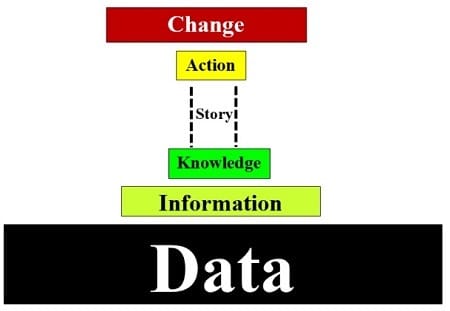
‘Data’ is a set of observations (facts, figures) that have not been organized, processed, and interpreted.
Once the data is organized, processed, and interpreted it becomes useful and meaningful. This useful and meaningful data is called ‘information’.
Web analytics reports are choke-full of information. However, not every piece of information has the potential to drive changes within an organization and improve the business bottomline.
When the information has the potential to drive changes within an organization it becomes ‘knowledge’.
A data analyst shares this knowledge with the decision-makers so that they take ‘action’ and help in driving ‘changes’ within an organization.
However, decision-makers will act on the shared knowledge only if they understand it, see business value in implementing it and understand the cost of delaying the implementation.
This is the area where most data analysts fail miserably and you often hear stories like:
150 Data Scientists and still no business value
Data analysts share the knowledge they have discovered, using data and visuals (like graphs, charts, and dashboards). They often fail to include ‘narrative’.
Without ‘narrative’ (your own commentary) the data and visuals are often misunderstood or not understood. And when the knowledge you are trying to share is not understood, no actions are taken and no changes occur.
This is where a ‘data story’ comes into the picture.
When you add ‘narrative’ to ‘data’ and ‘visuals’ it becomes a ‘data story’.
In order for your data reporting to be effective, 65% of your data story should be made up of ‘narrative’ and only 25% include ‘data’ and ‘visuals’. The rest 10% is the level of credibility you possess:
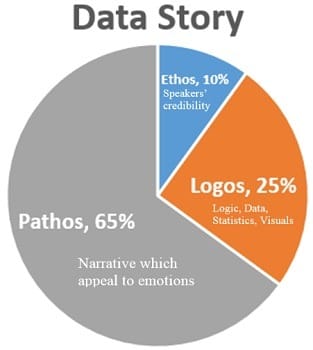
Many data analysts do the opposite. 60 to 70% of their data story is made up of ‘data’ and ‘visuals’ and only 30% include ‘narrative’ (if any).
The pie chart that you see above is based on Aristotle’s three modes of persuasion: Ethos, Pathos & Logos and the result of the analysis done by ‘Carmine Gallo’ on Bryan Stevenson’s famous Ted talk ‘We need to talk about an injustice’ for which he received the longest standing ovation in the history of TED conference and managed to receive a donation of $1 million for his non-profit from the conference attendees.
According to Carmine’s calculations, Bryan Stevenson’s presentation was worth $55,000 A Minute. You can read more about this study here: Public Speaking Payoff: The Presentation Worth $55,000 A Minute
Aristotle’s three modes of persuasion are:
- Ethos – the credibility of the speaker.
- Pathos – the act of appealing to emotions.
- Logos – means of persuasion through logic, data, and statistics.
Out of these three modes of persuasion, ‘pathos’ is the most difficult mode. You need a high level of ‘emotional intelligence’ in order to appeal to the emotions of the people.
“Emotional intelligence (EI) is the capability of individuals to recognize their own, and other people’s emotions, to discern between different feelings and label them appropriately, to use emotional information to guide thinking and behavior, and to manage and/or adjust emotions to adapt environments or achieve one’s goal(s)”
Source: https://en.wikipedia.org/wiki/Emotional_intelligence
Unfortunately, many data analysts/scientists lack ‘emotional intelligence’. They believe just presenting the raw statistics and logic would do the trick and get their recommendations implemented. But neuroscientists have proved time and again that people make decisions based on emotions and not logic.
So unless your narrative does not appeal to the emotions of your decision-makers, it is not going to be effective.
Presenting ‘data’ and ‘visuals’ is often the easy part of data reporting. Presenting the narrative is the hard bit. If your ‘narrative’ is not engaging, memorable, and persuasive then it will not drive changes and you won’t be able to deliver any business value through your analysis.
In order to drive changes, you need to work on delivering your narrative.
You can make your narrative engaging by introducing and using real-life/fictitious characters (like: ‘Sarah’ or ‘John’) and by creating a plot. Like we normally do, when we tell a story to a child.
The only difference here is that you are not telling a ‘bedtime story’. Your story needs to be believable. Your objective is not to put people to sleep. Your objective is to make decision-makers get excited and implement your recommendations ASAP.
Try to connect with your audience at the emotional level as soon as you can, so that they don’t lose interest in what you have to say next. What that means, do not start your presentation with raw data and statistics. Tell a story. Start with explaining the context.
Inject humour and anecdotes wherever you can. Make your presentation vivid. So if you want to show that your website is leaking money, you can show a real leaking tap and put a monetary value on each water drop lost say $500 and then say something like “We just lost $5000’ in one minute”
Decision-makers are more likely to remember that leaky tap than any raw figure you presented via charts or tables. That’s how you can make your story memorable.
In your narrative, answer the following questions:
- What happened?
- Why did it happen?
- What you discovered?
- Why what you discovered, is important to your target audience? What that means, do not report ‘bounce rate’ to a CEO, if you can’t figure out what action he should take on the basis of ‘bounce rate’.
- What is the upside potential of implementing your recommendation? For example, if you believe that a particular recommendation will improve orders from 500 to 1500, then the upside potential is of 1500 conversions.
- What efforts are involved in carrying out your recommendation? How much time and money it is going to cost? Who will be responsible for carrying out this recommendation and how exactly it will be carried out?
- What is the likelihood of success? Can you really carry out this recommendation and achieve the desired level of success within the designated time frame? Back up your recommendations with strong case studies, if possible.
- What is the cost of delaying the implementation of this recommendation?
You may be telling a story but you are still presenting a business case and it must provide business value.
In storytelling, you first present the narrative and then the data and visuals to support the narrative.
Use only that data which validate or enhance your discovery/findings.
Use data as an evidence.
Do not use data that just repeat what you have already said and which do not validate/enhance your discovery/findings.
Apply visuals to data only when it enhanced your discovery or the insight can’t be delivered otherwise. Do not use visuals that just repeat what you have already said. Do not use complex visuals (lots of design elements and/or data).
It is very important that in your narrative, you include a sense of urgency i.e. why your recommendation should be implemented immediately. Otherwise, decision-makers have got millions of priorities of their own. Why they should give your work the top priority?
If there is no urgency, then your recommendation can be implemented tomorrow, next week, next month, next year.
You can develop that ‘urgency’ by demonstrating the cost of delaying the implementation of your recommendation in your narrative. For example:
“The predicted cost of delaying the implementation of this recommendation would be a loss of potential revenue by $XXXX /day “
If you lack emotional intelligence, you can make up for it (to an extent) by inducing fear of monetary loss to get your recommendations implemented in a timely manner.
Fear of monetary loss drive changes really really fast. Businesses do not want to lose money.
Storytelling acts as a bridge between ‘knowledge’ and ‘action’. You need to build this bridge in order to drive changes within your organization.

Related Articles.
- Ecommerce Product Images Best Practices.
- 12 ecommerce best practices for your category pages.
- How to Start Conversion Optimization like a Pro.
- How to Use Agile Analytics to Quickly Solve Your Conversion Problems.
- How to determine the monetary value of non-ecommerce conversions.
- CPA optimization – How to reduce cost per acquisition.
- Excel for Data Analytics - Powerful Cheat Sheet.
- Practical Tips to develop user engagement for e-commerce website.
- Minimum Viable Traffic – The Maths Behind Conversion Optimization.
- GDPR IP Address Logging, Retention and Monitoring.
- Introduction to Machine Learning in Conversion Optimization.
- Schwartz five stages of awareness in marketing.
- Google Ads algorithm – How do Google ads work.
- WordPress Architecture Explained in Great Detail.
- ZMOT (zero moment of truth) in Marketing Explained.
- Mastering Data Reporting via Data Storytelling.
- How to Demonstrate Marketing ROI to Your Clients.
- What is Attribution Problem in Online Marketing.
- 10 Techniques to Migrate from Data-Driven to Data-Smart Marketing.
- How to create a marketing strategy & also analyze it.