

What is the Attribution Problem in Online Marketing?
An attribution problem occurs in online marketing when you can not determine the primary source of conversion or you do not know the conversion paths followed by your website users.
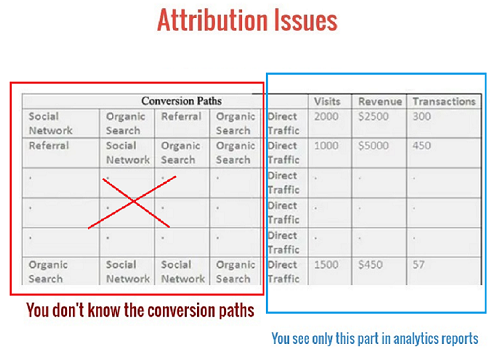
For example, you don’t really know where your sales came from.
You don’t really know which marketing channel or set of channels has the biggest impact on sales.
You as a business have got attribution issues when you can not put your finger on any one marketing activity and can not say with any degree of confidence that this is the marketing activity that has the most impact on our sales.
The types of businesses that are most likely to have attribution problems
The following types of businesses are most likely to have attribution problems:
- Businesses that have a long sales cycle
- Multi-channel retailers
- Non-ecommerce websites
#1 Businesses that have a long sales cycle
If you have a long sales cycle then you are bound to have attribution issues.
A long sales cycle means a large amount of consideration is involved in purchasing your product.
Therefore, multiple visits to your website by a prospective client over several days or weeks are inevitable.
#2 Multi-channel retailers
If you are a multi-channel retailer then you have got attribution issues.
Multi-channel retailers are those businesses that do multi-channel marketing.
They advertise and sell on multiple marketing channels at the same time. These marketing channels can be online or offline, or both.
#3 Non-ecommerce websites
The non-ecommerce websites are also most likely to suffer from attribution problems.
A non-ecommerce website is the one where the commerce is taking place offline.
For example, if a website sells properties then it is most likely a non-ecommerce website.
This is because the whole process of buying a property involves a lot of offline visits to the property, phone calls, a lot of paperwork and the final transaction is also carried out offline via a wire transfer.
In the case of a non-ecommerce website, the majority of conversions usually happen offline via phone calls, store visits, etc.
These websites generally do not have any macro conversion but have a lot of micro conversions.
If you are doing marketing for a non-ecommerce website then you will have to correlate your online marketing activities with offline conversions.
You will have to prove that your online efforts are really impacting offline conversions.
Otherwise, you will have a hard time reporting the value that you have added to the business bottom line.
If you run or market a non-ecommerce website then you have attribution issues.
Why you should not ignore attribution issues?
Gone are those days when you were advertising on just one marketing platform and device, and attributing sales was as easy as looking into an analytics report.
Now in the world of multi-channel and multi-device marketing and the ever-increasing number of marketing platforms, attributing conversions to the right touchpoint is becoming progressively complex and hard.
So you can no longer ignore attribution issues unless you don’t mind losing money and getting obsolete.
Because markets reward those who continue to add value to the marketplace. Those who refuse to upgrade themselves or believe they know it all are left behind.
How to fix the attribution problem in your online marketing?
FAQ: How do I optimize marketing campaigns when ad platforms underreport or overreport conversions?
According to the analysis from the analytics firm ‘Flurry’, just 4% of iPhone users in the US and 12% worldwide chose to opt into app tracking after the release of iOS 14.5.
As a result, advertising platforms like Google and Facebook Ads can underreport conversions.
If you don’t know where your website sales are really coming from, you can not find and scale winning channels, campaigns, ads and keywords. You then can not get rid of the losers.
Advertising platforms can also over-report conversions.
Most marketers operate under the assumption that only one channel at a time can take credit for a particular conversion.
But this is often NOT the case, esp. when you do multi-channel marketing.
For example, consider the following conversion path:
Person A visited your website via Google Ads but did not make the purchase.
He visited your website again but this time via Facebook Ads but did not make the purchase. However, he signed up for your newsletter.
He visited your website once again but this time via email newsletter, and made the purchase.
Now, if you are tracking ‘newsletter signups’ and ‘purchases’ as conversions, then the following could happen:
Google Ads could take the credit for ‘newsletter signup’ and ‘purchase’ because of the last Google Ads click attribution model.
Any conversion recorded on your website after the last Google ads click is because of Google Ads.
Facebook Ads could also take the credit for ‘newsletter signup’ and ‘purchase’ because of the last Facebook Ads click attribution model.
Any conversion recorded on your website after the last Facebook ad click is because of Facebook Ads.
The Email could also take credit for the ‘purchase’ because of the last-click attribution model.
Any conversion recorded on your website after the last Email click is because of the Email.
Three different marketing channels could take credit for the same conversion.
If you want to solve this conversion attribution problem, create a wide separation between your marketing activities.
So that visitors from Google Ads can not be re-targeted via Facebook Ads and vice versa.
The more separation you can create between the analysis of the various marketing activities, the more clarity you will get about conversion attribution.
You can create such separation by building different funnels.
You need different funnels for each major traffic source, down to different order confirmation pages.
That way, you can know exactly how each traffic source converts, where the users drop off in each funnel, etc.
That way, you know exactly what is working and not working in your multi-channel marketing.
You do more of what is working and less of what is not working.
Tag all your ad campaigns with UTM parameters, create different landing pages down to separate order confirmation pages for each major traffic source and rely on your CRM data to track the sales.
That’s the way to go.
Basically, completely separate marketing and sales funnels for each major traffic source.
So that you can say something like the following with confidence
“We first acquired this user via Facebook Ads, and he has made four purchases so far. One is from Facebook Ads, one is from email, one is from Google Ads, and one is from the LinkedIn organic post”.
Traffic from different marketing channels tends to behave and convert differently.
For example, you can’t expect Facebook ad traffic to convert like Google Ads traffic or YouTube traffic to convert like organic search traffic.
Yet most marketers give the same treatment to traffic from different marketing channels.
So they send traffic from different marketing channels to the same landing page.
All these different traffic types are often exposed to the same ad copy and offer, and all are eventually thrown into the same sales funnel to convert.
When different marketing channels tend to behave and convert differently, how can they all be part of the same funnel?
They shouldn’t be.
You optimize each marketing funnel differently.
What most marketers and analysts do instead is that they rely on segmenting their funnel data.
That’s a very inefficient way of doing funnel analysis and optimization.
I know it’s a lot of web development work creating and maintaining different marketing and sales funnels.
But that is the price you must be willing to pay if you want to fix your attribution issues and understand the true purchase journey of your customers.
You can fix the attribution problem in your online marketing by implementing attribution modelling in your organization.
Attribution modelling is the process of finding and fixing attribution issues, understanding the buying behaviour of your website users and determining the most effective marketing channels for investment at a particular point in time.
Data integration is the key to fixing attribution issues
If you are dead serious about implementing attribution modelling then you have to invest in data integration tools and technologies. You should always aim to integrate as much data as technically possible from different data sources.
Data integration is required so that you can:
- Correlate all of your data with metrics like revenue, cost, gross profit, etc.
- Quickly track various aspects of your marketing campaigns and analyse their overall performance.
- Gain a holistic view of your marketing.
Without proper data integration, you will always get a silo view of your marketing campaigns. This makes it very difficult to carry out attribution modelling.
There is no such thing as perfect attribution
Avoid being obsessed with getting perfect attribution because it does not exist.
No matter how robust your data collection tools and methodologies are, you will never be able to capture all the touchpoints of a user on a conversion path.
There will always be missing touchpoints in conversion paths. That is just the harsh reality. That is why, we continuously explore, analyse, and refine different attribution models.
That is why attribution modelling is not a one-time activity or some sort of side project.

Related Articles.
- Ecommerce Product Images Best Practices.
- 12 ecommerce best practices for your category pages.
- How to Start Conversion Optimization like a Pro.
- How to Use Agile Analytics to Quickly Solve Your Conversion Problems.
- How to determine the monetary value of non-ecommerce conversions.
- CPA optimization – How to reduce cost per acquisition.
- Excel for Data Analytics - Powerful Cheat Sheet.
- Practical Tips to develop user engagement for e-commerce website.
- Minimum Viable Traffic – The Maths Behind Conversion Optimization.
- GDPR IP Address Logging, Retention and Monitoring.
- Introduction to Machine Learning in Conversion Optimization.
- Schwartz five stages of awareness in marketing.
- Google Ads algorithm – How do Google ads work.
- WordPress Architecture Explained in Great Detail.
- ZMOT (zero moment of truth) in Marketing Explained.
- Mastering Data Reporting via Data Storytelling.
- How to Demonstrate Marketing ROI to Your Clients.
- What is Attribution Problem in Online Marketing.
- 10 Techniques to Migrate from Data-Driven to Data-Smart Marketing.
- How to create a marketing strategy & also analyze it.