

You can realistically advertise on Facebook or any other marketing platform (like Google Ad, Twitter, etc.) for FREE as long as you focus on optimizing this one metric called Return on Ad Spend (ROAS).
You just need to maintain your profitable ROAS.
However, the higher, the better.
Introduction to Profitable ROAS
Profitable ROAS is the ROAS you need, in order to remain within your Max. CPA
Let’s say you spent $25 on Facebook ads to generate 1 sale of $100 then your ROAS = $100 / $25 = 4
Let’s say your maximum CPA is $20.
Since your CPA from Facebook ads ($25) is higher than your max CPA of $20, you won’t be profitable.
So what should be your ROAS to be profitable?
Profitable ROAS = Average order value / Max. CPA
= $100 / $20 = 5
You would need a ROAS of 5 or more to stay within your Max. CPA target.
As long as you do that, you can continue to advertise on any marketing platform for FREE and still make money on top of that.
Let me show you how that is possible.
Suppose your Facebook ad spend last month was $200, and your sales from Facebook ads was $1200.
Your ROAS = $1200/$200 = 6
Since your ROAS of 6 is greater than your profitable ROAS, you are profitable.
The money that you spent on Facebook advertising was $200. So the money left after paying the Facebook ad bill = $1200 – $200 = $1000
And here is the cool thing. You did not pay this money from your own pocket. You paid this money from the sales you generated via Facebook ads.
So basically, you were paid by Facebook for advertising on their platform. This is the amount of money that you could not have earned without Facebook ads.
It is very important to remember that Facebook does not owe you any money. If you stop advertising on Facebook tomorrow, this money will disappear into thin air.
This is the kind of money you can generate only from Facebook. ROAS of 6 or 8 is quite realistic with Facebook.
Following is the ROAS of one of my Facebook ad campaigns:
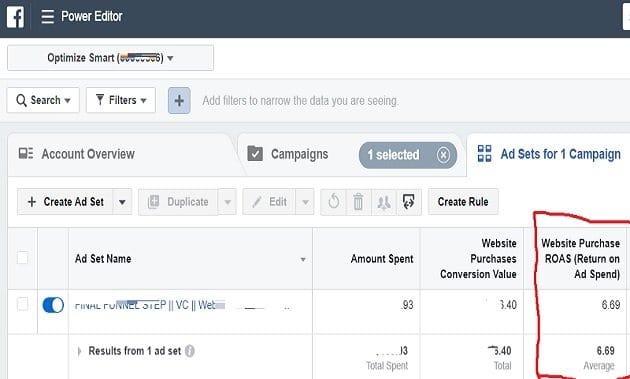
Here, the ROAS is 6.69, i.e. for every dollar I spent on Facebook, I got 6.69 dollars in return.
My ROAS fluctuates. Sometimes it goes as high as 10. I am not kidding:
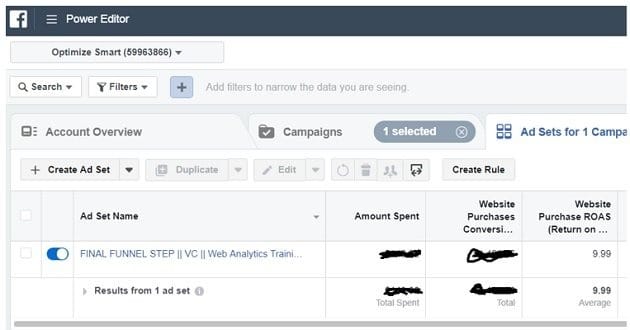
So basically, I advertise on Facebook for FREE.
In fact, Facebook pays me for advertising on its platform. Isn’t that awesome?
I sell my web analytics training courses through Facebook, which cost US $1498.
So I am not selling $10-$20 items here, which are much easier to sell on Facebook. I am selling high-ticket items.
And I do not have a big budget either. My daily ad spend is around $200. But I have consistently sold very high-priced items, which many will tell you is impossible.
I do not have tens of thousands or millions of followers on Facebook either. But my ads are reaching the right people, my core target audience. That’s the difference.
That’s why I don’t need a lot of reach to generate sales.
Most retailers sell items on Facebook below $50 and mostly target random people. Because of that, they need to target a very large audience, increasing ad spend and decreasing ROAS.
Having said that, my results are not typical, and I am not promising that you will also get the same level of results.
But, I can promise you that getting profitable ROAS is not a far-fetched dream. It is very realistic.
You have to be in some very boring niche not to be able to make any money from Facebook.
There are lot of marketers out there making insane amount of money through Facebook ads.
And you will be able to see through your reports whether or not you are profitable. You don’t have to rely on guesswork. Just track purchases within Facebook.
But here is the thing. You need a profitable ROAS for this magic to happen for you.
Many marketers do not get the desired ROAS because their focus lies elsewhere. They seem to be more interested in optimizing for clicks, impressions, cost per clicks, cost per thousand impressions, CTR, etc.
Now nothing really is wrong with these metrics. They are all good for optimization. But in the grand scheme of things, they don’t really matter.
What matters is your ROAS.
At the end of the day if you are no making money, if you are not profitable, even a CTR of 100% doesn’t mean anything.
If you focus on increasing your ROAS, you can practically run your ad campaigns with an unlimited marketing budget for FREE and continue to make money on top of that.
It is like using Facebook as a cash-generating machine. You put $1 into Facebook and get $2 or more back. The more dollars you put in, the more dollars you can get back.
However, there is one caveat here. Don’t get carried away. Don’t get your hopes so high.
If tomorrow you put $1 million dollar into Facebook advertising system, you won’t magically get $2 million or more in return.
The law of diminishing returns will stop you from doubling/tripling your ROAS by just doubling/tripling your marketing budget.
You can’t just double your ROAS by doubling your ad spend. It doesn’t work like that.
According to the law of diminishing returns, if you keep adding more of one unit of production to a productive process while keeping all other units constant, you will at some point start producing lower per unit returns.
So to increase your ROAS, you need to do much more than just doubling your marketing budget. You need to continue to optimize your ad campaigns for conversions. You would need to run new tests. Target new markets etc.
But this is all possible only when you first shift your focus from clicks & impressions to ROAS.
WARNING: If you operate on very low Max CPA, you may not be able to leverage any online advertising platform and hence won’t be able to scale
Average CPA is increasing month by month because of an increase in advertising competition. So to compete effectively, you would need to spend a lot more than your competitors to acquire customers.
Your Maximum CPA depends upon your desired level of profitability and your industry
The more operating profit you want to generate, the higher your operating profit margin needs to be.
However,
In order to acquire a new customer, you would need to sacrifice certain portion of your operating profit. This portion of your operating profit would cover your customer’s acquisition cost.
Consequently,
Higher your desired operating profit, lower is going to be your Max CPA
In other words,
Higher your desired operating profit margin, lower is going to be your Max CPA
Conversely,
The lower your desired operating profit margin, the higher your Max CPA can be.
If you are operating in a very competitive/saturated market, your average cost per acquisition will be pretty high.
In that case, you can not afford to operate with a high operating profit margin. You would then most likely have to operate on a very low-profit margin. Otherwise, any type of online advertising won’t be profitable for you.
You need a survival mindset in paid advertising.
Here is why marketers fail in Facebook advertising or paid advertising in general.
They approach advertising with a winning mindset. They expect to be profitable from day 1.
They want to crush it straightaway. They can’t handle short-term losses. They are afraid to lose money.
They don’t know what is working or not working in their marketing and where to invest time and money.
If you want to learn boxing, you are pretty much guaranteed to get a punch in the face. You may also need to handle occasional knockouts.
Paid advertising is just like boxing. That’s why so many people are scared of it. If you don’t play it well, it will punch you in the face.
You can’t just get up unharmed and then try again. Every mistake you make costs money.
However, when you start something new, you will fail.
Your targeting won’t work. Your ad creatives would fail. You are going to lose money. It is inevitable.
‘Nothing will work out immediately, no matter how much planning you do in advance.
“Everybody has a plan until they get punched in the Face.” – Mike Tyson
Be ready to fail and lose money but also learn from your mistakes.
Mr Balboa summarized this mindset really well:
“It’s not about how hard you hit. It’s about how hard you can get hit and keep moving forward. How much you can take and keep moving forward. That’s how winning is done. You got to be willing to take the hits.”
In paid marketing, bakers make money and cooks get burned.
A baker is a person who carefully plans a marketing campaign before launching it and then waits for it to fully bake (wait for the learning phase to get over and/or achieve statistically significant results) before analyzing its performance and making further changes to it.
On the other hand, a cook is an impatient person who rushes to launch a new campaign and then changes it based on the previous day’s performance.
Since a cook lacks patience and wants to cook (make money) as fast as possible, you can often find them making frequent edits to campaigns or launching new campaigns.
Since all major advertising platforms now use machine learning to find audiences most likely to convert, a cook almost always remains stuck in the learning phase and frequently burns dishes.
This is what happens when you try to cook a cake.
A cook actually believes they can outsmart machine learning algorithms, optimize much better than a machine and do better audience targeting.
So they believe in all things manual: manual optimization, manual placements, manual bidding….
The more you touch your campaign, the worse it gets.
Don’t try to cook a cake. Bake it. Be a baker in marketing.

Related Articles.
- Best Types of Charts in Excel for Data Analysis, Presentation and Reporting.
- KPI Meaning, Examples, Calculation & Dashboard Tutorial.
- Understanding A/B Testing Statistics to get REAL Lift in Conversions.
- Web Analytics Career Path – How to Become a Web Analyst.
- How to calculate maximum CPA and profitable ROAS.
- Bare Minimum Statistics for Web Analytics.
- Predictive Analytics & Marketing – The Next Stage of Business Optimization.
- How to improve data reporting skills – FREE Training.
- Maths and Stats behind Web Analytics – Beginners Guide.
- Learn to Analyze & Report above Average.
- What Matters More? Conversion Volume or Conversion Rate – Case Study.
- Is Your Conversion Rate Statistically Significant?
- Why Conversion Volume Optimization is better than CRO.
- Website Navigation Best Practices.
- How to advertise on Facebook for FREE with unlimited budget.
- Which Chart Type Works Best for Summarizing Time-Based Data in Excel.
- Pocket Guide to Do It Yourself Usability Testing.
- Understanding Historical Data in Web Analytics.
- 25 web form design best practices – optimizing forms for conversions.