

Over the past few years, I’ve tested both native GCP (Google Cloud Platform) setups and third‑party “easy” platforms (e.g. Stape, Taggrs) across growing accounts.
Here’s what consistently shows up in real projects:
>> Third‑party tools can be cheaper and faster to start with, especially at low volumes or for teams with no cloud experience.
>> As traffic and complexity grow, recurring fees, usage caps, and paid add‑ons often push total cost above a well‑tuned Cloud Run/App Engine deployment.
>> Debugging is harder when you don’t control the infrastructure: limited logs, short retention windows, and vendor‑side black boxes slow down root‑cause analysis when something breaks.
>> You trade away control over data, servers, and architecture. That’s fine until you hit a scaling, compliance, or accuracy issue and realise you can’t fix it without the vendor.
By contrast, a GCP‑based setup:
>> Follows Google’s standard architecture for GTM server‑side, with first‑class documentation and support patterns.
>> Gives you full access to logging, scaling, regions (including EU), and integrations with GA4, Google Ads, and BigQuery without an extra abstraction layer.
>> Scales more economically for high‑traffic and fast‑growing businesses, where a few percentage points of tracking accuracy or an hour of downtime can cost serious money.
Objection: Self-hosting on GCP isn't for everyone. Setting up and maintaining GCP hosting requires cloud expertise, ongoing DevOps work, log pipelines, versioning, scaling, debugging, API updates, monitoring...
What’s interesting is that this ‘self‑hosting on GCP is too complex’ objection rarely starts with clients. Because most clients do not/can not DIY SS tagging.
It’s usually introduced by SGTM platform vendors whose entire value proposition depends on convincing you that standard GCP is scary, so that renting their abstraction feels safer than owning your own, consultant‑implemented setup.
sGTM falls in the GA4/GTM consultant territory.
Just as companies hire specialists to implement GA4 ecommerce tracking, consent mode, or complex CRM integrations, they should treat server‑side GTM as a consulting project, not a DIY DevOps hobby.
The pattern is the same: one‑time architecture and setup, then ad‑hoc improvements and troubleshooting as needed. No new in‑house team required.
Most companies already accept this model for:
- Initial analytics architecture and audits.
- Complex GA4 ecommerce implementations.
- CRM / CDP integrations.
Server‑side tagging fits the same pattern.
The difference is what you get at the end: One‑off setup vs ongoing payroll.
You do not need in‑house cloud engineers to benefit from GCP; you need a partner who designs, documents, and hands over a standardised setup.
The cost model is: one‑time implementation + occasional ad‑hoc improvements.
With a consultant‑implemented GCP setup, you own a standard, portable, well‑documented stack that any qualified partner can support.
With a proprietary platform, you’re paying a recurring fee indefinitely for an additional abstraction layer you can’t freely move away from.
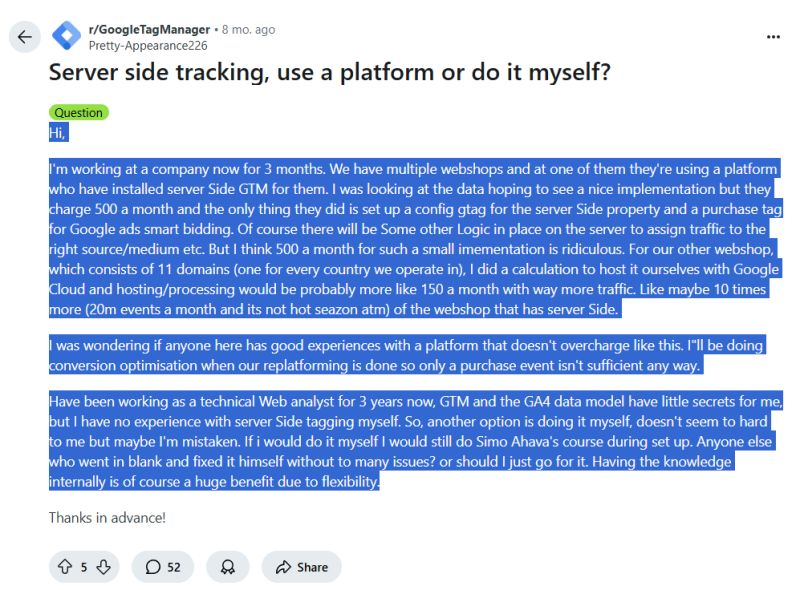
For businesses spending serious money on marketing, long‑term control and portability matter far more than avoiding a one‑time implementation project.
FAQ: What about self-hosting the ssgtm on your own infrastructure?
Technically, you can run the GTM server container on your own servers or another cloud.
But once you factor in development, testing, monitoring, security hardening, and scaling, self‑hosting is rarely cheaper than a well‑designed Cloud Run setup, especially as traffic grows.
Even with a strong DevOps team, matching GCP’s reliability, autoscaling, and operational maturity in‑house is extremely difficult and usually not worth the effort for just a tagging server.
GCP benefits from billions invested in R&D, continuous improvements, world‑class redundancy, compliance certifications, and near‑instant scalability.
With server‑side GTM, you essentially ride on that backbone for a relatively small incremental cost.
Note: Vendors often market EU data residency as a unique advantage, but Google Cloud already offers EU regions and GDPR‑compliant setups, often the same underlying infrastructure that those vendors use.
Final Conclusion:
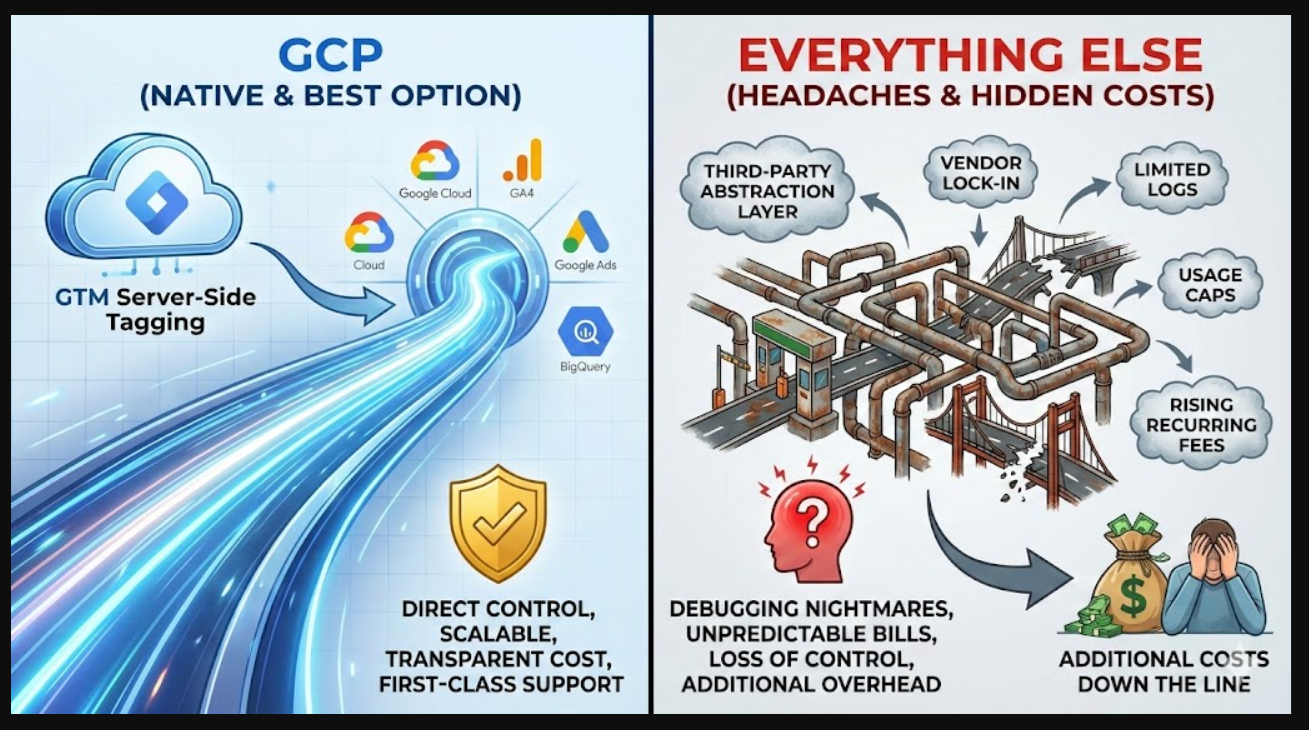
Google Cloud Platform (GCP) is the native and best option for GTM Server-Side Tagging. Everything else is a headache and often results in additional costs, directly or indirectly, down the line.

Other Articles on GA4.
- Google Analytics 4 often report inflated conversion counts by default.
- The Best Reporting Identity for Google Analytics 4.
- 'Days to key events' metric in Google Analytics 4.
- Advertising Reports in Google Analytics 4.
- Google Analytics 4 Data Delays Guidelines.
- Data deletion requests in Google Analytics 4 (GA4).
- How to Mix GA4 Dimensions & Metrics of Different Scopes?
- The best platform for GTM Server Side Tagging.
- Use the Data Manager API instead of the Measurement Protocol.
- utm_id (Campaign ID) in Google Analytics 4.
- utm_source (campaign traffic source) in Google Analytics 4.
- utm_medium (campaign traffic medium) in Google Analytics 4.
- utm_campaign (campaign name) in Google Analytics 4.
- utm_term (campaign term) in Google Analytics 4.
- utm_content (campaign content) in Google Analytics 4.
- utm_source_platform in Google Analytics 4.
- utm_campaign_id in Google Analytics 4.
- utm_creative_format in Google Analytics 4.
- utm_marketing_tactic in Google Analytics 4.
- Filter Google Analytics 4 Reports by UTM Parameters.