

The 'Days to key events' metric in the GA4 Attribution Paths report is not what you think. This metric is unreliable for understanding the full sales cycle or customer journey duration.
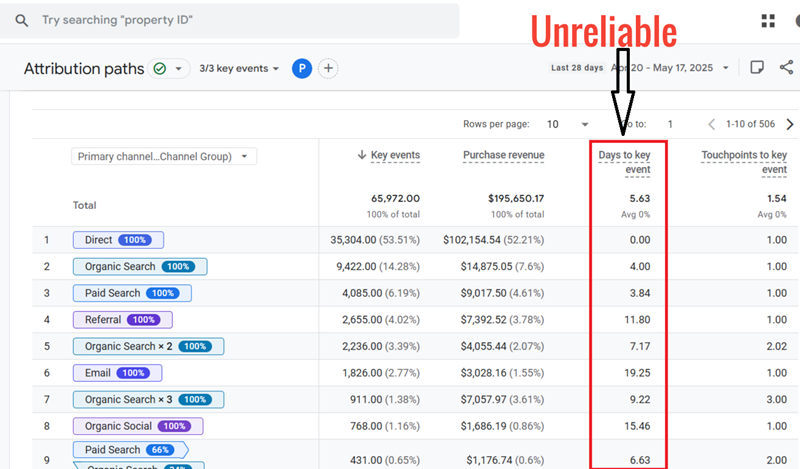
Google defines this metric as "The number of days from when the ad interaction happened until the conversion."
However, this metric actually refers to the time between the earliest conversion-credited touchpoint under the selected attribution model (which is often the DDA model) and the occurrence of the key event.
Consider the following user journey:
Day 1: User clicks a Google ad → visits your website but doesn't convert.
Day 2: Returns via organic search → reads a blog post.
Day 4: Clicks an email campaign → browses product pages.
Day 6: Comes back via direct → adds item to cart.
Day 7: Returns directly again and completes the purchase.
Conversion Attribution (DDA Model):
Email (Day 4) → receives conversion credit.
Direct (Day 7) → receives conversion credit.
Google Ad (Day 1) and Organic (Day 2) → receive no conversion credit (not deemed predictive).
"Days to key event" = 3 days (from Day 4 [first conversion credited touchpoint] → Day 7 [conversion])
Although the journey began with a Google ad on Day 1, the DDA model determined that only the email and final direct visit were influential.
Therefore, the "Days to key event" metric only measures from Day 4 onward, showing 3 days, not the full 7-day journey.
So the "Days to key event" metric reflects conversion attribution timing, not total journey length.
You are not seeing the full time from first contact to conversion, only from the first influential touchpoint, as defined by the DDA model.
As a result, this metric is unreliable for understanding the full sales cycle or customer journey duration.
The word "Ad interaction" in Google's definition of 'Days to key events' is also misleading because not all conversion-credited touchpoints are ads. They can include organic search, direct, referrals, email, social, etc.
In GA4's Attribution Paths report, the "Key events" dropdown lets you choose which conversion events you want to analyse (e.g., purchase, add_to_cart, sign_up, lead, etc.).
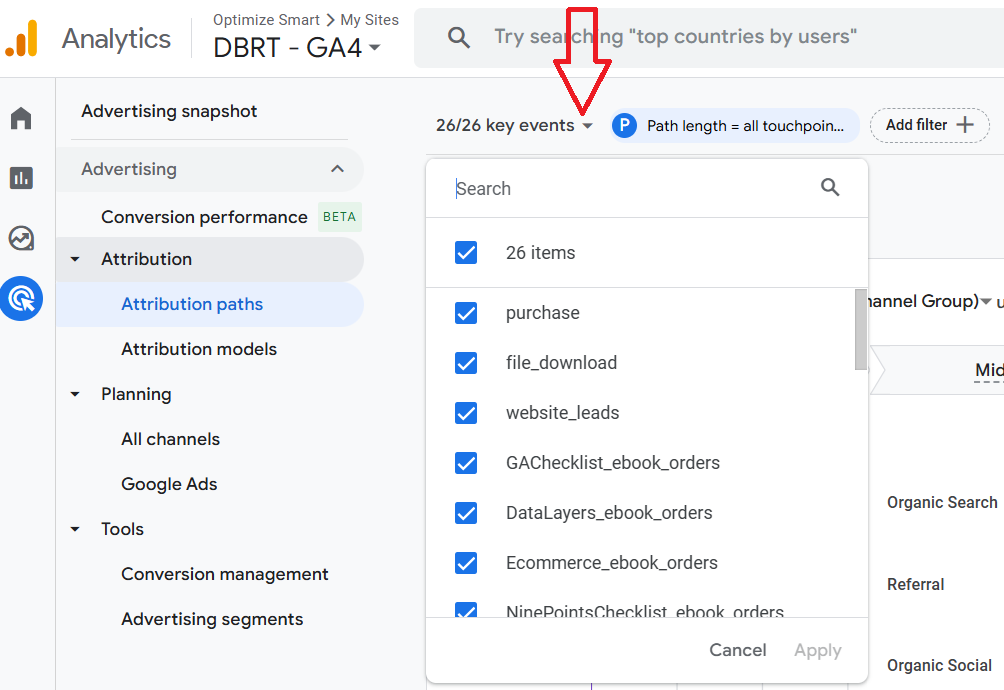
The "Days to key event" metric is calculated separately for each selected key event.
So, when you see the "Days to key event" metric reported for all selected conversions, you see misleading data.
Because you are combining multiple key events that may have very different conversion attribution timelines and user intent.
The "Days to key event" metric only provides somewhat meaningful insight when analyzed per individual key event.
Because the "Days to key event" metric only reflects the time between the first credited touchpoint and the conversion, not the full user journey, it doesn't support actionable decisions.
As a result, it's effectively useless for strategy, optimisation, or understanding true customer behaviour.
To measure true customer journey duration in GA4, use BigQuery. Calculate the time between a user’s first recorded interaction and the chosen key event.

Other Articles on GA4.
- Google Analytics 4 Migration Checklist - Upgrade to GA4.
- How to Install Google Analytics 4 on Shopify.
- How to link Google Analytics 4 with AdSense.
- Google Analytics 4 Subproperties Tutorial.
- How to connect Google Analytics 4 with Google Data Studio.
- Advertising Snapshot in Google Analytics 4 (GA4).
- Manage automatic event detection in Google Analytics 4.
- How to use Google Analytics 4 Event Builder.
- Is Safari Undermining Your GTM Server-Side Tagging?
- Guide to Google First Party Mode.
- You Can’t Really Trust Google Analytics 4 Engagement Metrics.
- Google Analytics 4 Metrics Tutorial.
- Google Analytics 4 Custom Metrics Tutorial.
- Don't Configure Google Tag via GTM, Google Ads and GA4.
- Retargeting Audiences in GA4 For Ecommerce Websites.
- Google Analytics 4 often report inflated conversion counts by default.
- The Best Reporting Identity for Google Analytics 4.
- 'Days to key events' metric in Google Analytics 4.
- Advertising Reports in Google Analytics 4.
- Google Analytics 4 Data Delays Guidelines.