

Learn how to access complete URLs in GA4. Follow these steps to view GA4 full page URLs for more accurate reporting and analysis.
If you want to track the traffic to various subdomains in GA4, you must be able to view the full-page URLs in the GA4 reports.
By default, the data in your GA4 reports include only the request URI and not the domain name. This makes it impossible to view subdomain traffic.
The request URI is that part of the URL that comes after the domain name.
For example, if your URL is: https://www.optimizesmart.com/contact/
Then request URI would be: /contact/
The hostname would be: https://www.optimizesmart.com
Unlike in GA3 (Universal Analytics), in GA4, you don’t need to append the hostname to the request URI to see the full URLs in the reports.
You just need to use the ‘Page Location’ dimension in an exploration report.
Follow the steps below to view full-page URLs in GA4:
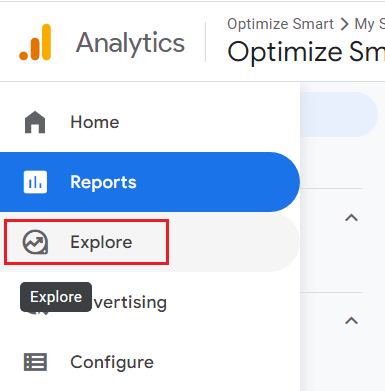
Step-1: Login to your GA4 property and then click on the ‘Explore’ link:
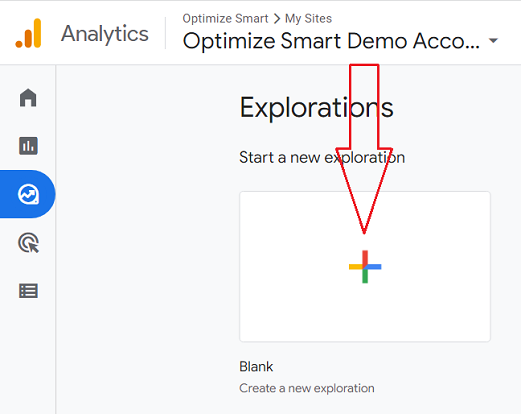
Step-2: Click on the ‘Blank’ exploration report template:
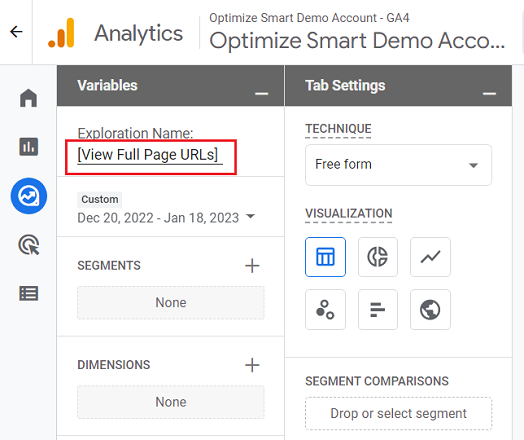
Step-3: Name your report ‘[View Full Page URLs]’:
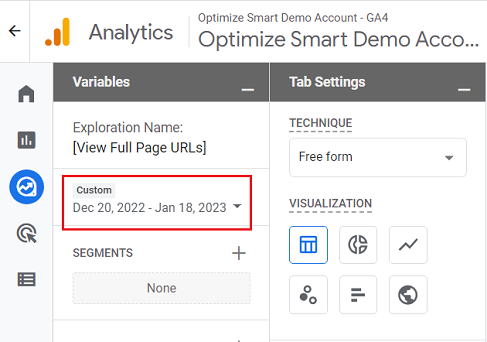
Step-4: Set the date range to the last 30 days:
Step-5: Click on the + button next to ‘DIMENSIONS‘:
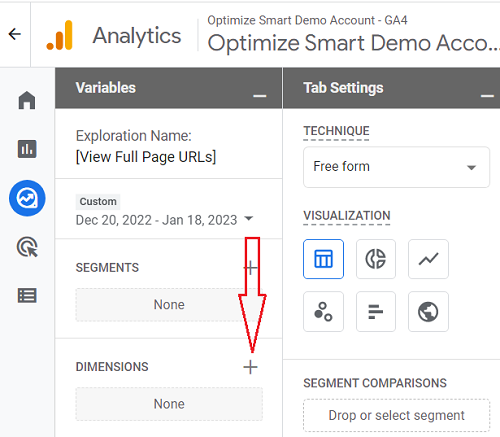
Step-6: Search for ‘Page Location’, click on the checkbox next to it and then click on the ‘Import’ button:
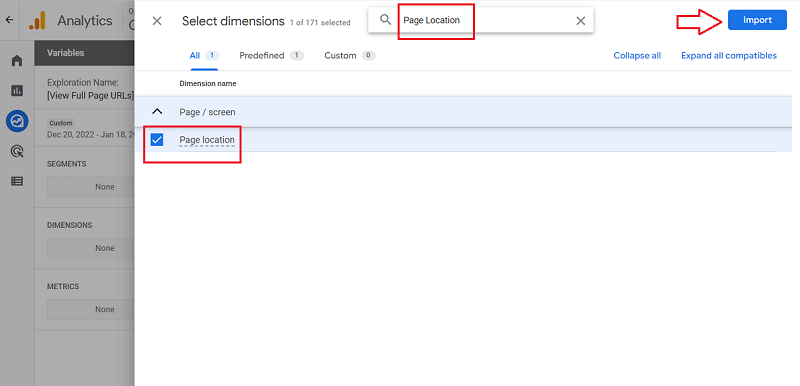
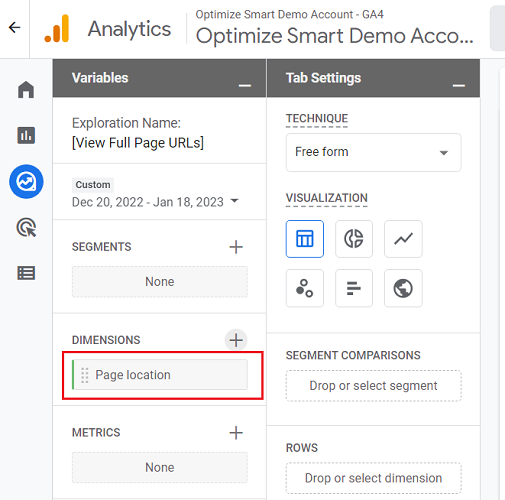
You should now see the imported dimension listed under the DIMENSIONS section:
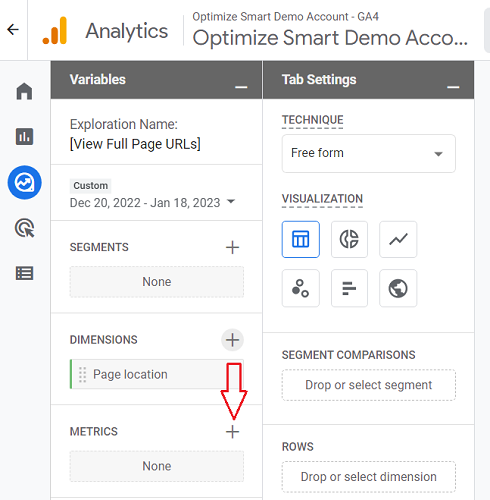
Step-7: Click on the + button next to METRICS:
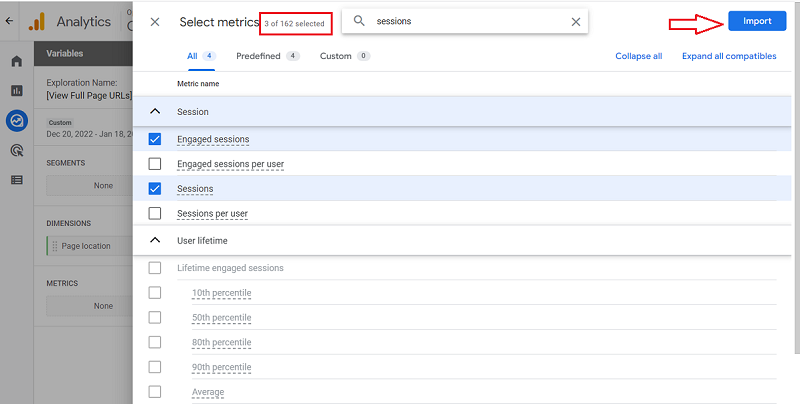
Step-8: Search and select the following metrics one by one in the exact order as mentioned below and then click on the ‘Import‘ button:
- Views
- Sessions
- Engaged Sessions
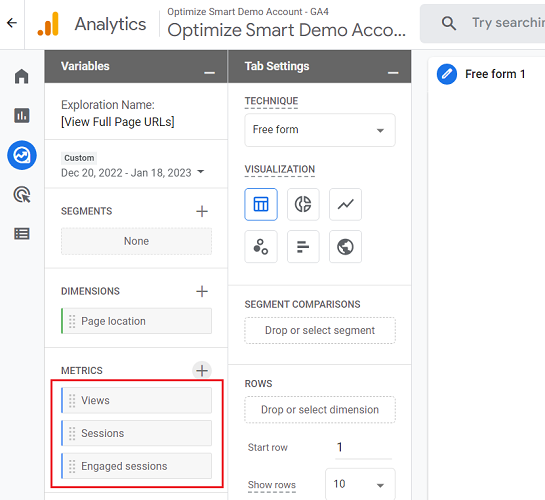
You should now see all the imported metrics listed under the METRICS section:
Step-9: Double click on the dimension ‘Page Location’ so that it is automatically added to the Rows section:
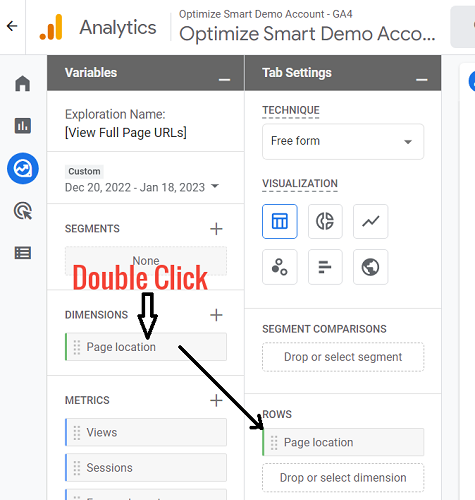
Note: When you double-click on the ‘Page Location’ dimension, you won’t see any change to the canvas on the right. But the dimension has been added to the canvas. Only when you start adding metrics to the canvas will you start seeing the dimension(s) added to the canvas.
Step-10: Double click on the following metrics one by one, starting from the very top, so that they are automatically added to the blank canvas on the right:
- Views
- Sessions
- Engaged Sessions
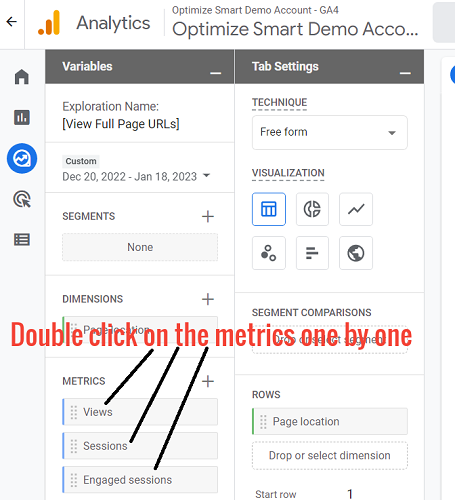
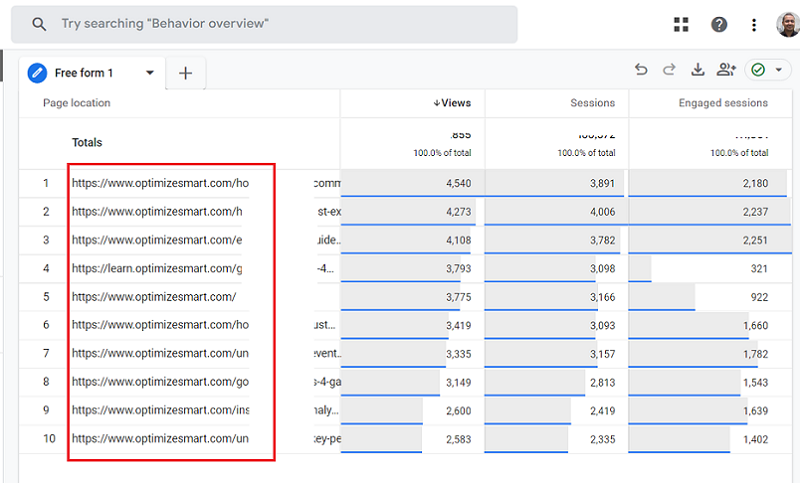
You should now be able to see the dimensions and metrics added to the report canvas on the right along with the full page URL:

Other Articles on GA4.
- Google Analytics 4 GDPR Compliance Checklist.
- Google Analytics 4 Behavioral and Conversion Modeling.
- GA4 – Missing Deep Links in your App [Fixed].
- How to create custom insights in Google Analytics 4 (GA4).
- Fixing data threshold issue in Google Analytics 4 (GA4).
- (organic) or (not set) as ‘session campaign’ for google / cpc in GA4.
- Session Fragmentation Is Ruining Your GA4 Attribution Data.
- Tracking Outbound Links/Clicks in Google Analytics 4.
- Understanding Data Sampling in Google Analytics 4 (GA4).
- User Explorer Google Analytics 4 Tutorial.
- Google Analytics 4 Explorations Tutorial.
- How to Change Attribution Models in Google Analytics 4.
- Google Analytics Real-time report not working? Here is the fix.
- Google Signals in Google Analytics 4 - See demographics (gender, age) data.
- How to Create Landing Page Report in Google Analytics 4.
- How to segment Google Analytics 4 data by data stream.
- Setup Cross Domain Tracking in Google Analytics 4.
- How to see full page URLs in Google Analytics 4.
- Roll up Property in Google Analytics 4 – Tutorial.
- The Best Tag Auditing Tools for Google Analytics 4.