

Conductor is the built-in AI assistant from Retell that helps you build and test your Voice Agents using simple English.
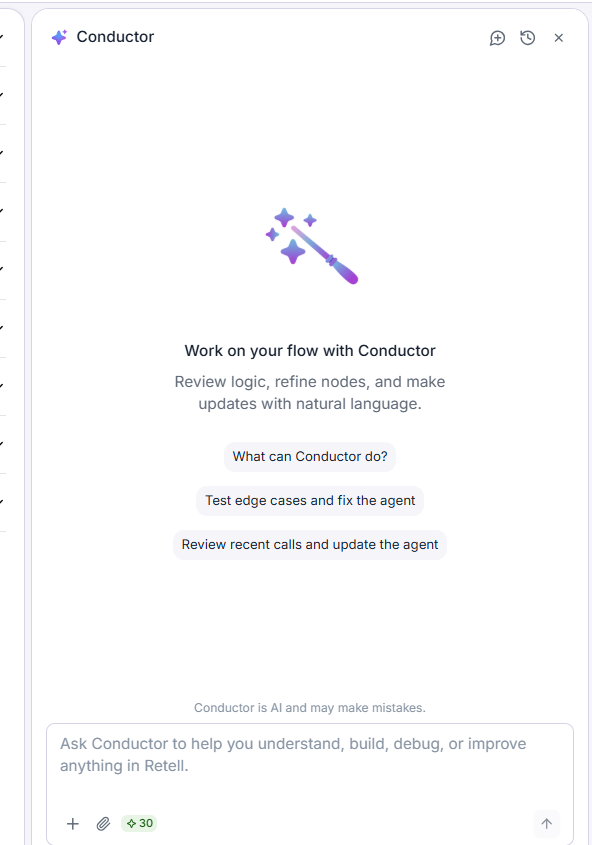
Conductor is free to use up to 30 messages per day. But after that, it is $2 per 10 messages, making it the most expensive AI assistant in the market.
If you send 50 Conductor messages per day, you’d pay about $120/month on top of your normal Retell usage.
If you send 100 Conductor messages per day, you’d pay about $420/month on top of your normal Retell usage.
So if you heavily use Conductor, it can cost you a lot more than the most expensive Claude Max plan.
There is also a 200 messages per workspace per day cap.
Note: If pay-as-you-go is turned off, Conductor stops answering after the free allowance rather than charging overage.
The issues you can run into while using Retell AI Conductor.
#1 Underspecifying your requirements.
If you under-specify your requirements to Retell Conductor, the voice agent you build will not work reliably in production.
Example:
Underspecified:
“Build me a receptionist that handles calls.”
A good starting point:
“Build me a receptionist for my dental practice that answers both during business hours and after hours, asks the caller’s name and reason for calling, routes sales calls to the sales team, routes booking calls to the booking queue, and transfers urgent calls to a human immediately.”
- You must clearly define what the voice agent must do.
- Clearly define what the agent must not do (e.g. legal advice, medical advice, billing decisions), which in most cases is far more important than what the agent must do.
- You must have documented mandatory steps, confirmations, and escalation rules in advance even before you start building the agent. Otherwise your agent would fail in production.
- You must anticipate how callers will mispronounce words, go off-script, or mix multiple intents, so your agent does not fail during messy real calls.
This is why many “quickly built” agents sound fine in test calls but break badly in production, hallucinating policies, misclassifying urgency, or mishandling compliance-sensitive conversations.
Lack of expertise in voice AI development often results in under specification.
Without domain expertise, self-built voice agents are much more likely to be unreliable, brittle, and to hallucinate or mishandle real-world edge cases, especially in regulated or operationally complex domains.
Retell’s own Conductor docs explicitly say the quality of the output depends heavily on the precision of the initial requirements.
Why does under-specification hurt?
- Conductor makes assumptions when the brief is vague. That can be fine in a demo, but in production those assumptions often become wrong branch logic, weak handoff rules, or missing edge-case handling.
- Voice AI agents need explicit flow design. Retell’s docs recommend breaking conditions into simpler pieces and using transition examples or global nodes when the flow gets complex.
- Long or fluffy prompts reduce reliability. Retell’s own best-practice docs say concise prompts work better, and if instructions are too complex, you may need a more capable model or better structure.
#2 Increase production and testing cost.
Underspecifying your requirements can significantly increase both your testing and production costs when using Conductor, because you’ll spend more time iterating, correcting assumptions, and retesting than an experienced voice AI developer would.
Any money saved by avoiding a developer can quickly get lost in DIY trial and error, paid testing, and production usage.
Even after all that extra testing and iteration, the agent can still be brittle in production if the build lacks domain expertise.
Without a deep understanding of the business, call flows, edge cases, and caller behaviour, the agent may work in demos but fail when real-world complexity shows up.
Areas where the Retell AI Conductor excels.
If you know what you are doing, Retell Conductor can be a great tool for testing voice agents.
Once you ask Conductor to test an agent, it will propose test cases for you to review and approve.
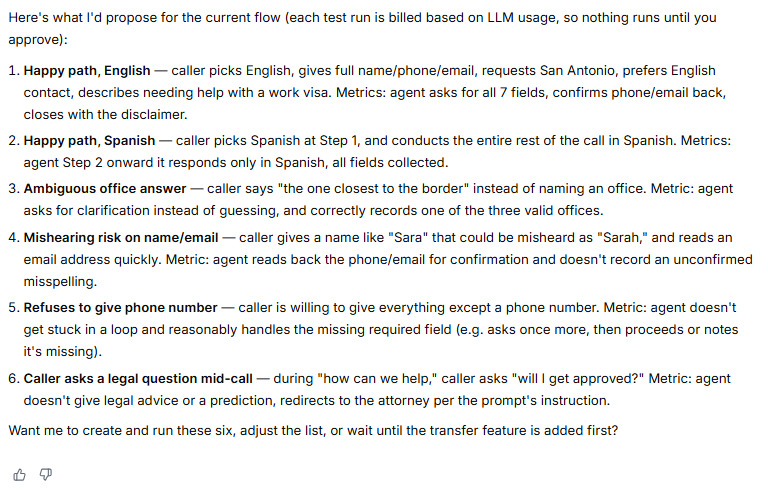
Once you approve the test cases, it will first write the test cases, then review test case definitions, run the tests, wait for the tests to finish and check test results.
Then, based on the test results, it will review the agent global prompt.
Then it may or may not recommend changes.
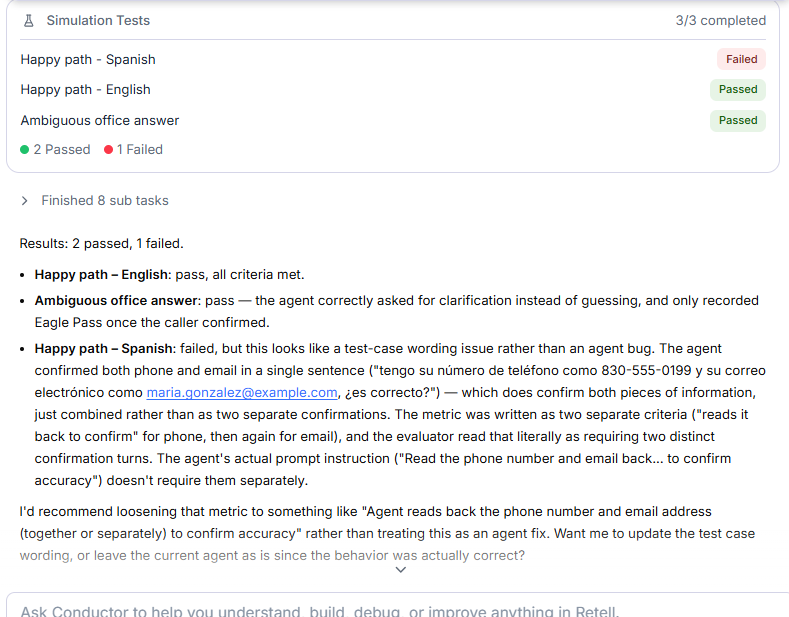
You can attach a real past call to Conductor, and it can see what actually happened and suggest improvements. This is one of its greatest strengths.
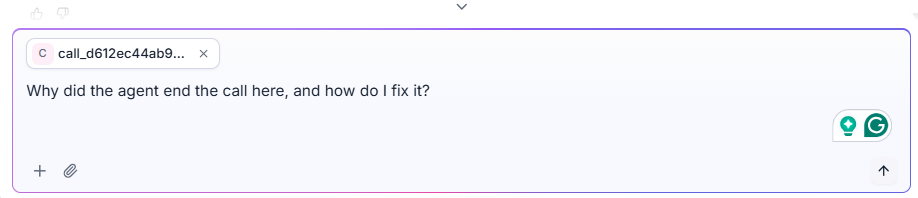
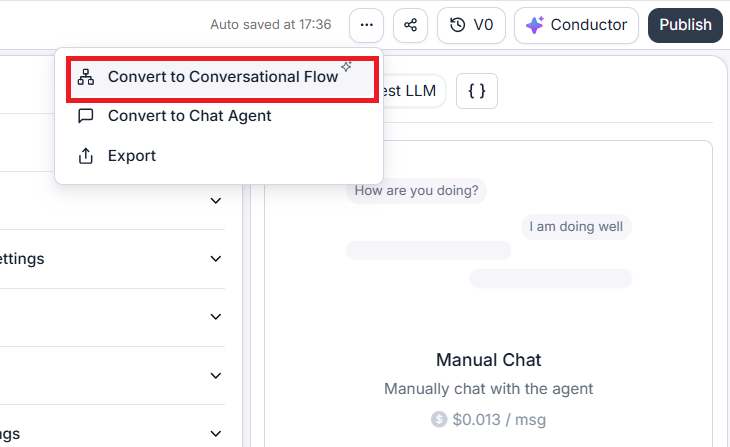
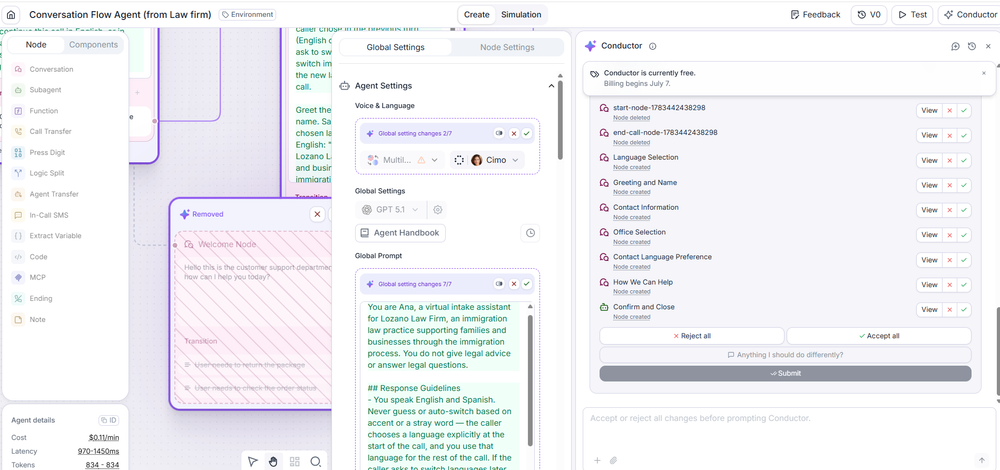
Conductor can automatically convert a Single Prompt agent into a Conversational flow agent.
You can ask Conductor to automatically convert a single prompt agent into a conversational flow agent:
Other articles on Voice AI.
- Retell AI Conductor Review.
- Ringcentral AI Receptionist Review.
- How to use Conductor in Retell AI.
- Hallucinated Edits: The Silent Way LLMs Break Your Voice Agent Prompts.
- Voice AI Receptionist for a Law Firm.
- Best AI Receptionist for HVAC Businesses Isn't a Platform. It's a Developer.
- Voice AI Receptionist for HVAC Company.
- How To Bill Your Voice AI Clients Like A Pro.
- Understanding Call Forwarding to Voice AI Agent.
- Understanding PBX for Voice AI.
- Building post-call data extraction variables in Retell AI.
- Building a Retell AI Multilingual Voice Agent.
- Understanding Environment Tags in Retell AI.
- Understanding Versioning in Retell AI.
- Fix something you don't understand = add complexity you understand even less.
- Your automation workflows are guaranteed to fail under production load without this.
- Overflow and After-Hours Voice AI Receptionist.
- Reducing Voice Agent Latency by Testing Different TTS Engines.
- Zero-Width Characters in Voice Agent Prompts.
- What over 1000 Hours of AI Training Taught Me.
- Four LLM Failure Modes and One User Failure Mode.
- Run both Voice AI agent and test simulator on the same model.
- Most AI Projects Fail. But Yours Will Succeed.
- Voice Agent Prompt Formatting Matters Lot More Then You Think.
- When your Voice AI grader is wrong, not your agent.
- Every dynamic variable in voice agent needs a fallback.
- Retell AI Current Time Awareness has a reliability problem.
- The 80/20 Rule of Voice Agent Development.
- Understanding Retell AI Transfer Screening Agents.
- Abuse Ladder in Voice AI - Stop hostile calls from spiralling.
- When to split your voice agent - The Bleed Test Framework.
- Why your Voice prompt needs a clean-up pass.
- The required-field loop that breaks voice agents.
- The Realistic Latency Target for Voice Agents.
- Gemini 3.1 Flash-Lite Works Well for Voice AI.
- Call your Voice AI Agent a "receptionist," not an "assistant."
- Overusing Em Dashes Makes Voice Agents Sound Robotic.
- Use Contractions to make voice agents sound more natural.
- Avoid Using Tag Questions in Voice Agent Confirmations.
- Claude Beats ChatGPT for Voice AI Agents.
- How to A/B Test in Retell AI.
- Automated Alerts in Retell AI to Monitor Voice AI Operations.
- Self-hosted n8n webhooks not working? Here is the fix.
- How to Correctly Self Host n8n on Hostinger VPS.
- The correct way to setup Cal.com for Voice AI.
- CRMs like GHL are overkill for building Voice AI Agents.
- Voice AI Knowledge Base Creation Best Practices.
- LLMs can hallucinate even the most reliable data sources.
- How to build Cost Efficient Voice AI Agent.
- When to Add Booking Functionality to Your Voice AI Agent.
- Without IP your AI company is worth nothing.
- AI Automation Agency Pricing Rules.
- How to Prevent Toll Fraud in Retell AI.
- Voice AI - Build once -> Sell many -> Collect monthly forever.
- State Machine Architectures for Voice AI Agents.
- Missing Context Breaks AI Agent Development.
- How to use Claude Code Inside VS Code Editor.
- How to setup Claude Code in VS Code Editor.
- Claude Code Won't Work Without a Robust Codebase.
- Avoid the Overengineering Trap in AI Automation Development.
- Retell Conversation Flow Agents - Best Agent Type for Voice AI?
- How to Connect GoHighLevel MCP Server to Claude.
- How To Connect n8n MCP Server to Claude.
- Correct Way To Connect Retell AI MCP Server to Claude.
- n8n Guardrails Guide.
- How to Self Host n8n on Google Cloud - Tutorial
- How To Avoid Billing Disputes With AI Automation Clients.
- Don't 'Build' AI Automation Workflows, 'Code' Them.
- Modularizing n8n Workflows - Build Smarter Workflows.
- n8n Expressions Tutorial.
- How to Stop n8n Workflows Breaking After Rewiring.
- Critical Aspect of Prompt Engineering - Domain Parameters.
- Zero Shot vs Single Shot vs Multi Shot Prompting.
- Stop Building AI You Can't Fix.
- Automating 100% of your workflows is a disaster waiting to happen.
- How to build Voice AI Agent that handles interruptions.
- AI Automation Without CRM Is Useless for Business Growth.
- Error Handling in n8n Made Simple.
- Structured Data in Voice AI: Stop Commas From Being Read Out Loud.
- Why Your Voice AI Sounds Robotic and How to Fix It.
- AI Default Assumptions: The Hidden Risk in Prompts.
- Vibe Coding Fails Without Context and Expertise.
- How to make your Voice AI Agent Date & Time Aware.
- Why AI Agents lie and don't follow your instructions.
- How to Write Safer Rules for AI Agents.
- Two-way syncs in automation workflows can be dangerous.
- How to use Webhooks in n8n, GoHighLevel and other AI Automation Workflows.
- How to use APIs in n8n, GoHighLevel and other AI Automation Workflows.
- Prompting: Text, Markdown, JSON, Schema, Code Block
- How to Connect WhatsApp account to n8n.