

It's like a wrench manufacturer calling itself the best HVAC contractor.

The wrench matters. But nobody's hiring the wrench to diagnose why the compressor's short-cycling, size the ductwork, or show up when the unit dies at 11pm in July. That's the technician. The tool is not the trade.
Search "best AI receptionist for HVAC" or "best AI Voice Agents for HVAC" businesses and you'll land on a stack of near-identical blog posts, each one written by a vendor, each one crowning itself the winner of a comparison it designed.
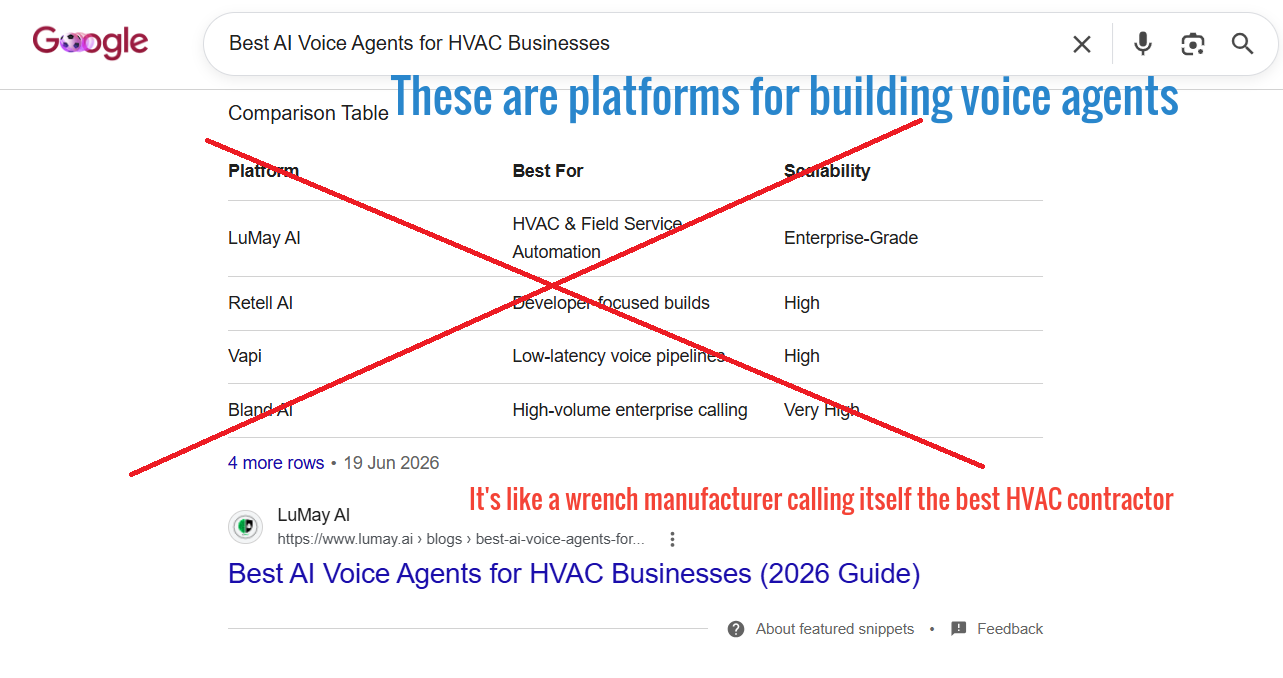
Dig deep, and you will see case studies with no company name attached, a benchmark stat pulled from a report nobody can find, a comparison table where every competitor's weakness is stated plainly and the vendor's own weakness is quietly left off.
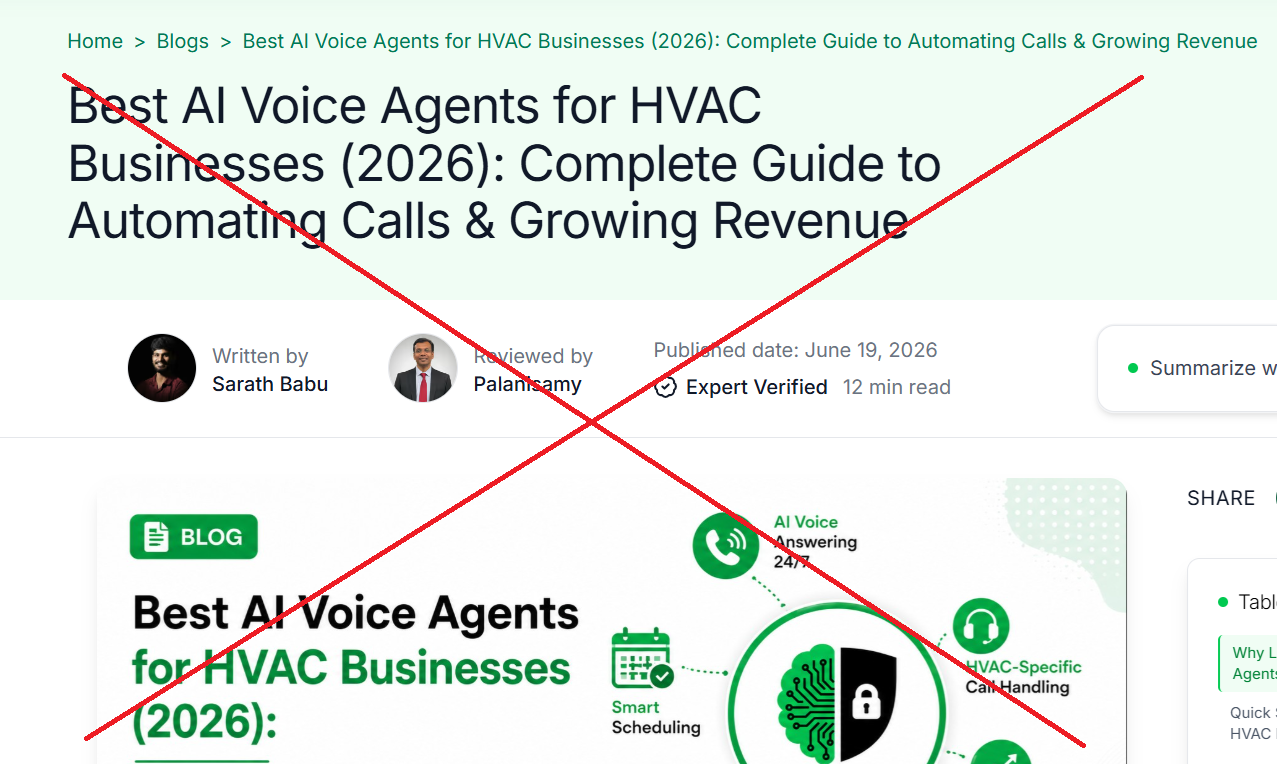
If you're a HVAC contractor trying to figure out whether an AI receptionist/Voice Agent is worth deploying, the platform review is the wrong artifact to be evaluating in the first place.
Here is how the platforms' deception actually works.
It's rarely an outright lie. It's structural bias dressed up as objectivity.
Self-graded comparisons. A platform publishes a "best tools ranked" post, includes itself in the ranking, and unsurprisingly comes out on top. The methodology is never disclosed. There's no way to audit the scoring.
Stats with nowhere to land. "Studies show a 30% reduction in operational costs." Which study? Whose data? A number gets attached to a credible-sounding source and then floats free of any citation you can actually check.
Selective cost accounting. This is the one that costs you real money. A platform will present its own pricing as a clean per-minute rate - "$0.07/min, no platform fee" while breaking a competitor's pricing all the way down to its true blended cost once every add-on is stacked in.
The trick is applying full-cost accounting to everyone except themselves. In reality, almost every voice AI platform's advertised rate is just one line item.
LLM tokens, TTS, telephony, and platform fees are usually separate charges that get bolted on after you've already anchored on the headline number.
Testimonials with no subject. "A mid-sized regional HVAC contractor saw a 40% increase in booked jobs." No name, no link, no way to verify it happened. It reads like a case study. It functions like a made-up one.
If you strip the branding off ten of these posts, they're the same document. Different logo, same playbook.
The best AI receptionist for HVAC businesses isn't a platform. It's the developer who builds it.
This is the part every ranked listicle skips, because it doesn't sell platform signups: the platform is not the product. The agent is. And the agent is only as good as the person who built it.
Two HVAC contractors can deploy the exact same underlying platform and end up with completely different outcomes: one with a receptionist who books jobs at 2am without a hitch, the other with an agent who mishandles the first edge case a real caller throws at it.
Same infrastructure, same LLM, same voice engine. The only variable that moved is who built it.
That's the whole story the "best tool" rankings refuse to tell, because it doesn't fit the format. You can't rank a person's competence in a comparison table designed to sell a subscription.
Most self-built AI receptionist/agents are brittle.
- They hallucinate on edge cases nobody thought to test.
- They fail silently when a tool call errors out, rather than surfacing the failure.
- They leak data through prompts that were never audited for what they expose.
- They don't scale past a handful of concurrent calls. They have no evaluation loop, so nobody notices the agent has quietly gotten worse until a customer complains.
The business owner doesn't know any of this until it's already live and already failing. A caller gets misrouted. A lead gets lost. The agent confidently says something wrong to a customer at 9pm on a Saturday.
And the business owner doesn't conclude "I built this without the right expertise." They conclude "AI doesn't work."
Other articles on Voice AI.
- Retell AI Conductor Review.
- Ringcentral AI Receptionist Review.
- How to use Conductor in Retell AI.
- Hallucinated Edits: The Silent Way LLMs Break Your Voice Agent Prompts.
- Voice AI Receptionist for a Law Firm.
- Best AI Receptionist for HVAC Businesses Isn't a Platform. It's a Developer.
- Voice AI Receptionist for HVAC Company.
- How To Bill Your Voice AI Clients Like A Pro.
- Understanding Call Forwarding to Voice AI Agent.
- Understanding PBX for Voice AI.
- Building post-call data extraction variables in Retell AI.
- Building a Retell AI Multilingual Voice Agent.
- Understanding Environment Tags in Retell AI.
- Understanding Versioning in Retell AI.
- Fix something you don't understand = add complexity you understand even less.
- Your automation workflows are guaranteed to fail under production load without this.
- Overflow and After-Hours Voice AI Receptionist.
- Reducing Voice Agent Latency by Testing Different TTS Engines.
- Zero-Width Characters in Voice Agent Prompts.
- What over 1000 Hours of AI Training Taught Me.
- Four LLM Failure Modes and One User Failure Mode.
- Run both Voice AI agent and test simulator on the same model.
- Most AI Projects Fail. But Yours Will Succeed.
- Voice Agent Prompt Formatting Matters Lot More Then You Think.
- When your Voice AI grader is wrong, not your agent.
- Every dynamic variable in voice agent needs a fallback.
- Retell AI Current Time Awareness has a reliability problem.
- The 80/20 Rule of Voice Agent Development.
- Understanding Retell AI Transfer Screening Agents.
- Abuse Ladder in Voice AI - Stop hostile calls from spiralling.
- When to split your voice agent - The Bleed Test Framework.
- Why your Voice prompt needs a clean-up pass.
- The required-field loop that breaks voice agents.
- The Realistic Latency Target for Voice Agents.
- Gemini 3.1 Flash-Lite Works Well for Voice AI.
- Call your Voice AI Agent a "receptionist," not an "assistant."
- Overusing Em Dashes Makes Voice Agents Sound Robotic.
- Use Contractions to make voice agents sound more natural.
- Avoid Using Tag Questions in Voice Agent Confirmations.
- Claude Beats ChatGPT for Voice AI Agents.
- How to A/B Test in Retell AI.
- Automated Alerts in Retell AI to Monitor Voice AI Operations.
- Self-hosted n8n webhooks not working? Here is the fix.
- How to Correctly Self Host n8n on Hostinger VPS.
- The correct way to setup Cal.com for Voice AI.
- CRMs like GHL are overkill for building Voice AI Agents.
- Voice AI Knowledge Base Creation Best Practices.
- LLMs can hallucinate even the most reliable data sources.
- How to build Cost Efficient Voice AI Agent.
- When to Add Booking Functionality to Your Voice AI Agent.
- Without IP your AI company is worth nothing.
- AI Automation Agency Pricing Rules.
- How to Prevent Toll Fraud in Retell AI.
- Voice AI - Build once -> Sell many -> Collect monthly forever.
- State Machine Architectures for Voice AI Agents.
- Missing Context Breaks AI Agent Development.
- How to use Claude Code Inside VS Code Editor.
- How to setup Claude Code in VS Code Editor.
- Claude Code Won't Work Without a Robust Codebase.
- Avoid the Overengineering Trap in AI Automation Development.
- Retell Conversation Flow Agents - Best Agent Type for Voice AI?
- How to Connect GoHighLevel MCP Server to Claude.
- How To Connect n8n MCP Server to Claude.
- Correct Way To Connect Retell AI MCP Server to Claude.
- n8n Guardrails Guide.
- How to Self Host n8n on Google Cloud - Tutorial
- How To Avoid Billing Disputes With AI Automation Clients.
- Don't 'Build' AI Automation Workflows, 'Code' Them.
- Modularizing n8n Workflows - Build Smarter Workflows.
- n8n Expressions Tutorial.
- How to Stop n8n Workflows Breaking After Rewiring.
- Critical Aspect of Prompt Engineering - Domain Parameters.
- Zero Shot vs Single Shot vs Multi Shot Prompting.
- Stop Building AI You Can't Fix.
- Automating 100% of your workflows is a disaster waiting to happen.
- How to build Voice AI Agent that handles interruptions.
- AI Automation Without CRM Is Useless for Business Growth.
- Error Handling in n8n Made Simple.
- Structured Data in Voice AI: Stop Commas From Being Read Out Loud.
- Why Your Voice AI Sounds Robotic and How to Fix It.
- AI Default Assumptions: The Hidden Risk in Prompts.
- Vibe Coding Fails Without Context and Expertise.
- How to make your Voice AI Agent Date & Time Aware.
- Why AI Agents lie and don't follow your instructions.
- How to Write Safer Rules for AI Agents.
- Two-way syncs in automation workflows can be dangerous.
- How to use Webhooks in n8n, GoHighLevel and other AI Automation Workflows.
- How to use APIs in n8n, GoHighLevel and other AI Automation Workflows.
- Prompting: Text, Markdown, JSON, Schema, Code Block
- How to Connect WhatsApp account to n8n.