

RingCentral is a big name. Their AI receptionist looks polished in a demo. So why pay for something custom-built?
The polish you see in a demo is real, but it's the same polish every RingCentral customer gets because it's a template. The gap shows up once real callers, real edge cases, and your specific business start hitting it.
#1 RingCentral AI receptionist is template-based. Built for broad use across every business type.
It's built from a generic template, not your business.
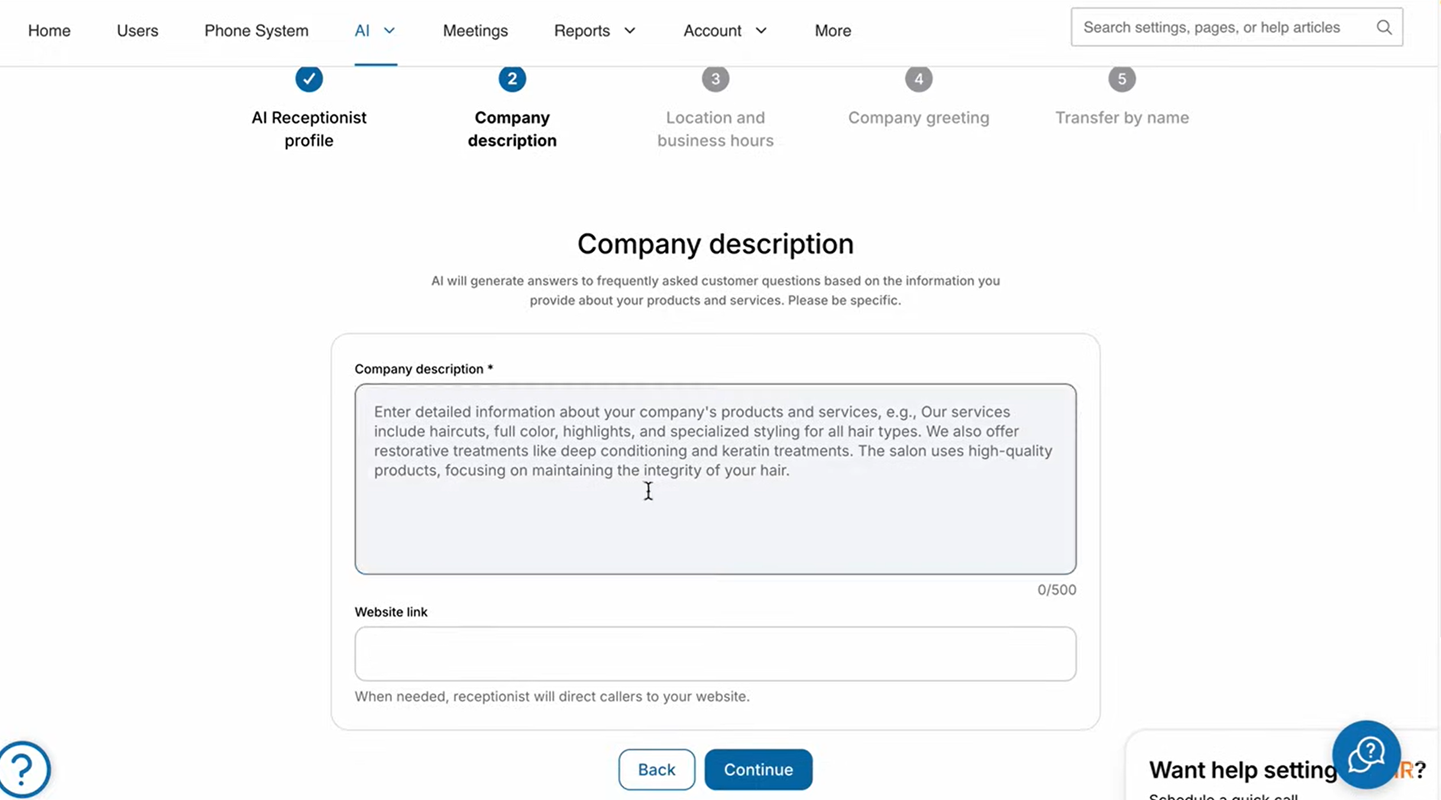
Setup is: pick a personality → paste your website or company description → it auto-generates FAQs → syncs hours and location → add a greeting → done.
That's fast, but it's auto-generated content, not something tuned to your specific business, industry, or day-to-day judgment calls.
#2 RingCentral AI receptionist struggles when callers go off-script.
Real callers interrupt, ramble, change topics, or give information out of order.
A template-based agent often misroutes them or gives the closest-matching FAQ answer even when it doesn't actually answer the question.
#3 RingCentral AI receptionist handles interruptions and corrections awkwardly.
If a caller corrects an address or adds urgent information mid-call, a generic system rarely stops, retains the update, and continues naturally.
#4 Same tone for every caller.
An upset customer with an urgent issue gets treated the same way as someone making a casual enquiry. There's no real read on emotional context.
#5 Escalation relies on keywords.
RingCentral AI receptionist is built to catch callers who explicitly ask for a manager, but often misses frustration, repeated questions, confusion, or indirect signs that a call needs to be escalated.
#6 Context can get lost on longer calls.
During scheduling, intake, or qualifying questions, RingCentral AI receptionist can repeat itself or forget information the caller already gave it.
#7 Lack of granular customization (biggest drawback).
Getting strong results requires the business to already know exactly how they want calls handled. The specific things the receptionist should say, ask, or avoid in each scenario.
RingCentral's setup gives you broad controls (personality, greeting, hours, FAQs), but doesn't offer the fine-grained scripting or conversation-design tools needed to define precise behaviour scenario-by-scenario.
Businesses without a clear, pre-defined sense of their ideal call flow tend to get generic results; those who want tight control over specific phrasing, question sequencing, or edge-case handling will find the platform's customization ceiling low compared to a purpose-built solution.
#8 Doesn't plug deeply into other tools.
RingCentral AI receptionist provides limited support for complex CRM updates or fully custom workflows compared to purpose-built alternatives.
#9 No control over the model or concurrency.
RingCentral AI Receptionist is a closed system.
You configure it through their admin panel, but you can't choose or swap the underlying LLM, and you have no ability to set or scale concurrent call limits.
Everything runs on RingCentral's fixed infrastructure and model choices.
If your call volume spikes, or you want a different model for cost, speed, or reasoning reasons, there's no lever to pull. You're locked into whatever RingCentral has configured on the backend.
#10 Limited language support.
RingCentral AI receptionist is solid for major European languages, but limited beyond that.
#11 Caller ID and call quality issues.
Some users report caller ID not working correctly for extended periods, despite continuing to be billed.
#12 Cost is not limited to £32/$42.90 per account/month.
The £32/$42.90-per-account/month figure is only the base subscription for a limited number of included minutes (typically ~100/month), not the total cost of running the product.
Actual cost depends on:
- Overage charges: The plan only includes a limited number of minutes each month (typically ~100/month). Once you go over, you're charged roughly $0.50 per extra minute, and those charges add up fast. A typical small business handling normal call volume can use up its entire monthly minute allowance in under two days.
- Bundling structure pricing differs depending on whether it's standalone or bundled with RingEX (from $39 + $30/user when bundled)
- Billing rounding: calls are rounded up to the nearest minute, so even a one-second call counts as a full minute
- Spam/robocall minutes: with no dedicated filter in front of it, spam calls consume paid minutes too.
- Billing rounds up aggressively: Even a one-second call can be billed as a full minute, eating into included minutes faster than expected.
#13 RingCentral AI receptionist only works with RingCentral phone lines.
If you ever switch providers, your setup doesn't transfer with you.
#14 Support and cancellation can be difficult.
The most consistent complaint across current reviews is slow support responses, having to repeat the same issue multiple times, difficulty cancelling, and auto-renewal contracts that catch people off guard.
#15 A human-sounding voice raises expectations.
If the voice agent sounds human but then loses context, repeats questions or gives an irrelevant response, the failure feels even more noticeable. The caller may feel they are talking to an idiot or a broken robot.
This is a common issue with template based voice agents like Ringcentral AI Receptionist.
A natural voice alone does not create a natural conversation.
Here's how a custom build AI Receptionist addresses each of those gaps:
1. We test it against real callers, not clean scripts. Before launch, we stress-test the agent with interruptions, topic changes, and unexpected questions, not just the happy path. We continue testing even after launch and refine the receptionist based on real calls.
2. The knowledge base reflects how you actually work. We build it around your pricing exceptions, dispatch priorities, and judgment calls, not just what's copied off your website.
3. Interruptions are handled with context. The agent knows the difference between someone correcting an address (stop and adjust) and someone just saying "okay" (keep going).
4. Tone shifts with the call. Urgent calls get fast, no-nonsense handling. General enquiries get a more conversational pace.
5. Escalation isn't keyword-based. We design it to pick up on hesitation, repeated questions, or frustration, not just wait for someone to say "manager."
6. Failed calls get fixed at the root. When something breaks, we rework the logic behind it, not just bolt on another FAQ.
7. Custom build AI Receptionist remembers what's already been said. Across longer calls (scheduling, intake, qualifying), it retains answers and corrections instead of asking twice.
8. The voice and model are chosen for your use case. Speed, reasoning depth, tone, and cost are all matched to what your calls actually need.
9. Your language is built in. We add your product names, technical terms, abbreviations, and local place names, then test them so the agent recognises and pronounces them correctly.
10. We find the awkward moments before your customers do. Pre-launch testing is built to surface exactly where a human-sounding agent might behave unnaturally.
The difference in one line: a template asks you to configure a standard system and hope it fits. A custom build is designed around how your customers actually call.
Other articles on Voice AI.
- Retell AI Conductor Review.
- Ringcentral AI Receptionist Review.
- How to use Conductor in Retell AI.
- Hallucinated Edits: The Silent Way LLMs Break Your Voice Agent Prompts.
- Voice AI Receptionist for a Law Firm.
- Best AI Receptionist for HVAC Businesses Isn't a Platform. It's a Developer.
- Voice AI Receptionist for HVAC Company.
- How To Bill Your Voice AI Clients Like A Pro.
- Understanding Call Forwarding to Voice AI Agent.
- Understanding PBX for Voice AI.
- Building post-call data extraction variables in Retell AI.
- Building a Retell AI Multilingual Voice Agent.
- Understanding Environment Tags in Retell AI.
- Understanding Versioning in Retell AI.
- Fix something you don't understand = add complexity you understand even less.
- Your automation workflows are guaranteed to fail under production load without this.
- Overflow and After-Hours Voice AI Receptionist.
- Reducing Voice Agent Latency by Testing Different TTS Engines.
- Zero-Width Characters in Voice Agent Prompts.
- What over 1000 Hours of AI Training Taught Me.
- Four LLM Failure Modes and One User Failure Mode.
- Run both Voice AI agent and test simulator on the same model.
- Most AI Projects Fail. But Yours Will Succeed.
- Voice Agent Prompt Formatting Matters Lot More Then You Think.
- When your Voice AI grader is wrong, not your agent.
- Every dynamic variable in voice agent needs a fallback.
- Retell AI Current Time Awareness has a reliability problem.
- The 80/20 Rule of Voice Agent Development.
- Understanding Retell AI Transfer Screening Agents.
- Abuse Ladder in Voice AI - Stop hostile calls from spiralling.
- When to split your voice agent - The Bleed Test Framework.
- Why your Voice prompt needs a clean-up pass.
- The required-field loop that breaks voice agents.
- The Realistic Latency Target for Voice Agents.
- Gemini 3.1 Flash-Lite Works Well for Voice AI.
- Call your Voice AI Agent a "receptionist," not an "assistant."
- Overusing Em Dashes Makes Voice Agents Sound Robotic.
- Use Contractions to make voice agents sound more natural.
- Avoid Using Tag Questions in Voice Agent Confirmations.
- Claude Beats ChatGPT for Voice AI Agents.
- How to A/B Test in Retell AI.
- Automated Alerts in Retell AI to Monitor Voice AI Operations.
- Self-hosted n8n webhooks not working? Here is the fix.
- How to Correctly Self Host n8n on Hostinger VPS.
- The correct way to setup Cal.com for Voice AI.
- CRMs like GHL are overkill for building Voice AI Agents.
- Voice AI Knowledge Base Creation Best Practices.
- LLMs can hallucinate even the most reliable data sources.
- How to build Cost Efficient Voice AI Agent.
- When to Add Booking Functionality to Your Voice AI Agent.
- Without IP your AI company is worth nothing.
- AI Automation Agency Pricing Rules.
- How to Prevent Toll Fraud in Retell AI.
- Voice AI - Build once -> Sell many -> Collect monthly forever.
- State Machine Architectures for Voice AI Agents.
- Missing Context Breaks AI Agent Development.
- How to use Claude Code Inside VS Code Editor.
- How to setup Claude Code in VS Code Editor.
- Claude Code Won't Work Without a Robust Codebase.
- Avoid the Overengineering Trap in AI Automation Development.
- Retell Conversation Flow Agents - Best Agent Type for Voice AI?
- How to Connect GoHighLevel MCP Server to Claude.
- How To Connect n8n MCP Server to Claude.
- Correct Way To Connect Retell AI MCP Server to Claude.
- n8n Guardrails Guide.
- How to Self Host n8n on Google Cloud - Tutorial
- How To Avoid Billing Disputes With AI Automation Clients.
- Don't 'Build' AI Automation Workflows, 'Code' Them.
- Modularizing n8n Workflows - Build Smarter Workflows.
- n8n Expressions Tutorial.
- How to Stop n8n Workflows Breaking After Rewiring.
- Critical Aspect of Prompt Engineering - Domain Parameters.
- Zero Shot vs Single Shot vs Multi Shot Prompting.
- Stop Building AI You Can't Fix.
- Automating 100% of your workflows is a disaster waiting to happen.
- How to build Voice AI Agent that handles interruptions.
- AI Automation Without CRM Is Useless for Business Growth.
- Error Handling in n8n Made Simple.
- Structured Data in Voice AI: Stop Commas From Being Read Out Loud.
- Why Your Voice AI Sounds Robotic and How to Fix It.
- AI Default Assumptions: The Hidden Risk in Prompts.
- Vibe Coding Fails Without Context and Expertise.
- How to make your Voice AI Agent Date & Time Aware.
- Why AI Agents lie and don't follow your instructions.
- How to Write Safer Rules for AI Agents.
- Two-way syncs in automation workflows can be dangerous.
- How to use Webhooks in n8n, GoHighLevel and other AI Automation Workflows.
- How to use APIs in n8n, GoHighLevel and other AI Automation Workflows.
- Prompting: Text, Markdown, JSON, Schema, Code Block
- How to Connect WhatsApp account to n8n.